
Are You Making Following Jesus Harder Than It Has to Be? Mark 2:23-28

Study Guide: Mark 2:23-28

Making following God harder than it needs to be is nothing new.
Think about mandatory break rules at work.
The rule exists for a good reason: people need a break, and without one, some employers would happily work people straight through lunch.
But imagine a workplace where everybody becomes obsessed with exactly when the break starts, where you can sit, what you can do, and whether walking to your truck counts as part of your 15 minutes. Pretty soon, everyone is arguing about the break policy—and nobody is actually getting any rest.
The rule meant to help people has become another headache.
Something like that had happened with the Sabbath. God had given Israel a regular day to stop working, rest, worship, and remember that they belonged to Him. By Jesus’ day, serious religious teachers had spent generations working out what keeping the Sabbath should look like in everyday life. The desire to honor God wasn’t necessarily bad, but rules and traditions could pile up until people became more focused on what counted as breaking Sabbath than on why God gave Sabbath in the first place.
Then Jesus and His hungry disciples walk through a grainfield.
And suddenly, lunch becomes a religious controversy.
📖 TODAY'S PASSAGE
READ: Mark 2:23-28
BIG IDEA
God gave the Sabbath for people’s good, not as another burden to carry—and Jesus claims the authority to tell us what God intended it to be.
👀 WATCH FOR THIS
As you read, notice how Jesus moves the conversation away from “Did they break our rule?” and back toward “Why did God give this in the first place?”
🎥 WATCH THE TEACHING

This study guide goes with our teaching from the Daily Bible Podcast.
You can watch the teaching first and then work through this guide, follow along while you watch, or come back afterward and use the questions to dig deeper.
SETTING THE SCENE
We’re in a stretch of Mark where disagreements around Jesus are starting to stack up. Jesus has forgiven a paralyzed man’s sins, eaten with tax collectors and other people respectable religious folks avoided, and challenged expectations about fasting.
Now the issue is Sabbath.
The Sabbath wasn’t some goofy religious idea Jesus needed to get rid of. It came from God. Israel was commanded to stop working every seventh day, and Deuteronomy connects that rest directly to their rescue from slavery (Deuteronomy 5:12–15). They had spent generations in Egypt where somebody else owned their time. God rescued them and gave them something slaves don’t control for themselves: the ability to stop.
The disagreement in Mark 2 isn’t over whether God’s Sabbath command matters. The disagreement is over what obedience to that command actually looks like—and who has the authority to say.
That last part becomes the real issue.
1. THE PROBLEM ISN’T EATING — IT’S THE DAY — Mark 2:23–24
Let’s make sure we understand what’s actually happening.
Jesus and His disciples are walking through a grainfield. They’re hungry, so as they walk, the disciples pick some heads of grain and eat them.
First question: Are they stealing somebody’s grain?
No.
God’s Law actually allowed this. Deuteronomy 23:25 says you could pick grain by hand from someone else’s field. You couldn’t show up with harvesting equipment and start filling your wagon, but if you were hungry and walking through, you could grab enough to eat.
So the Pharisees aren’t upset because the disciples are stealing.
They’re upset because it’s the Sabbath.
God had commanded Israel to stop working on the seventh day. That sounds simple enough until you have to answer the next question:
Okay...what exactly counts as work?
That’s where things got complicated.
Religious teachers had spent a lot of time thinking through questions like that because they wanted people to obey God. But eventually the focus could shift from “Why did God give us this day?” to “Exactly what are you allowed to do?”
The Pharisees apparently see the disciples picking grain and think:
That looks like harvesting. Harvesting is work. Work is forbidden on the Sabbath. Therefore, you’re breaking the Sabbath.
That’s why they confront Jesus.
And notice something important: the disciples aren’t trying to rebel against God.
They’re hungry.
They’re walking.
They grab some food.
But something that simple has now become a religious violation.
That’s the problem Jesus is about to address.
2. JESUS SAYS, “REMEMBER DAVID?” — Mark 2:25–26
At first, Jesus’ answer can seem strange.
The Pharisees are complaining about the disciples picking grain on the Sabbath, and Jesus basically says, “Remember what David did?”
Okay...what does David have to do with this?
Here’s the connection.
In 1 Samuel 21:1–6, David and his men were hungry. David went to a priest looking for something to eat.
The priest basically said, “I don’t have any regular bread.”
But he did have special bread that had been used in worship. God’s Law said that bread was normally for the priests to eat (Leviticus 24:5–9).
David wasn’t a priest.
So normally, that bread wasn’t for him.
But David and his men needed food, so the priest gave it to them.
That’s the story Jesus wants the Pharisees to remember.
Why?
Because the Pharisees and religious leaders respected David. They knew this story. They weren’t walking around saying, “David was a terrible man because he ate bread that was normally reserved for priests.”
So Jesus is pointing out the problem with their thinking.
David was hungry. He ate bread normally reserved for priests.
Now:
Jesus’ disciples are hungry. They pick some grain that God’s Law allowed hungry travelers to eat.
Yet the Pharisees are upset because they believe picking the grain counts as work on the Sabbath.
Jesus is basically saying:
“Wait a minute. You understand that David’s need for food mattered in that situation. So why can’t you see what’s happening right in front of you?”
Jesus isn’t saying, “If you’re hungry, God’s rules don’t count.”
He’s saying, “You’re so focused on protecting the rule that you’ve forgotten why God gives His commands in the first place.”
And now Jesus’ next sentence makes a lot more sense:
“The Sabbath was made to meet the needs of people, and not people to meet the requirements of the Sabbath.” — Mark 2:27 NLT
God didn’t create people so He would have somebody to follow Sabbath rules.
God gave people the Sabbath because people need rest.
That’s Jesus’ point.
The rule was supposed to serve people. The people weren’t supposed to become slaves to the rule.
3. GOD MADE SABBATH FOR PEOPLE — Mark 2:27
After bringing up David, Jesus finally says what He wants them to understand:
“The Sabbath was made to meet the needs of people, and not people to meet the requirements of the Sabbath.” — Mark 2:27 NLT
That sentence is pretty simple once we understand what Sabbath was supposed to be.
God told Israel:
Every seventh day, stop working.
Why?
Because people need to stop.
They need rest. Their families need rest. Their workers need rest. Even their animals needed rest.
And there was something even bigger behind it.
Israel had once been slaves in Egypt. Slaves don’t get to decide when they’re finished working. Pharaoh told them when to work, how much to produce, and even demanded more when they couldn’t keep up.
Then God rescued them.
In Deuteronomy 5:12–15, when God tells Israel to keep the Sabbath, He specifically reminds them:
You used to be slaves. Remember that.
In other words:
“You don’t belong to Pharaoh anymore. You can stop working.”
Sabbath was supposed to feel like freedom.
But imagine what happens when people become so focused on Sabbath rules that they’re afraid of grabbing a handful of grain because somebody might accuse them of working.
The gift of rest has become another job to get right.
That’s what Jesus is pushing against.
He isn’t saying Sabbath was bad.
He’s saying:
“You’ve forgotten what it was for.”
God didn’t make people because Sabbath needed somebody to obey it.
God made Sabbath because people needed the gift of stopping.
4. JESUS CLAIMS THE RIGHT TO CALL THE SHOTS — Mark 2:28
If Jesus stopped there, we might think this whole story is simply:
“Jesus wants people to have a healthier attitude about rest.”
But then He says something much bigger:
“So the Son of Man is Lord, even over the Sabbath!” — Mark 2:28 NLT
Slow down and think about what Jesus just said.
Who created the Sabbath?
God did.
Who gave Israel the command to keep it?
God did.
So who has the right to say what Sabbath is really for?
You would think the answer would be:
God.
And Jesus says:
“The Son of Man is Lord, even over the Sabbath.”
That’s a huge claim.
Jesus isn’t standing there saying, “Well, here’s my opinion about Sabbath.”
He isn’t just another rabbi jumping into the argument with His interpretation.
He is claiming the authority to tell them what Sabbath means and what God intended when He gave it.
And Mark has been building toward this.
Jesus has already forgiven sins—and the religious leaders asked, “Who but God can forgive sins?”
Now Jesus claims authority over something else God established: the Sabbath.
So this story starts with a few hungry guys picking grain, but it ends with a much bigger question: Who exactly is Jesus?
Because if Jesus really is Lord of the Sabbath, then the Pharisees don’t get the final word.
Tradition doesn’t get the final word.
Our favorite religious rules don’t get the final word.
Jesus does.
And that brings the whole passage right into our world.
The biggest question isn’t simply:
“Am I doing Sabbath correctly?”
It’s:
“Am I actually letting Jesus tell me what following God looks like—or have I made my own rules the boss?”
🔎 DON’T MISS THIS: SABBATH STARTED WITH FREEDOM
Sabbath wasn’t supposed to feel like another job.
God told Israel to remember: You used to be slaves. Now you’re free (Deuteronomy 5:15).
Pharaoh said, “Keep working.”
God said, “You can stop.”
That was the gift.
So when Sabbath became another pile of rules people worried about getting wrong, they had turned a reminder of freedom into another burden.
Jesus is taking them back to the point.
THE BIGGER LESSON
This isn’t mainly about getting better at taking a day off.
It’s about how easily we can make following God harder than God made it.
We add rules. We defend traditions. We argue about what “good Christians” should and shouldn’t do. Eventually, we can become more concerned about getting our system right than actually following Jesus.
Jesus isn’t saying rules don’t matter.
He’s saying our rules don’t get to replace Him.
WHO IS JESUS?
Jesus doesn’t just give His opinion about Sabbath.
He says He is Lord of the Sabbath.
In plain English: Jesus has the authority to tell us what God wants.
WHAT DOES IT ACTUALLY MEAN TO FOLLOW HIM?
Jesus gets the final word.
Sometimes that means asking whether something we’ve always called “biblical” actually came from Jesus—or whether it’s a tradition or rule somebody handed us.
The question isn’t:
“How much can I get away with?”
It’s:
“Jesus, what do You actually want?”
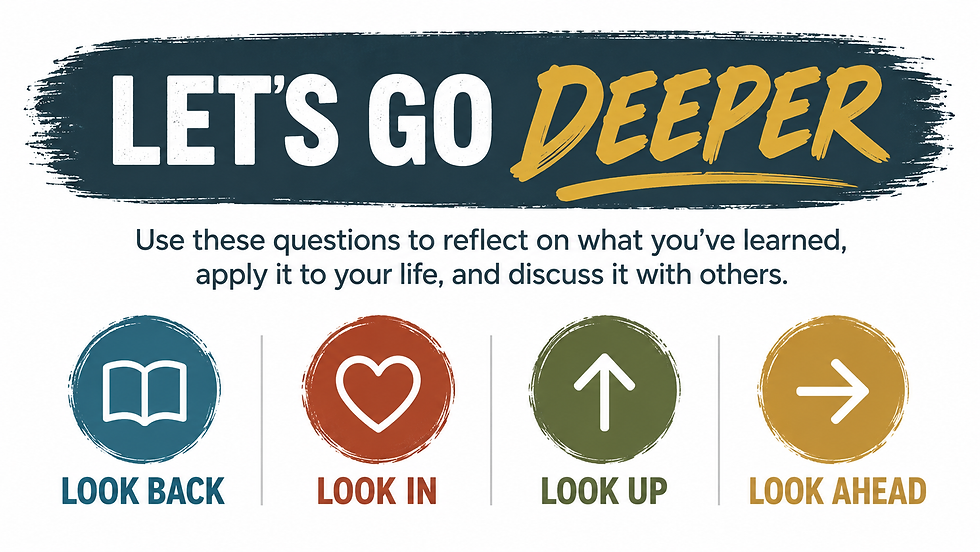
👀 LOOK BACK — WHAT DOES THE PASSAGE ACTUALLY SAY?
What were Jesus’ disciples doing that caused the Pharisees to confront Him?
Why does Jesus bring up David and the sacred bread from 1 Samuel 21?
According to Mark 2:27, who was the Sabbath made to serve?
🪞 LOOK IN — WHAT IS HAPPENING INSIDE ME?
Have you ever discovered that something you thought was a clear Christian rule was actually a tradition or somebody’s interpretation?
Where are you most tempted to focus on “Am I doing this right?” instead of asking “What does Jesus actually want?”
Which comes more naturally to you: having clear rules to follow or trusting Jesus enough to understand the reason behind them?
⬆️ LOOK UP — WHAT DOES THIS SHOW ME ABOUT JESUS AND GOD?
What does Jesus’ statement that Sabbath was made for people tell us about why God gives commands?
What is Jesus claiming when He calls Himself “Lord, even over the Sabbath”?
How does this passage challenge the picture of God as someone mostly watching to catch people breaking rules?
➡️ LOOK AHEAD — WHAT WILL I DO WITH THIS?
Is there one “Christian rule” you’ve always assumed came straight from God that would be worth actually checking in Scripture?
Where might you be making following Jesus harder for yourself—or somebody else—than Jesus made it?
This week, when you catch yourself asking, “What am I allowed to do?”, try asking a better question: “What does Jesus want this to produce in me?”
💬 SMALL GROUP DISCUSSION STARTER
Tell the group about a rule you’ve encountered at work, school, church, home, or somewhere else that probably started for a good reason—but eventually became more about enforcing the rule than accomplishing what the rule was supposed to do.
A NOTE FOR GROUP LEADERS
This is a good conversation to resist the urge to immediately correct everybody. Someone may share a church rule or tradition you actually agree with. That’s okay. Ask why they experienced it the way they did and listen.
The goal isn’t to create a room full of people complaining about churches or rules.
Help the group keep coming back to the passage: What was God trying to accomplish, and what does Jesus show us about it?
You don’t need to finish every question.
🌱 DISCIPLE-MAKER TIP: HELP PEOPLE FIND THE “WHY”
When someone asks, “Is a Christian allowed to do this?”, don’t always jump straight to yes or no.
Sometimes the better move is opening Scripture together and asking, “What do you think God is trying to accomplish here?”
That helps people learn to follow Jesus instead of becoming dependent on you for a list of approved and unapproved behavior. Rules can tell somebody what to do when you’re standing there. Helping them understand Jesus and His Word gives them something they can use when you’re not.
That’s a much better goal for making disciples.
🤝 DON'T JUST STUDY IT — PRACTICE IT
Think of one Christian rule, expectation, or tradition you’ve always assumed was biblical.
Don’t immediately throw it out.
Instead, spend ten minutes this week finding out what Scripture actually says about it. Read the passage in context and ask:
What did God actually say, and what were people trying to add to it?
📌 REMEMBER THIS
Don’t make following Jesus harder than Jesus made it.
📖 NEXT: Mark 3:1–6 — WHAT HAPPENS WHEN THE RULE MATTERS MORE THAN THE PERSON?
The Sabbath conversation isn’t finished.
Jesus is about to walk into a synagogue where He meets a man with a deformed hand.
Once again, religious leaders will be watching closely—but this time Mark tells us they aren’t simply curious.
They’re looking for a reason to accuse Jesus.
And Jesus is going to put a painfully simple question in front of them: What is the Sabbath actually for—doing good or doing harm, saving life or destroying it?
The argument over rules is about to get much more serious.
📺 KEEP GOING THROUGH MARK
Follow the complete Gospel of Mark Verse-by-Verse Bible Study as we work through the entire Gospel together.
New Daily Bible Podcast teachings and study guides will be added throughout our journey.
Understand the Bible | Find Christian Friends | Grow as Disciple Makers
Don't follow Jesus alone.
📺 FROM THE YJJ ARCHIVES: HAVE YOU SEEN THIS SERIES?
If you’re newer to YJJ, there’s a whole lot of older teaching you may have never discovered!
Our S.O.M.A. Series — Sermon on the Mount Alone started with a crazy question: What if you only had 18 teachings from Jesus to help you live as His disciple?
We traveled through the Canadian Rockies and northern Canada, exploring Jesus’ Sermon on the Mount against some absolutely spectacular scenery—and asking one practical question: How do we actually LIVE what Jesus taught?
There are 18 lessons waiting for you. Give the series a try!
▶️ START THE S.O.M.A. ADVENTURE: CLICK HERE
Watch the series promo 👇🏻



Comments