
Before You Read Mark, You Need to Know THIS | Gospel of Mark Bible Study

Study Guide: INTRO TO MARK

Who is Jesus really—and what does it actually mean to follow Him?
Most of us do not come to Jesus with a blank slate.
We have heard sermons, watched movies, listened to other Christians, inherited church traditions, and formed our own ideas about who Jesus is and what He expects from us.
The disciples had expectations too.
They walked with Jesus, heard Him teach, watched Him perform miracles, and still regularly discovered that Jesus was not quite who they expected Him to be.
That is one reason the Gospel of Mark is so valuable.
As we begin this journey, bring what you know. Bring your questions, doubts, experiences, and church background. Just leave enough room for Mark to challenge some assumptions and help us see Jesus more clearly.
Because throughout this entire book, we are going to keep coming back to two enormous questions:
WHO IS JESUS?
WHAT DOES IT ACTUALLY MEAN TO FOLLOW HIM?
📖 TODAY'S PASSAGE
This is our introduction to the Gospel of Mark, so instead of studying one passage, we are going to look at the big picture.
If you have your Bible handy, take a few minutes to look through Mark and especially notice:
Mark 1:1 | Mark 4:35–41 | Mark 8:27–35 | Mark 10:45 | Mark 15:37–39 | Mark 16:1–8
BIG IDEA
Mark takes us on a fast-moving journey to discover who Jesus really is and what it actually means to follow Him.
👀 WATCH FOR THIS
As we move through Mark, pay attention to who recognizes Jesus clearly, who misunderstands Him, and how often people have to change their expectations about Him.
🎥 WATCH THE TEACHING

This study guide goes with our Intro to the Gospel of Mark teaching from the Daily Bible Podcast.
▶️ Before You Read Mark, You Need to Know THIS | Gospel of Mark Bible Study
You can watch the teaching first and then work through this guide, follow along while you watch, or come back afterward and use the questions to dig deeper.
SETTING THE SCENE
The four Gospels tell the story of Jesus, but they do not all begin in the same place.
Matthew begins with a genealogy connecting Jesus with Abraham and David.
Luke introduces us to Zechariah, Elizabeth, Mary, shepherds, angels, and the events surrounding Jesus' birth.
John reaches all the way back to creation: “In the beginning was the Word…”
Then there is Mark.
No genealogy. No Bethlehem. No manger. No shepherds.
Mark opens with “The beginning of the gospel of Jesus Christ…” and starts moving.
John the Baptist appears. Jesus is baptized. He goes into the wilderness, begins preaching, calls disciples, confronts evil, heals people, and draws crowds.
Mark does not waste much ink.
Yet underneath all that movement, Mark is slowly answering those two enormous questions:
Who is Jesus?
And if this really is who Jesus is...
What does it actually mean to follow Him?
1. THIS ISN'T ADVICE. IT'S NEWS.
The first sentence tells us what Mark believes he is writing:
“The beginning of the gospel of Jesus Christ, the Son of God.” — Mark 1:1
The word gospel means good news.
That distinction matters because news is different from advice.
Advice tells you something you should do. News tells you something that has happened.
In Israel's Scriptures, “good news” could announce God's rescue and His reign (Isaiah 40:9; 52:7). In the wider Roman world, similar language could also be used for important public announcements involving victories and rulers.
Mark is not beginning with a list of religious rules for improving your life.
He is announcing that something has happened and Someone has come.
Christianity certainly teaches us how to live, but it begins with what God has done through Jesus.
That is the story Mark wants us to see.
2. SO... WHO WROTE THIS?
Here we need to separate what we know from what early Christian tradition tells us.
The Gospel itself never identifies its author by name. However, very early Christians connected it with Mark, traditionally understood to be John Mark, a man who appears several times in the New Testament.
Mark's mother hosted believers in Jerusalem (Acts 12:12). He later traveled with Paul and Barnabas but left during their journey (Acts 13:13).
When Barnabas wanted to take Mark on another missionary trip, Paul refused. Their disagreement became so serious that Paul and Barnabas separated (Acts 15:36–40).
That could have been the end of Mark's story.
It wasn't.
Years later, Paul described Mark as “useful to me for ministry” (2 Timothy 4:11).
Peter also referred affectionately to “Mark, my son” (1 Peter 5:13).
Early Christian testimony connected Mark with Peter's preaching about Jesus. One of the earliest descriptions comes from Papias, an early Christian writer whose comments were later preserved by the church historian Eusebius. Papias said that Mark carefully recorded what he had learned from Peter's teaching.
We cannot prove every detail of that tradition from the Gospel itself, but the connection between Mark and Peter appears very early in Christian history.
A simple way to remember the traditional picture is:
Peter saw it. Peter preached it. Mark wrote it.
3. WHEN AND WHERE ARE WE?
Many scholars date Mark somewhere around the late AD 60s or early 70s, although the exact date remains debated.
Early Christian tradition also connects Mark with Rome, but Mark never gives us an address, so we should not pretend we know more than we do.
There are clues that at least some of Mark's readers were unfamiliar with Jewish customs and languages.
Mark sometimes explains Jewish practices (Mark 7:3–4) and translates Aramaic expressions for his readers (Mark 5:41; 7:34; 15:34).
That matters because these readers lived in a world dominated by Rome, where emperors, armies, power, wealth, and social status were difficult to ignore.
Then Mark introduces Jesus.
As the story unfolds, we will discover that Jesus has extraordinary authority, yet He uses power very differently from the rulers around Him.
Mark is going to force us to reconsider what a King actually looks like.
4. MARK DOESN'T WASTE MUCH TIME
Mark moves quickly.
Jesus is baptized. He enters the wilderness. He announces God's kingdom. He calls disciples. He teaches with authority. He confronts demons. He heals the sick.
And that is basically just chapter one.
Mark repeatedly uses a Greek word often translated “immediately,” which helps give the Gospel its fast-moving feel.
But there is something interesting happening underneath all that activity.
Mark gives us information that many of the people inside the story do not yet understand.
Right from the beginning, Mark identifies Jesus as “the Christ, the Son of God” (Mark 1:1).
Then we watch everyone else try to figure out who He is.
After Jesus calms a storm, His frightened disciples ask:
“Who then is this, that even the wind and the sea obey him?” — Mark 4:41
That question hangs over much of the Gospel.
Who is this?
5. SEEING JESUS ISN'T ALWAYS THE SAME AS SEEING HIM CLEARLY
The disciples have front-row seats.
They hear Jesus teach. They watch Him heal people. They see Him confront evil, forgive sins, command storms, feed crowds, and do things they cannot explain.
Yet they repeatedly struggle to understand Him.
Sometimes outsiders recognize something the insiders miss. Religious experts can know their Scriptures and still oppose Jesus. The disciples can witness an incredible miracle and then appear completely confused a short time later.
Mark does not hide any of this.
That should probably make us a little more humble about our own understanding of Jesus.
Being familiar with stories about Jesus is not necessarily the same thing as seeing Jesus clearly.
And Mark wants to help us see.
6. THE TURNING POINT: RIGHT ANSWER, WRONG IDEA
A major turning point arrives in Mark 8.
Jesus asks His disciples:
“Who do you say that I am?” — Mark 8:29
Peter answers:
“You are the Christ.”
That is the right answer.
But Peter quickly demonstrates that he does not yet understand what his answer means.
Jesus begins explaining that He will suffer, be rejected, die, and rise again.
Peter objects.
Apparently Peter wanted a Messiah.
He just wasn't expecting this kind of Messiah.
Jesus then begins talking about denying ourselves, taking up our cross, and following Him (Mark 8:34–35).
Suddenly the second question becomes impossible to avoid.
If Jesus really is the Messiah...
What does it actually mean to follow Him?
Following Jesus is more than knowing correct information about Him.
It means allowing Jesus to reshape our ideas about power, greatness, success, sacrifice, and even life itself.
7. WHERE IS THIS STORY HEADING?
From this point forward, Mark increasingly turns our attention toward Jerusalem.
Jesus knows what is coming.
The disciples are still wrestling with what it means.
They continue thinking about greatness in familiar human terms, while Jesus keeps turning their expectations upside down.
Eventually He explains His mission this way:
“For even the Son of Man came not to be served but to serve, and to give his life as a ransom for many.” — Mark 10:45
A ransom is a price paid to set someone free.
Mark's King does not conquer the way people expect.
He serves.
He gives His life.
The road through Mark leads to Jerusalem, to a cross, to a tomb...
and then to the astonishing announcement that the tomb is empty.
🔎 DON'T MISS THIS: MARK WANTS US TO LEARN HOW TO SEE
As we move through Mark, watch for the language and imagery of seeing.
One particularly interesting moment happens in Mark 8:22–26.
Jesus heals a blind man, but something unusual happens. At first the man can see, but he cannot see clearly. Jesus touches him again, and his sight becomes clear.
Immediately afterward, Peter correctly recognizes Jesus as the Messiah but completely misunderstands what kind of Messiah Jesus will be.
Later, a blind man named Bartimaeus receives his sight and follows Jesus “on the way” (Mark 10:52).
As we study Mark, watch this theme carefully.
The question isn't simply whether people can see Jesus standing in front of them.
The deeper question is:
Do they see Him clearly enough to follow Him?
THE BIGGER LESSON
It is easy to assume that because we know stories about Jesus, we understand Jesus.
The disciples warn us against making that assumption.
They heard Jesus teach. They watched His miracles. They traveled with Him. Peter even correctly identified Him as the Messiah.
Yet they still had things to learn—and things to unlearn.
That makes Mark a wonderful Gospel for someone opening the Bible for the first time and for someone who has followed Jesus for decades.
We are not going through Mark simply to collect more information about Jesus.
We want to see Him more clearly.
Throughout this series, keep asking:
WHO IS JESUS?
What does this passage reveal about His character, authority, priorities, mission, and identity?
Then ask:
WHAT DOES IT ACTUALLY MEAN TO FOLLOW HIM?
What needs to change if what we are discovering about Jesus is actually true?
By the time we reach the end of Mark, hopefully we will know much more about this Gospel.
But the bigger goal is that we will know Jesus better.
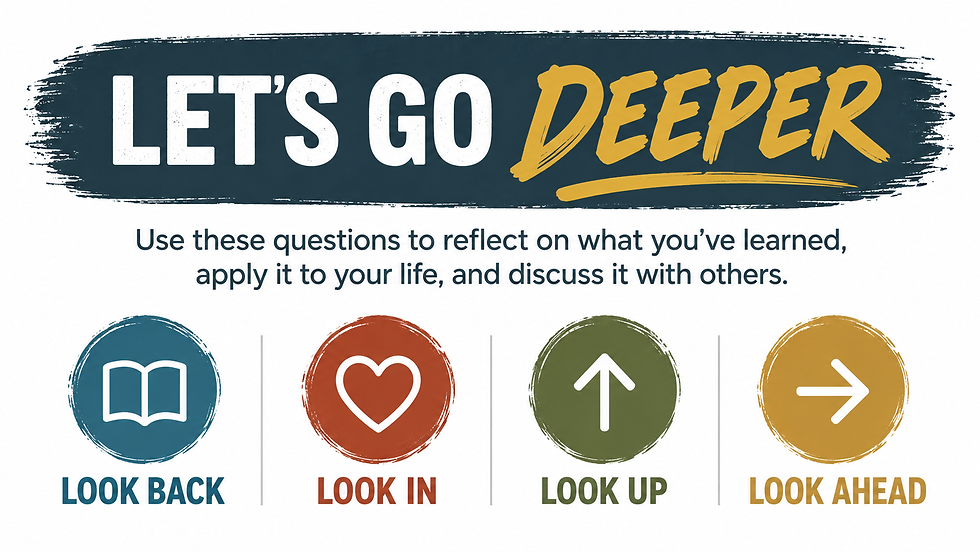
👀 LOOK BACK — WHAT DOES THE PASSAGE ACTUALLY SAY?
1. Compare the opening of Mark with Matthew, Luke, and John. What is noticeably different about the way Mark begins?
2. What titles does Mark give Jesus in the very first verse?
3. Read Mark 4:35–41 and Mark 8:27–35. What are the disciples beginning to understand about Jesus, and what are they still struggling to understand?
🪞 LOOK IN — WHAT IS HAPPENING INSIDE ME?
1. When you think about Jesus, what has most shaped your picture of Him: Scripture, church, family, culture, personal experiences, or something else?
2. Is there an area where you might be tempted to prefer the Jesus you expect over the Jesus Scripture actually shows us?
3. What are you most hoping to understand or wrestle with during our journey through Mark?
⬆️ LOOK UP — WHAT DOES THIS SHOW ME ABOUT JESUS AND GOD?
1. Why do you think Mark tells his readers who Jesus is in the opening verse while allowing the people inside the story to slowly discover His identity?
2. What does Mark 10:45 tell us about the kind of King Jesus came to be?
3. How does Jesus' willingness to serve and give His life challenge ordinary ideas about power and greatness?
➡️ LOOK AHEAD — WHAT WILL I DO WITH THIS?
1. What would it look like for you to approach Mark with curiosity instead of assuming you already know what each story means?
2. What is one question about Jesus you want to carry with you through this entire study?
3. Who could you invite to join you for this journey through Mark?
💬 SMALL GROUP DISCUSSION STARTER
Go around the group and finish this sentence:
“Growing up—or before I really began studying the Bible—I thought Jesus was ______.”
Share briefly where that picture came from and whether your understanding of Jesus has changed.
A NOTE FOR GROUP LEADERS
You do not need to work through every question in this study guide.
Choose the questions that seem most helpful for your group and leave enough room for people to talk. The goal is not to finish the study guide. The goal is to help people understand Scripture, know one another more deeply, and learn to follow Jesus together.
Sometimes the best group discussion happens when you never make it to the next question.
That's okay.
🌱 DISCIPLE-MAKER TIP: ASK ONE MORE QUESTION
When someone shares something meaningful, resist the urge to immediately tell your own story or give advice.
Instead, become curious.
Try asking:
“What was that like for you?”
“Why do you think that affected you so much?”
or simply:
“Tell me more about that.”
Intentional disciple makers do more than give good answers. They learn to listen well enough to understand the person sitting in front of them.
Relationships grow when people realize we are genuinely interested in their story and not simply waiting for our turn to talk.
🤝 DON'T JUST STUDY IT — PRACTICE IT
Choose one person and invite them to join you during our journey through Mark.
You do not have to become their Bible teacher.
You could simply say:
“I'm going through the Gospel of Mark and trying to understand Jesus better. Would you want to do it with me?”
Then read. Watch the teachings. Talk about what you are learning. Ask each other questions.
Disciple making does not always begin with having all the answers.
Sometimes it begins with a simple invitation:
Come with me. Let's learn to follow Jesus together.
📌 REMEMBER THIS
The goal isn't simply to know more about Jesus. It is to see Jesus more clearly so we can follow Him more faithfully.
📖 NEXT: MARK 1:1–8 — SOMEONE IS COMING
Mark wastes absolutely no time.
The story begins in the wilderness with a strange man wearing camel hair, eating locusts, baptizing people, and announcing that Someone far greater is coming.
Before Jesus even walks onto the scene, Mark introduces us to an important idea:
Repentance.
What does that actually mean?
And why does Mark begin the story of Jesus by taking us into the wilderness?
That's where our verse-by-verse journey begins.
📺 KEEP GOING THROUGH MARK
Follow the complete Gospel of Mark Verse-by-Verse Bible Study as we work through the entire Gospel together.
New Daily Bible Podcast teachings and study guides will be added throughout our journey.
Understand the Bible | Find Christian Friends | Grow as Disciple Makers


Comments