
Beyond the Fish: Why the Book of Jonah Is the Old Testament's Most Uncomfortable Story

Jonah Day 1: Introduction

Imagine you are a lifelong New Yorker, living through the tragedy of 9/11. You saw the devastation, felt the terror, and hated the orchestrators of that horror with a burning, righteous passion. Years later, you become a successful civil engineer. Then, you receive a direct command from God: "Go to the capital city of the very group that orchestrated that attack, the enemy you despise, and warn them so they can repent and be saved."
Your whole life, you've prayed for justice, which, in your mind, meant their destruction. Your deepest human instinct screams, "No! They don't deserve mercy. Let them be consumed by the judgment they earned!"
That visceral resistance, that deep internal conflict between duty and prejudice, is the exact emotional state of the prophet Jonah. The Book of Jonah is not primarily about a big fish; it’s about a man consumed by nationalism and hate, and a God consumed by universal, boundary-breaking compassion.
It is the story of a prophet running from the God who loves his enemies.
Before you dig into the book of Jonah in the days ahead, I would suggest reading or listening to it in two different bible translations from this list: NIV, NLT, NASB, ESV, NKJV

Learn more about our exciting out-of-the-box ministry here
Setting the Scene
The events of the Book of Jonah take place approximately between 793 and 753 B.C., during one of the most prosperous yet morally turbulent times for God’s people. The narrative is framed within the Northern Kingdom (Israel), but the main action shifts quickly to Nineveh, the colossal capital city of Assyria.

Assyria was the great world power on the rise, infamous for its exceptional brutality, cruelty, and ruthless expansion. Their capital, Nineveh, was the nerve center of this "Boogeyman" empire. During this time, the Northern Kingdom of Israel was led by King Jeroboam II, who was politically and militarily successful but deeply wicked in his religious practices.
This period was an economic and territorial "Golden Age" for the Northern Kingdom. They had recovered land lost to Syria, and trade flourished, leading to immense national pride and materialism (as documented in 2 Kings 14:25). Externally, things looked great. However, internal pressures were severe: economic disparity and injustice saw the wealthy exploiting the poor. The external pressure was the looming shadow of the Assyrian Empire, which was a constant, existential threat. Israel desperately wanted God to judge Assyria and save them alone.
Regarding their relationship with God, the nation was experiencing material blessing, thanks in part to Jonah’s own successful prophecy of territorial gain. They were successful in the eyes of the world. Yet, religiously, they were rebellious, practicing idolatry and social hypocrisy. Contemporary prophets like Amos and Hosea condemned the nation's severe lack of social justice, indicating their worship was superficial and disconnected from righteous living.
Who was Jonah?
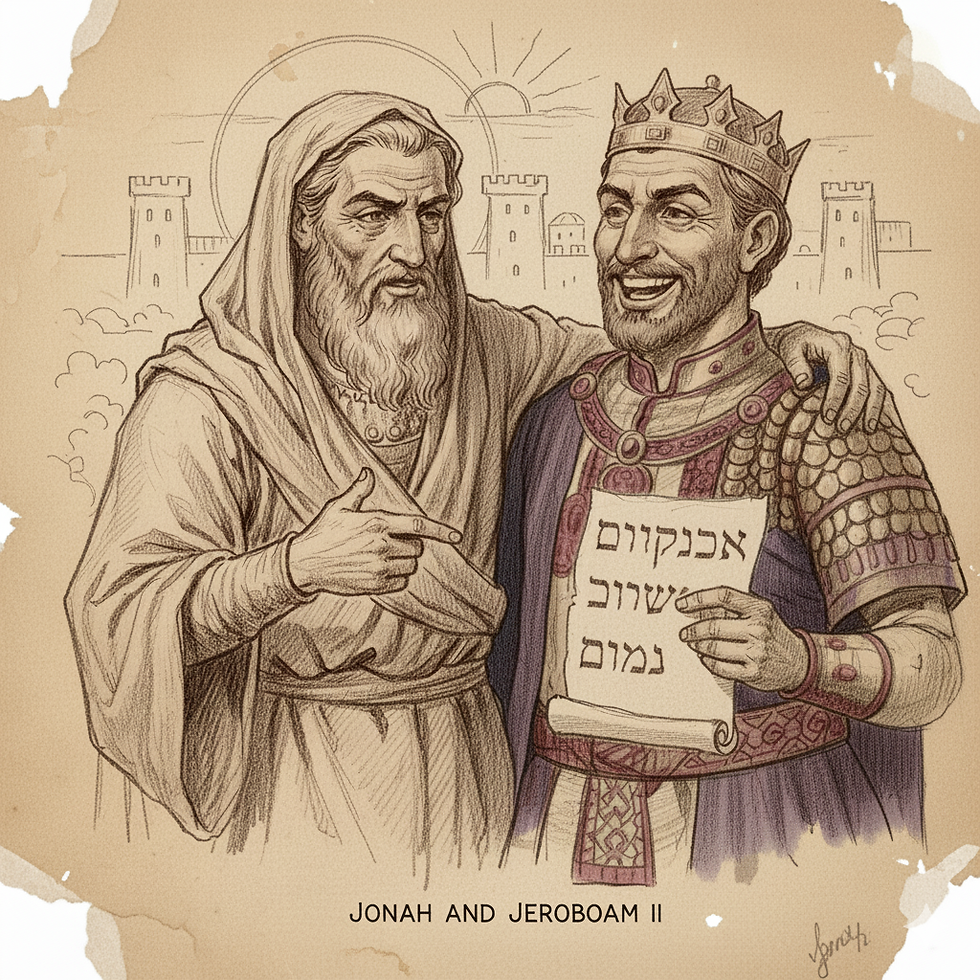
Jonah was not a nobody; he was a successful, well-known prophet. His name, Jonah, means "dove," and he was the son of Amittai, meaning "son of faithfulness." He was from Gath-hepher, a village in the Galilee region of the Northern Kingdom.
Jonah was already a highly popular figure within Israel, having previously delivered a prophecy referenced in 2 Kings 14:25. He predicted the complete restoration of Israel's national borders to their former glory. King Jeroboam II successfully acted upon Jonah's words, which led to massive territorial expansion and a period of great economic prosperity for the Northern Kingdom. This history cemented Jonah as a patriotic, politically relevant prophet—a purveyor of "good news" for Israel. This past success is critical, as it highlights his pride and explains why he was so enraged when God commissioned him to deliver "good news" (a chance at repentance) to his hated enemies (Nineveh).
His primary trade was being a spokesman for God, but his previous successes likely made him a proud, narrow-minded nationalist who believed God's favor was exclusively for Israel. In short, Jonah was exactly the kind of person who would be horrified by God’s command to save his nation's greatest enemy. His loyalty was to his nation, not God's global heart.
General Summary of the Book
The Book of Jonah is a short, narrative masterpiece (only 4 chapters) that functions less like a historical biography and more like a parable designed to shock the reader.

It tells the story of a disobedient prophet who is commanded to go to Nineveh, the capital of Assyria, and call them to repentance. Jonah immediately runs in the opposite direction, booking passage on a ship headed to Tarshish. A massive storm threatens the ship, and Jonah is thrown overboard, swallowed by a great fish, and delivered back to dry land. After his second call, he reluctantly goes to Nineveh, delivers a five-word sermon ("Yet forty days, and Nineveh shall be overthrown!"), and the entire city, from the king down to the animals, repents (the animals don't really repent). God relents from the promised judgment, which causes Jonah to fly into a rage. The book concludes with a poignant conversation between God and Jonah about the prophet's profound lack of compassion compared to God's expansive, universal love.
What is Uniquely Jewish about the Story?
A modern Western reader is likely to miss several crucial elements that would have been shocking to the original Israelite audience.
First, The Parable Genre is Key. While we read it as a historical account, its structure and extreme events—such as one sermon leading to the instant repentance of an entire empire—suggest it's primarily a didactic narrative (a teaching story) designed to deliver a harsh lesson. The focus is on the reader's reaction to the prophet's behavior, not just the prophet’s journey itself.

Second, The Horror of Nineveh's Salvation. For the Israelites, Assyria was pure evil. They were practicing destroyers, and their destruction was deeply desired. The fact that God would send a prophet to save them, and succeed, was an absolute scandal. The average Israelite reader would have identified completely with Jonah's rage and disappointment in Chapter 4—a desire for God's mercy to be narrow and for His judgment to be wide.
Third, The Inclusivity of God. While God’s attention is often focused on Israel for covenant purposes, Jonah shatters this boundary, showing God's concern for a powerful, pagan, and despised gentile nation. The entire non-Israelite world—the pagan sailors, the pagan king, and the pagan capital—shows greater spiritual sensitivity and obedience to God than the prophet himself. This contrast is the entire, shocking point of the book.
The Unique Nature of the Book of Jonah
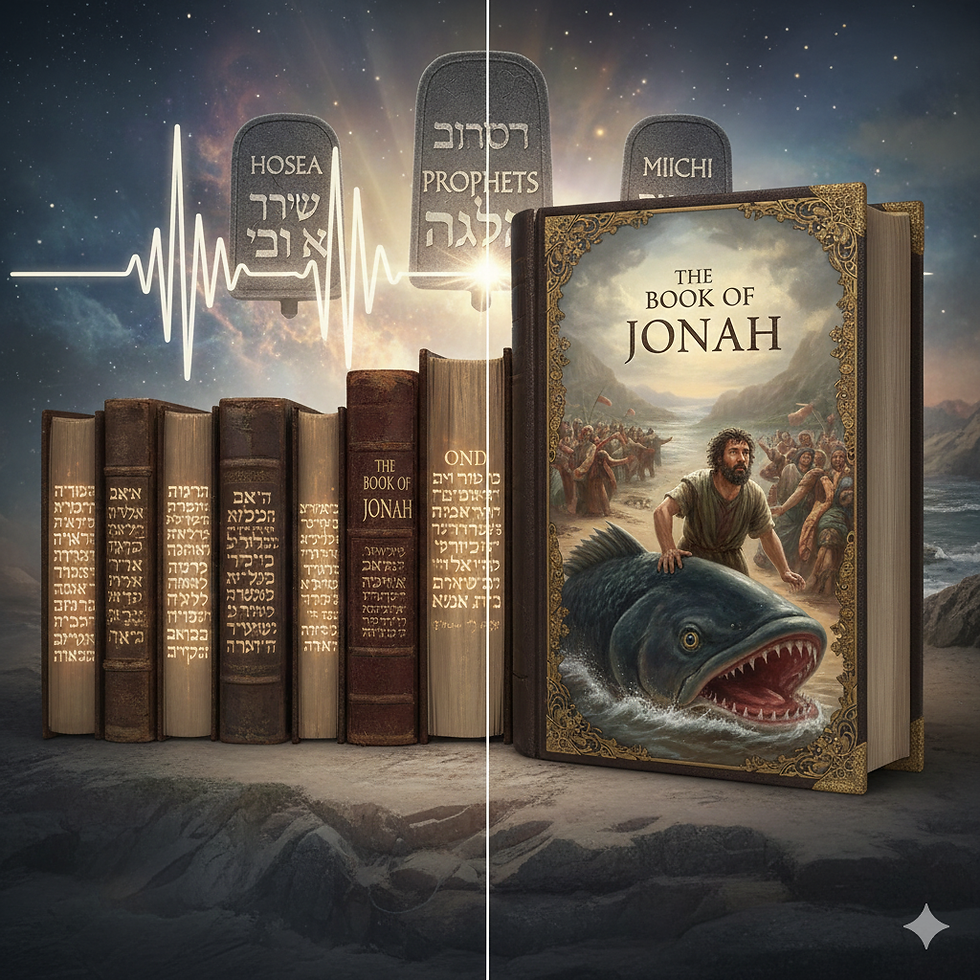
The Book of Jonah stands as an anomaly within the collection of the Twelve Minor Prophets. While other prophetic books primarily document the divine messages delivered by the prophet, Jonah is a story told about the prophet. This stylistic and structural shift impacts its message, its intended audience, and how it should be read.
Literary Differences from Other Prophetic Books
The distinctions between Jonah and more traditional prophetic books like Jeremiah, Isaiah, or Amos are dramatic and intentional.
The Primary Content of typical prophetic books is a collection of oracles, sermons, and judgments directed toward nations. In contrast, the Book of Jonah is a single, continuous narrative tracing the actions, rebellion, and inner thoughts of its main character. Consequently, the Focus shifts dramatically: in other prophetic literature, the attention is almost entirely on God's word, but in Jonah, the attention is focused almost entirely on the Prophet's response to that word.
Regarding the Prophetic Role, most prophets function as a generally faithful mouthpiece or messenger. Jonah, however, is portrayed as the protagonist of a story who rebels, runs, and is characterized as selfish, nationalistic, and angry. This reversal changes the Emphasis. Traditional prophetic books focus on theological doctrines, covenant fidelity, and future eschatology (end-times). Jonah, conversely, emphasizes psychological drama, God's limitless compassion, and uses biting satire directed at Israelite exclusivity. Finally, while other books contain detailed Historical Markers (such as identifying the kings under whose reign the prophecy was delivered), Jonah offers only a brief introduction, as its highly stylized events lack detailed political context.
Key Elements That Make Jonah a Didactic Story
The entire structure of Jonah is designed to function as a parable, with the deliberate goal of teaching the reader a specific, uncomfortable lesson.
This is achieved primarily through Absurdity and Hyperbole. The story is full of highly improbable, exaggerated events that signal its non-literal nature. For instance, the narrative includes a massive fish swallowing a man, keeping him alive, and then vomiting him onto dry land (Ch. 1-2). Furthermore, a massive city like Nineveh repents completely after Jonah delivers a single, five-word sermon ("Yet forty days, and Nineveh shall be overthrown!") (Ch. 3). This is capped by a plant growing and dying in a single day, followed by God's elaborate lesson on pity (Ch. 4).
Another key element is the casting of The Prophet as the Antagonist. In most prophetic books, the prophet embodies God's perspective. In Jonah, the prophet actively works against God's purpose. The central conflict is therefore not between God and Nineveh, but fundamentally between God and Jonah.
Finally, the book uses The Unanswered Question as its climax. The book famously ends on an open question from God to Jonah: "And should not I pity Nineveh, that great city, in which there are more than a hundred and twenty thousand persons who do not know their right hand from their left, and also much cattle?" (Jonah 4:11). The abrupt ending leaves the reader to answer the question, forcing them to confront their own prejudices and capacity for mercy.
How These Differences Trip Up Readers
The unique literary genre and hyperbolic nature of Jonah lead to three main traps for modern readers:
A. Getting Hung Up on Historicity:
🪤 The trap here is that because the book is listed with the "Historical Prophets," readers often assume it must be a literal historical record, particularly concerning the size of the fish or the repentance of Nineveh.
✅ The solution is to realize that focusing on historical accuracy misses the entire point. The purpose of the unbelievable events (the fish, the plant, the instantaneous repentance) is to make the reader ask, "Why would a prophet be so angry if this miraculous thing happened?" The miracles are stage props for the main lesson: God's boundless compassion.
B. Misidentifying the Central Theme:
🪤 The trap is that many readers conclude the book is merely about "obeying God" or "running from your calling."
✅ The solution is to understand that while Jonah does run, the theme is much deeper. It’s an internal critique of Israelite nationalism. Jonah hates the Ninevites (Assyrians) and knows that if he preaches, God will be merciful. His fear is not failure, but success. The book is fundamentally about overcoming national and theological prejudice to embrace God's universal mercy.
C. Ignoring the Satire:
🪤 The final trap is that readers overlook the humor and irony, such as the pagan sailors fearing God more than the prophet, or the Ninevites repenting with their cattle (a comical flourish to emphasize the total nature of their turnaround).
✅ The solution is that recognizing the satire reveals the book's bite. It is a sharp critique of the original audience (Israel) for being less faithful and less merciful than the Gentiles.
Applying it Today
This introduction challenges us to confront our own internal boundaries and exclusive views of who God should love. We can apply this story correctly by taking concrete steps, and incorrectly by missing the point entirely.
🛑 How Not to Apply It: We must avoid focusing only on the spectacle of the miracle, such as trying to figure out what kind of fish it was and treating the story like a natural history episode. This misses the entire theological point. Also, do not use the story to justify running from all responsibility—Jonah ran from a specific, prophetic command rooted in compassion.
✅ How to Apply It Correctly: A correct application involves two steps.
First, we must Identify Your Nineveh. This means asking, "What person, group, or nation do I deeply feel is beyond God's mercy, or who I secretly wish God would judge and destroy?" This forces us to confront our own nationalism, tribalism, or prejudice.
Second, we must Embrace God's Sovereignty, acknowledging that God’s compassion and plan are bigger than our personal preferences, politics, or prejudices. His love extends even to those we deem unworthy of it.
Questions to Chew on and Discuss:
Personal Reflection and Conviction
The Heartbeat of Resistance: The opening hook compared Jonah’s situation to hating the orchestrators of 9/11. Can you identify a person, group, or nation today that fills you with that level of "righteous" hatred or visceral resistance?
Success vs. Compassion: Jonah was a successful prophet who had restored Israel’s borders. How do our personal successes or pride in our own "group" (nation, church, family) make us narrow-minded about who deserves God’s favor?
God's Sovereignty: When reading about the instant repentance of Nineveh, did you feel a sense of relief or a flicker of Jonah’s anger? Be honest: do you ever secretly desire God's judgment for those you feel deserve it?
Literary and Theological Understanding
Genre Matters: Given that Jonah is a didactic narrative (a teaching parable) filled with hyperbole, how does this change the way you read Chapters 1 and 2? Do you find the theological lesson more or less powerful when you focus on the character's reaction rather than the miracle itself?
The Unanswered Question: The book ends abruptly with God asking Jonah about his lack of pity (Jonah 4:11). If you were the intended Israelite reader, how would you have answered that question?
Journey Group Discussion Starter:
Use one or more of these prompts to begin your conversation in your small group or study setting.
Identifying Nineveh (Starter Prompt): To begin, let’s talk about the final application point: identifying our own "Nineveh." Without naming specific people or political groups, can you describe the kind of group (e.g., judgmental people, opposing political figures, rival religious organizations) that you instinctively believe is "beyond God’s mercy"?
The Horror of Salvation: Why was the salvation of Nineveh such a scandal for the average Israelite? How does the concept of God saving your greatest national enemy challenge our modern tendency to nationalize or politicize our faith?
Running from Duty: Jonah ran from his prophetic command. What are some less dramatic, more subtle ways we "run" from assignments that require us to extend grace, mercy, or outreach toward people we dislike?ns?
BE SURE TO WATCH THE VIDEO PODCAST THAT GOES WITH THIS STUDY GUIDE
See viewer comments and questions on screen at the end of the podcast.
MORE RESOURCES TO HELP YOU GROW AS A CHRISTIAN
Your Jesus Journey is an independent, non-denominational Christian ministry. We're fueled by God's grace and the generosity of our supporters. Our team—led by Pastor Thad and his wife Kaila—is made up of dedicated disciples from all over the United States. Together, we work to help people understand the Bible, find Christian friends, and grow as disciple-makers.

Be sure to grab our free E-Book, "Stop Reading the Bible Wrong: 7 Strategic Shifts that Change Everything." Just click the Free Gift button at the top of our website, and we'll send it to you today!
Go to https://www.yourjesusjourney.com/journeygroups to learn more about Journey Groups, get connected in one, or even learn how to start your own. It's like a spiritual potluck, but instead of questionable casseroles, we share insights and grow closer to God. See you there!
You can also get our FREE in-Depth Bible-Study Guides delivered to your inbox: https://forms.wix.com/r/7330608166566101604.
To learn more about YJJ, Thad and Kaila, and Your Jesus Journey, check out our ABOUT US section: https://www.yourjesusjourney.com/learn-about-thad-and-kaila-and-the-journey-church-online.
There's lots more to see and learn on our website, from our "what we believe" page to hundreds of blogs. We encourage you to swing on by and take a look around at www.YourJesusJourney.com!


Comments