
Do You Feel Too Broken for Jesus to Want You? | Mark 1:40–45

Study Guide: Mark 1:40-45

Have you ever had something happen to you that left you feeling dirty, ashamed, angry, embarrassed, or somehow damaged?
Maybe someone abused you, betrayed you, used you, abandoned you, or did something that still makes your stomach tighten when you think about it. You know intellectually that what happened wasn’t your fault and it's not who you really are, but part of you still feels like it is.
Or maybe nobody did it to you. Maybe you did it.
Did you sleep with people you wish you hadn’t? Lose years to alcohol or drugs? Make parenting decisions you would give almost anything to redo? Destroy a friendship, wreck a marriage, burn bridges at work, or hurt somebody you loved?
Sometimes we hide those parts of our story. We keep people at arm’s length. We learn how to smile, go to church, talk about Jesus, and look reasonably put together while quietly thinking:
If they really knew me...
And sometimes that fear reaches all the way to God.
You may believe Jesus can forgive people. You may believe He can restore people. You’ve heard the stories.
But underneath all that is a much more personal question:
Would Jesus really want to come near someone like me?
That is remarkably close to the question a desperate man brings to Jesus in Mark 1.
📖 TODAY'S PASSAGE
READ: Mark 1:40-45
Jesus doesn’t simply have the authority to make an unclean man clean. He is willing to come near him and begin restoring the life that uncleanness had pushed to the outside.
BIG IDEA
Jesus doesn’t merely teach with authority. He demonstrates real authority over evil, sickness, and disease—and people respond by bringing others to Him.
👀 WATCH FOR THIS
As you read, notice that the man asks Jesus to make him clean, not merely healthy. Then watch what Jesus tells him to do after his skin is healed.
There’s more happening here than a medical recovery.
🎥 WATCH THE TEACHING

This study guide goes with our teaching from the Daily Bible Podcast.
You can watch the teaching first and then work through this guide, follow along while you watch, or come back afterward and use the questions to dig deeper.
SETTING THE SCENE
Jesus’ reputation is exploding. In Mark 1:21–39, people have watched Him teach with unusual authority, command an unclean spirit, heal Simon’s mother-in-law, and help crowds of sick and suffering people. People are now coming to Him from everywhere.
Then Mark introduces one man whose problem carries another layer.
The NLT says he has “leprosy,” but the biblical term could cover several serious skin diseases, not only what we call Hansen’s disease today. Under the Law of Moses, certain skin conditions could cause someone to be declared ceremonially unclean.
That didn’t mean the person was necessarily being punished for some terrible sin. “Unclean” was a ritual category under Israel’s law. But the social consequences could be brutal.
Leviticus 13:45–46 says someone with such a condition could be required to wear torn clothing, leave their hair uncombed, cover their mouth, call out “Unclean! Unclean!” and “live in isolation...outside the camp.”
Imagine having your condition become the identity people heard before they even got close to you.
That is the world this man has been living in.
1. “WOULD YOU WANT SOMEONE LIKE ME?” — Mark 1:40
The man comes to Jesus, kneels down, and begs Him, “If you are willing, you can heal me and make me clean.”
Notice what he doesn’t question.
He doesn’t say, “If you can.”
After everything Jesus has been doing around Galilee, this man apparently believes Jesus has the power. His uncertainty is much more personal:
Would Jesus be willing to use that power for me?
Maybe you understand that question better than you wish you did.
Have you ever believed God loves people while secretly wondering whether He likes you very much?
When you remember what somebody did to you, do you still feel damaged by it? When you remember what you did, do you feel like everybody else in church belongs in the room while you’re hoping nobody discovers why you don’t?
Shame often tells us to hide. It says, Don’t let them get too close. Don’t tell the whole story. If people knew, they’d see you differently.
Eventually, we can begin imagining Jesus looking at us the same way.
This man has spent part of his life being identified as unclean. Now he is kneeling in front of Jesus asking whether Jesus is willing to do anything about it.
Jesus’ answer isn’t theoretical.
He moves toward him.
2. JESUS TOUCHES THE MAN — Mark 1:41
Jesus doesn’t need to touch him. We already know Jesus can accomplish things simply by speaking. Yet Mark specifically tells us that Jesus reaches out and touches this man.
Think about how that may have landed for someone whose condition required people to keep their distance.
Then Jesus answers the question underneath the man’s question:
“I am willing.”
Most English Bibles describe Jesus as moved with compassion here. There is an ancient manuscript difference in verse 41, however; some manuscripts read that Jesus was moved with anger. Scholars continue to debate which wording was original. We don’t need to solve that debate to see what Mark unmistakably shows us: Jesus reaches toward the man rather than backing away.
That matters when shame has taught you to expect rejection.
When you’ve been sexually abused, betrayed, abandoned, addicted, promiscuous, dishonest, angry, or destructive, you may start believing the safest thing to do is hide the ugliest pieces of your story.
Jesus already sees the whole person kneeling in front of Him.
And He reaches toward him.
The man wondered whether Jesus was willing to come near.
Jesus answers by coming near.
3. UNCLEAN BECOMES CLEAN — Mark 1:42
Mark says the disease disappears immediately, and the man is made clean.
There’s an important reversal here.
Under Israel’s purity laws, contact with something unclean could make another person unclean. But Jesus isn’t overwhelmed by this man’s uncleanness. Instead, Jesus’ authority brings cleansing to him.
That continues something Mark has been showing us throughout chapter 1. Jesus doesn’t merely claim authority. Wherever He goes, Mark shows us that authority at work.
An unclean spirit obeys Him.
Sickness gives way.
Disease gives way.
Now an unclean man becomes clean.
But be careful about turning this into a promise that Jesus will immediately remove every physical disease, painful memory, consequence, or broken relationship when we ask. Mark is showing us what happened in this particular encounter and what it reveals about Jesus.
The man’s physical healing is real and important.
But Jesus’ next instruction shows that healthy skin isn’t the end of the story.
The disease had affected more than this man’s body. Being declared unclean had affected where he could live and how other people could relate to him.
Jesus is about to address that too.
4. JESUS IS MAKING A WAY HOME — Mark 1:43–44
Jesus doesn’t tell the man, “Your skin looks great. Have a nice day.”
He gives him a strong warning not to spread the story around and says, “Go to the priest and let him examine you.” Then he is to offer what Moses commanded for someone who had been cleansed.
To understand why, read Leviticus 14.
The restoration process was surprisingly detailed. A priest examined the person outside the camp (Leviticus 14:2–3). If the disease was gone, the process involved two birds, fresh water, cedar wood, scarlet yarn, and hyssop (14:4–7). The person washed his clothes, shaved, bathed, and could then return to the camp—but still waited seven days before returning to his tent (14:8). After another washing and shaving, sacrifices followed on the eighth day (14:9–20).
Some Christians through the centuries have seen symbolic connections in those details. We should be careful not to assign a hidden Christian meaning to every bird, piece of wood, color, or number when Leviticus itself doesn’t explain one.
The bigger point is clear enough without guessing.
Restoration was public, careful, and verifiable.
The priest didn’t perform the healing. He examined the man and could confirm that he was clean.
The man thought he needed his skin restored.
Jesus understood that he needed his place among people restored too.
🔎 DON’T MISS THIS: CLEAN SKIN WASN’T THE FINAL GOAL
This may be the detail that changes how you read the entire story.
Jesus tells the man not to run around announcing what happened. Instead, He sends him through the process that could confirm his cleansing.
Why?
Because this man’s problem wasn’t only what was happening on his skin. He had been carrying an identity that required him to stay on the outside.
Unclean. Stay away. Don’t come any closer.
Going to the priest mattered because the community didn’t merely need the man to announce, “Trust me, I’m better!” There was an established process for examining him and declaring him clean.
Jesus wasn’t only removing something from this man.
He was restoring something to him.
His skin could be healed in a moment, but the goal was bigger than skin. Jesus was making a path for a man who had lived on the outside to return to community life.
And that opens the door to something deeply personal for us.
THE BIGGER LESSON
When something terrible has happened to you, you may spend years wishing God would somehow make it disappear.
Can You make me forget what happened?
Can You take away the anger?
Can You make me stop feeling dirty?
Can You undo what they did?
Or maybe the shame comes from choices you made.
Did you sleep with people you wish you hadn’t?
Did alcohol or drugs take over part of your life?
Did you hurt your children during years you wish you could redo?
Did your anger destroy a friendship?
Did you betray somebody’s trust or burn a bridge you can’t rebuild?
You may wish Jesus would erase that chapter.
Jesus doesn’t always erase our history or remove every consequence. What He offers goes deeper: your worst experience and your worst decision no longer have to be your identity.
The New Testament will describe those who belong to Christ as forgiven (Colossians 1:13–14), loved (Romans 8:38–39), adopted into God’s family (Galatians 4:4–7), and welcomed into a new community where former outsiders become members of God’s family (Ephesians 2:19).
That doesn’t make abuse okay. It doesn’t make our sinful choices harmless. It doesn’t magically repair every relationship we damaged.
It means those things don’t get the final word about who you are.
WHO IS JESUS?
He is the One who is willing to move toward the person who wonders whether anyone could still want them.
WHAT DOES IT ACTUALLY MEAN TO FOLLOW HIM?
It means letting Jesus do more than hide the thing that embarrasses us. We begin trusting His verdict about who we are, and we learn to step out of hiding and into honest relationship with God and His people.
There is one more twist in Mark’s story.
The healed man doesn’t follow Jesus’ instructions.
He tells everybody.
The result is almost painfully ironic: the man who had lived on the outside can go back in, while Jesus now has to remain outside the towns (Mark 1:45).
People also begin chasing Jesus because they know what He can do for physical problems.
But Mark has already told us Jesus’ mission is bigger than becoming Galilee’s traveling medical clinic. He came announcing God’s Kingdom (Mark 1:14–15), and in the very next story He will claim authority to forgive sins (Mark 2:5–12).
His healings matter. They show God’s restoring rule breaking into a broken world. But they point toward something larger: God is restoring people, defeating what destroys them, forgiving sin, and bringing outsiders home.
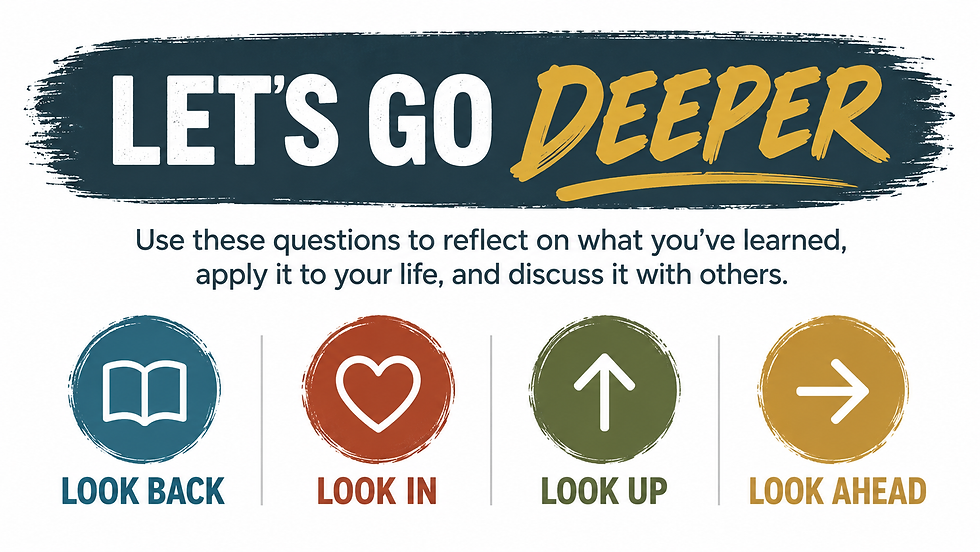
👀 LOOK BACK — WHAT DOES THE PASSAGE ACTUALLY SAY?
What does the man seem completely confident Jesus can do, and what is he uncertain Jesus is willing to do?
Why was Jesus’ instruction to show himself to a priest important when you consider Leviticus 13–14?
What happens after the man ignores Jesus’ instruction and spreads the news everywhere?
🪞 LOOK IN — WHAT IS HAPPENING INSIDE ME?
Have you ever carried something that made you afraid people would see you differently if they knew the whole story? How has that affected your willingness to let people get close?
When you think about your own story, which is harder for you to believe: Jesus can help me or Jesus actually wants me near Him?
Do you still define yourself by something that happened to you or something you did years ago? What words have you allowed that experience to attach to your identity?
⬆️ LOOK UP — WHAT DOES THIS SHOW ME ABOUT JESUS AND GOD?
What does Jesus deliberately touching this man reveal about Him?
What does Jesus sending the man toward the process of community restoration show us about the kind of restoration Jesus cares about?
How does this encounter add to the picture of Jesus Mark has been building throughout chapter 1?
➡️ LOOK AHEAD — WHAT WILL I DO WITH THIS?
Is there something you’ve been hiding because shame tells you that honesty would make you unwanted? Who is one safe, mature Christian you could begin talking with?
What old identity do you need to stop rehearsing this week? Write down one truth from Scripture that describes who you are in Christ and put it somewhere you’ll see it.
Is there someone else you have kept on the outside because of their past? What would it look like to treat that person as someone Jesus is willing to move toward?
💬 SMALL GROUP DISCUSSION STARTER
Without sharing anything you don’t feel ready or safe to share, can you remember a time when somebody knew something imperfect about you and chose to stay close anyway? What did that do for you?
A NOTE FOR GROUP LEADERS
Today’s conversation may touch wounds people have carried quietly for years. Don’t pressure anyone to tell their story. Silence doesn’t mean somebody isn’t participating; they may be processing something very personal.
If someone does share abuse, addiction, sexual history, family failure, or another painful experience, resist the urge to immediately fix it with a verse or a quick answer. Listen. Thank them for trusting the group. Ask what would be helpful. If someone discloses current abuse, danger, or serious risk, help them connect with appropriate professional or emergency support rather than treating the group as a substitute for that help.
🌱 DISCIPLE-MAKER TIP: MAKE IT SAFE TO STOP HIDING
If someone trusts you with an ugly or painful part of their story, your first job usually isn’t to explain why it happened or give them five steps to fix it.
Listen.
You might simply say, “Thank you for trusting me enough to tell me that.”
Then ask, “How can I walk with you in this?”
People who have spent years hiding are watching closely to see whether telling the truth changes the way you look at them. You can’t give anyone a new identity—that belongs to Jesus—but you can become the kind of Christian who helps people discover that following Jesus doesn’t require pretending their story is cleaner than it really is.
🤝 DON'T JUST STUDY IT — PRACTICE IT
Take a piece of paper and privately finish this sentence:
“The thing I’m afraid would make me unwanted is __________.”
Then underneath it write:
“Jesus already knows—and He still invites me near.”
If what you wrote has kept you isolated, choose one trustworthy, mature Christian and take one small step toward an honest conversation this week. You don’t have to tell everybody everything. Just stop letting shame convince you that hiding is your only option.
📌 REMEMBER THIS
Your worst experience—or your worst decision—doesn’t get the final word about who you are.
Jesus does.
📖 NEXT: MARK 2:1–12 — YOUR BIGGEST PROBLEM ISN’T WHAT YOU THINK
Today a man came to Jesus asking to be made clean, and Jesus saw that restoration involved more than his skin.
Tomorrow, four friends bring a paralyzed man to Jesus with an even more obvious physical problem. They tear through a roof because they are convinced Jesus can help him.
Everybody in the room can see what needs fixing.
Then Jesus looks at the man and says something nobody came there expecting Him to say.
Instead of beginning with the man’s legs, Jesus begins somewhere completely different.
What if Jesus sees a deeper need than the one everybody else can see?
📺 KEEP GOING THROUGH MARK
Follow the complete Gospel of Mark Verse-by-Verse Bible Study as we work through the entire Gospel together.
New Daily Bible Podcast teachings and study guides will be added throughout our journey.
Understand the Bible | Find Christian Friends | Grow as Disciple Makers
Don't follow Jesus alone.
Back in December 2024, I took you along one of Idaho’s most beautiful drives—following the Salmon River Road through rugged canyons and breathtaking scenery, passing 4 very different bridges along the way. The final suspension bridge? It leads hikers and horse packers into Idaho’s largest wilderness area.
And those 4 bridges connect beautifully with what we’re learning about John the Baptist in Mark.
🎥 Come along for the adventure - Click Here to Watch: https://youtu.be/mQwynEtlBGs



Comments