
IS THE POPE BIBLICAL?

A Balanced Look at Scripture, History, and Authority
Is the Pope biblical? This is one question that can stir up a debate.

For some Christians, the answer feels obvious. The Pope is viewed as the successor of Peter, carrying on a leadership role established by Jesus Himself.
For others, the answer is far less clear. While Peter was undeniably important, they believe the office of the Pope developed gradually over centuries and extends beyond what Scripture explicitly teaches.
What this really boils down to is how Christians interpret authority, leadership, and the relationship between Scripture and church tradition.
The Short Answer
While Peter is undeniably central to the New Testament, the modern office of the Pope, including universal authority and papal infallibility, is not explicitly described in Scripture.
The Bible never uses the word “Pope,” nor does it directly describe a continuing line of Roman bishops ruling over the global Church.
However, Catholics believe that the foundation of the papacy lies in the authority Jesus gave Peter.
Other Christians believe Peter was important without believing he established an ongoing office of supreme authority.
That is why the question continues to be debated nearly 2,000 years later.
Who Was Peter?
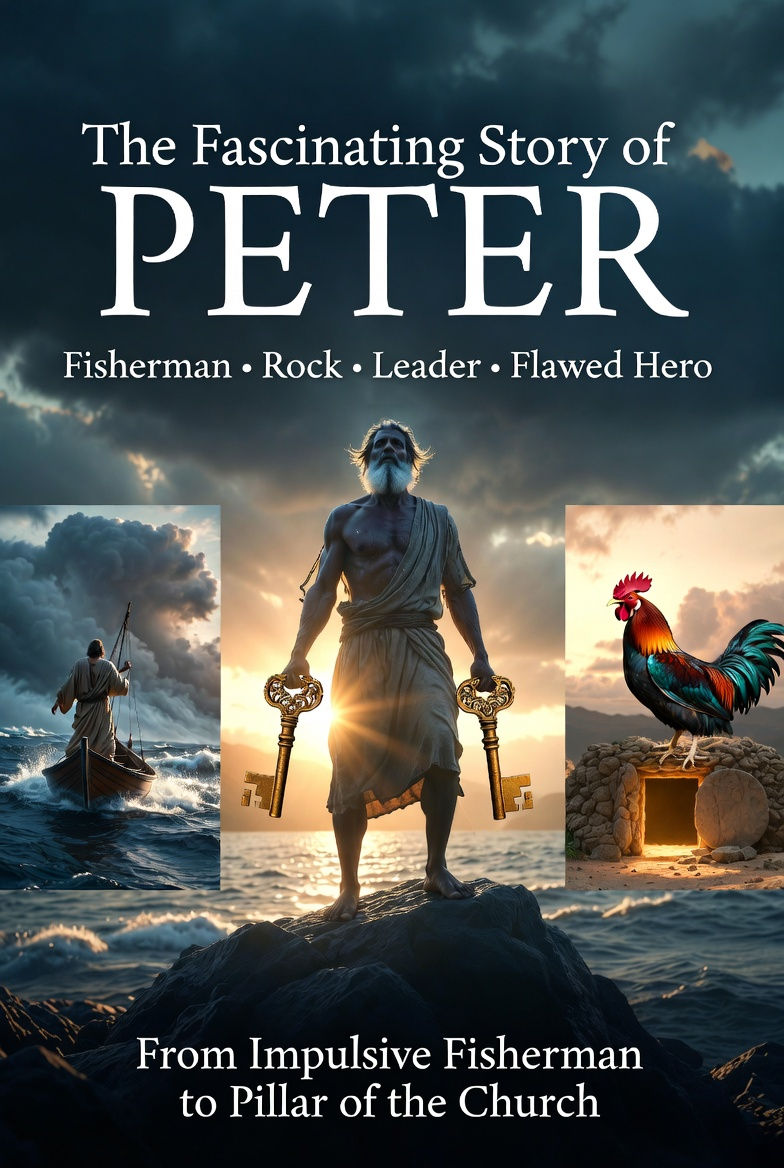
Peter’s story is a fascinating one!
Before following Jesus, Peter was a fisherman named Simon from Bethsaida.
Then Jesus did something significant. He renamed him.
In John 1:42, Jesus calls him Cephas (Aramaic) or Peter (Greek), meaning “rock.”
Throughout the Gospels, Peter stands out constantly because:
He is bold.
He is impulsive.
He speaks first.
He asks difficult questions.
He steps out of the boat in faith and then panics halfway across the water.
Peter was also the first disciple to openly declare Jesus as the Christ. Yet this is the same Peter who later denied even knowing Jesus three times. And yet still, after the resurrection, Jesus restored him.
In John 21, Jesus repeatedly tells Peter: “Feed my sheep.”Peter’s story is definetly not the story of a flawless spiritual giant. What it is,is the story of an imperfect man continually being transformed by Christ. And maybe many Christians find him compelling for just that reason.
Learn more about our exciting out-of-the-box ministry here
Was Peter the Only Apostle Given a Special Role?
This is a question that often gets overlooked. Yes, Jesus gave Peter a new name.
But Peter was not the only disciple singled out in meaningful ways.
Jesus also gave James and John the name “Boanerges,” meaning “Sons of Thunder” (Now

that's a cool name!) (Mark 3:17). Other apostles were entrusted with leadership, teaching, miracles, and authority throughout the New Testament.
In Matthew 18:18, Jesus even broadly grants the authority to “bind and loose” to the apostles as a group, not just to Peter.
So this raises an important question: Was Peter uniquely elevated above the others in a permanent leadership office? Or was he one of the especially prominent apostles among a group of leaders sharing authority?
Even Christians who reject the papacy usually acknowledge that Peter clearly stood out.
He appears first in apostolic lists.
He often spoke on behalf of the group.
He becomes a major leader in the early church.
But prominence and supreme authority are not automatically the same thing.
That is where interpretation begins, dividing Christians into different conclusions.
The Key Passage: Matthew 16:18-19
Nearly every discussion about the pope eventually arrives at the same passage.

Jesus says to Peter:
“You are Peter, and on this rock I will build my church… I will give you the keys of the kingdom of heaven…”
This verse became foundational to Catholic teaching about the papacy.
The Catholic Interpretation
Catholics believe Jesus was establishing Peter as the foundational leader of the Church.
The “keys of the kingdom” are often connected to Isaiah 22, where a royal steward is entrusted with authority within the king’s kingdom.
From this perspective: Peter receives a unique leadership role, one that continues through successors. The bishops of Rome inherit this authority through apostolic succession and this becomes the basis for pope.
Protestant and Orthodox Interpretations
Other Christians interpret this passage differently. Some believe the “rock” refers to Peter’s confession of faith rather than Peter himself. And still others believe the rock is Christ.
Many also point out that authority is shared among the apostles in other parts of Scripture.
We can also note that Paul publicly corrected Peter in Galatians 2, which suggests Peter was a leader among equals, not a supreme ruler.
And lastly the New Testament never clearly establishes a future office of universal Pope
From this perspective, Peter may have been a leading apostle without becoming a supreme ruler over all Christians.
Why Did Rome Become So Important?
This part of history surprises many people including me, because Rome was brutal.
The Roman Empire persecuted Christians. Jesus Himself was crucified under Roman authority. Early believers were imprisoned, tortured, and killed.

So why did Rome become central to Christianity?
The answer is partly because Rome was the center of the known world at that time.
Its roads, trade systems, political influence, and communication networks connected vast regions together. Christianity spread through those same channels.
But another major reason was because of Peter and Paul. Both were traditionally believed to have been martyred in Rome. That gave the Roman church enormous spiritual influence.
It definetly was not because Rome was morally pure. But because the church there was deeply connected to apostolic history and endured intense persecution.
Over time, other churches increasingly looked to Rome for guidance during disputes. What began as influence eventually developed into authority.
How the Papacy Developed Historically
One thing historians broadly agree on is this: The modern papacy/the pope, did not appear overnight.
The earliest church looked much simpler than the structure seen in Catholicism today.
There were apostles, elders, bishops, and local church leaders.
The title “Pope,” meaning “father,” was originally used more broadly and only gradually became reserved specifically for the bishop of Rome.
Over centuries:
* Rome gained influence
* Church structure became more formalized
* The bishop of Rome gained increasing authority
* Political and spiritual leadership became intertwined
Figures like Pope Leo I strongly argued that the bishop of Rome carried authority as Peter’s successor.
Eventually, doctrines connected to the papacy became more formally defined.
One major example is papal infallibility. At the First Vatican Council in 1870, the Catholic Church officially taught that under very specific conditions, the Pope can speak infallibly on matters of faith and morals.
This does not mean Catholics believe the Pope is always right about everything. It refers only to rare formal doctrinal declarations.
Still, many Christians reject the concept entirely because they believe only Scripture itself is infallible.
Is It Logical to Only Accept What Is Explicitly in the Bible?
At first glance, that idea feels very reasonable. If Christianity is based on Scripture, shouldn’t Christians only believe what is directly stated there?
But once we try to apply that consistently, things become more complicated. For example: * The word “Trinity” never appears in the Bible

Every Christian interprets Scripture in some way. The real question is not whether interpretation exists. The real question is who carries the authority to interpret.
Catholics believe church authority and tradition help preserve correct doctrine.
Most Protestants believe no church authority should stand above Scripture itself.
And that difference shapes nearly every conversation about the Pope.
After exploring Scripture, church history, Peter’s role, and the development of the papacy, one thing becomes very clear:
This discussion is far more layered than many people realize.
Peter was undeniably important.
Jesus singled him out in meaningful ways.
He became a central figure in the early church.
His connection to Rome shaped Christian history for centuries.
But Peter was not the only apostle entrusted with leadership, authority, or special assignments.
That is why sincere Christians who deeply love Jesus and deeply value Scripture continue arriving at different conclusions.
Some believe having a pope is a faithful continuation of leadership established through Peter. Others believe the office expanded far beyond anything clearly established in the early church.
And maybe before we rush to choose sides we need to slow down enough to ask deeper questions:
* What does biblical authority truly look like?
* How much weight should church history carry?
* What did Jesus actually intend for leadership within His Church?
Those are not small questions. But no matter what, our goal is still to keep our eyes fixed on Jesus Himself.
Because long before denominations, councils, titles, and theological debates existed, Christianity simply began with people following Christ.
Study & Reflection Questions
Compare Matthew 16 (Peter) and Matthew 18 (the Group). What differences do you see in the authority given?
In the Book of Acts, does Peter act as a sole commander or as a team member?
God changed names like Abram to Abraham and Simon to Peter. What does a name change signify to you personally in your walk with God?
How much should historical church tradition weigh compared to the "Bible alone”?
Final Thoughts: Decision Time

Whether the pope represents a faithful growth of Peter’s role or an addition to the Biblical
text depends on how much weight you give to Church tradition. One thing is certain: Peter’s life shows us that God uses "rocks" that are sometimes cracked and imperfect to build His Kingdom.
What do you think? Was Peter the first Pope, or was his role different? Leave a comment below!
Meet the author and Her Partner in Faith:
Tammy and Bruce have been married for 39 years, navigating life as best friends and partners in faith. Their days are a beautiful of service and creativity: Tammy serves her as an active EMT when she isn't on the road, while Bruce, a retired Law Enforcement officer, is the visionary artist behind God’s Country Art.

Between the adrenaline of emergency medicine and the peace of the open road, Tammy is a lifelong writer currently preparing to publish her debut Christian Fantasy novel, Beyond the Mirror’s Edge.
Together, they are devoted parents and grandparents who find God’s handiwork in everything—from a life-saving moment in the field to a quiet piece of hand-carved wood. Whether through fellowship with others online at Your Jesus Journey, or a campfire chat at a new campsite, they are committed to sharing the love of Christ one mile at a time.
You can see some of Bruce's handiwork at Godscountryart.com


Good blog, I'll pass this along to my husband raised in the Catholic church.