
Jesus Calls You BEFORE You’re Ready | Mark 1:16–20 Bible Study

Study Guide: Mark 1:16-20

Most of us like to feel ready before we commit to something important. We want enough information, enough experience, and preferably some idea of where this thing is going.
That makes Mark 1:16–20 uncomfortable.
Jesus walks up to four working fishermen and says, in effect, Come with me. Put your life behind mine. Learn from me. Let me turn you into something you aren't yet.
And they go.
It's tempting to make this scene easier by filling in details Mark doesn't give us. Maybe these guys were teenagers who had failed to make the cut at “rabbi school.” Maybe students normally chose rabbis, so Jesus choosing them was completely unheard of. Maybe they'd never met Jesus before this moment.
Some of those ideas make great sermons. The problem is that we can't confidently prove them.
What we can establish is actually more interesting. Jesus is functioning as a Jewish teacher gathering disciples, but He takes the initiative. He calls working fishermen into a relationship in which they will learn not merely by listening to Him, but by following Him. And although Mark doesn't tell us what previous contact they had with Jesus, John's Gospel gives us good reason to think at least Andrew and Simon had encountered Him before.
They don't know nearly enough yet to understand where this is going.
But they know enough to follow.
That distinction may change the way we think about discipleship.
📖 TODAY'S PASSAGE
READ: Mark 1:16-20
I suggest reading the passage in the NLT and one of these "NASB, ESV, CSB"
BIG IDEA
Jesus calls ordinary people to follow Him, be formed by Him, and join Him in His mission.
👀 WATCH FOR THIS
As you read, notice who takes the initiative in every encounter. Who sees whom? Who calls whom? And who promises to do the changing?
🎥 WATCH THE TEACHING

This study guide goes with our teaching from the Daily Bible Podcast.
You can watch the teaching first and then work through this guide, follow along while you watch, or come back afterward and use the questions to dig deeper.
SETTING THE SCENE
Yesterday's passage ended with Jesus announcing:
“The Kingdom of God is near! Repent of your sins and believe the Good News!” (Mark 1:15 NLT).
Now Mark shows us what that announcement looks like when it lands in someone's actual life.
Jesus is beside the Sea of Galilee, the large freshwater lake that supported a significant fishing industry. Simon and Andrew are casting nets. James and John are preparing nets in their father's boat. This is their work, their livelihood, and in James and John's case, their family business.
Jesus is also beginning to function publicly as a Jewish teacher with disciples. “Rabbi” was not yet the formal ordained office it would become in later Judaism; in Jesus' world it could be used respectfully for a teacher. Jesus is called Rabbi elsewhere in the Gospels, and John 1:38 actually explains the word as “Teacher.”
But Jesus isn't waiting in a classroom for students.
He goes looking for them.
1. THE TEACHER GOES LOOKING FOR STUDENTS — Mark 1:16–17
It's common to hear this explained like this: Every Jewish boy studied Torah. The best advanced to higher schools. Eventually an elite student would approach a rabbi and ask to become his disciple. If the rabbi thought he was good enough, he accepted him. These fishermen had obviously washed out of the system, but Jesus chose the rejects.
There's a problem.
We don't have enough first-century evidence to state that entire system as historical fact. Some of the detailed educational stages commonly taught in Christian circles rely heavily on later Jewish sources being projected backward into Jesus' time.
We can say something more modest and reliable.
Jewish teachers gathered students around themselves, and disciples learned much more than information. A disciple attached himself to a teacher, learned his teaching, observed his life, and imitated his way of living. Jesus gathering disciples therefore wasn't strange by itself.
What Mark emphasizes is Jesus' initiative.
He sees Simon and Andrew.
He calls them.
Then He sees James and John.
He calls them.
They don't audition. Mark gives us no entrance exam and no résumé.
Jesus chooses them.
And look where He finds His first four disciples: not among Jerusalem's religious leadership but among fishermen working beside a lake.
That fits something we're going to see repeatedly in Mark. Jesus keeps stepping into ordinary people's lives.
2. HOW OLD WERE THESE GUYS? — Mark 1:16–20
You may have heard that Jesus' disciples were probably teenagers—sometimes very specific ages such as 15–18 are given.
The Bible never tells us their ages, and we don't have enough evidence to calculate them confidently.
There are clues, but they don't produce birthdays.
Simon is married; Mark will introduce his mother-in-law in the very next scene (Mark 1:29–31). That tells us he had adult family responsibilities, but people could marry younger in the ancient world than is common in modern America.
James and John work with their father Zebedee, who also employs hired workers (Mark 1:20). That tells us they're involved in a functioning family business, not how old they are.
Another popular argument comes from Matthew 17:24–27. Jesus provides the Temple tax for Himself and Peter, and some have argued that this proves the other disciples were under twenty because Exodus 30:14 required the payment beginning at age twenty. That's more than Matthew actually tells us. The scene concerns a question specifically put to Peter about Jesus' payment; it never says the other disciples were exempt because of their ages.
So were some disciples young men?
Very possibly.
Can we say Simon was 25, John was 16, or all but Peter were teenagers?
No.
That's a useful Bible-study lesson by itself: sometimes saying “we don't know” is more faithful to Scripture than giving a fascinating answer Scripture never gives us.
3. DID THEY EVEN KNOW JESUS? — Mark 1:16–18
Read Mark by itself and this scene feels almost shocking.
Jesus walks past.
“Come, follow me…”
They drop their nets.
If this were their first-ever encounter, we'd probably want to ask, Guys…maybe at least get His last name first?
But Mark doesn't tell us this was their first meeting. In fact, Mark simply doesn't tell us how much they already knew about Jesus. His focus is the authority and urgency of Jesus' call. Scholars have long recognized that previous contact is possible even though Mark doesn't describe it.
John's Gospel gives us another piece of the puzzle.
In John 1:35–42, Andrew is originally connected with John the Baptist. After John identifies Jesus, Andrew spends time with Jesus, becomes convinced that they have found the Messiah, finds his brother Simon, and brings Simon to Jesus. Jesus even speaks directly to Simon and gives him the name Cephas/Peter.
So if John's account describes an earlier encounter—and many Christians reasonably understand it that way—Simon and Andrew definitely weren't meeting a complete stranger beside the lake.
Luke gives still another telling of the call in Luke 5, involving a miraculous catch of fish. The Gospel writers arrange and emphasize these events differently, so we shouldn't pretend we can reconstruct every day's exact sequence with certainty.
But this much is important:
“Immediately they left their nets” does not require us to believe they knew absolutely nothing about Jesus.
They may have known Him.
They certainly didn't yet understand Him.
That's the bigger point.
Andrew may already call Jesus Messiah in John 1:41, but nobody at this stage understands what kind of Messiah Jesus will actually be. The disciples' expectations will need major correction as Mark unfolds.
They know enough to trust Him enough to start walking.
The rest they'll learn on the road.
4. “I WILL MAKE YOU…” — Mark 1:17
Now notice what Jesus does not say:
Get yourself ready and then follow me.
He says:
“Come, follow me, and I will show you how to fish for people!” (Mark 1:17 NLT).
Other translations bring out the idea, “I will make you become fishers of people.” Either way, the important point is the same:
Jesus intends to do something to these men as they follow Him.
That matters because if you've read the rest of Mark, you know Jesus has quite a project ahead of Him.
These guys are going to misunderstand Him. They're going to argue about which of them is greatest. They're going to struggle with Jesus' teaching about suffering. Peter will actually rebuke Jesus for talking about the cross (Mark 8:31–33). James and John will eventually ask for the best seats in Jesus' kingdom (Mark 10:35–45).
Eventually, when Jesus is arrested, they will run.
Jesus knows none of these men are finished products.
He calls them anyway.
That's the pattern we see beginning here:
FOLLOW JESUS → BE FORMED BY JESUS → JOIN THE MISSION OF JESUS
Jesus doesn't merely give disciples information.
He forms people while they follow Him.
5. FOLLOWING MEANS MORE THAN BELIEVING SOMETHING — Mark 1:18–20
Simon and Andrew leave their nets. James and John leave their father in the boat with the hired workers.
The hired workers are a small but helpful detail. Zebedee apparently operates a fishing business substantial enough to employ additional labor. James and John aren't sitting around with nothing to lose. They have work, family obligations, and a livelihood.
Mark isn't commanding every Christian to quit a job or walk away from a family.
He's showing us that following Jesus rearranges a life.
That's especially important in a culture where Christianity can be reduced to believing the correct things: I believe Jesus is the Son of God. I believe He died and rose again. Therefore, I'm a Christian.
Belief matters enormously to Mark—Jesus has just said, “believe the Good News” (1:15).
But look at the first picture Mark gives us of that belief in action:
They follow.
And that's remarkable because these men still know so little. Some of what they think about Jesus and God's kingdom will turn out to be wrong.
Jesus doesn't wait until their theology is flawless.
He calls them to trust Him enough to follow Him.
Their understanding will grow because they walk with Jesus, listen to Him, watch Him, fail, get corrected, and keep following.
Christianity isn't merely adding some new beliefs to your existing life.
Jesus calls for your life to come behind His.
🔎 DON’T MISS THIS: JESUS CHOSE THEM BEFORE THEY WERE READY
The most surprising thing here isn't that four fishermen become disciples.
Teachers having disciples wasn't unusual. What deserves our attention is the way Mark tells the story: Jesus takes the initiative.
And we need to be careful not to exaggerate the cultural background to make that seem dramatic. We can't prove the popular story that first-century students always chose their rabbis and rabbis never initiated relationships with students.
But we don't need that claim.
Mark's emphasis is already powerful enough.
Jesus sees. Jesus calls. Jesus promises to form.
These men don't present qualifications. Jesus doesn't tell them to come back after additional Torah training. He calls them right where they are and says that He will make them into people who can participate in His mission.
The call comes before the finished product.
That's why “before you're ready” isn't just a catchy lesson title.
It's sitting right inside the story.
THE BIGGER LESSON
WHO IS JESUS?
Mark has already told us far more about Jesus than these fishermen understand.
We know He's the one John said was greater than himself (Mark 1:7). We've heard the voice from heaven call Him God's beloved Son (1:11). We've watched Him confront Satan in the wilderness (1:12–13). We've heard Him announce that God's kingdom has come near (1:14–15).
Now this same Jesus looks at ordinary fishermen and says:
Follow me.
And He speaks with the confidence that He can transform them.
WHAT DOES IT ACTUALLY MEAN TO FOLLOW HIM?
This is where Mark begins dismantling the idea that following Jesus is simply knowing the right answers.
These men don't.
They know very little compared with what they'll eventually understand. Some of their assumptions are wrong. They have no idea that following Jesus will eventually lead toward Jerusalem, suffering, a cross, and an empty tomb.
Yet Jesus doesn't begin with:
“Understand everything about me.”
He begins with:
“Follow me.”
Biblical faith isn't blind faith. These men apparently had reasons to take Jesus seriously, and the wider Gospel tradition suggests some previous contact.
But they still have to trust Him beyond what they presently understand.
They don't understand everything and then follow Jesus. They follow Jesus—and discover who He really is along the way.
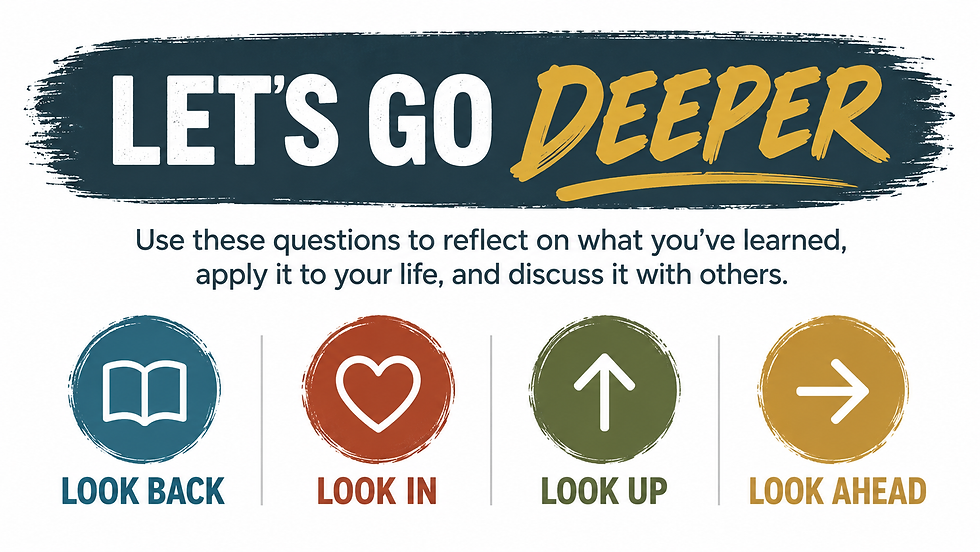
👀 LOOK BACK — WHAT DOES THE PASSAGE ACTUALLY SAY?
Who takes the initiative in Mark 1:16–20: Jesus or the fishermen? What words in the passage show you that?
What are Simon and Andrew doing when Jesus calls them? What are James and John doing?
What does Jesus promise to do after calling them to follow Him?
🪞 LOOK IN — WHAT IS HAPPENING INSIDE ME?
Do you tend to think you need to understand everything before you can take the next step with Jesus?
Which is harder for you: trusting Jesus when you don't know where He's leading, or allowing Him to change something you already feel comfortable with?
Has following Jesus ever changed a priority you once thought was non-negotiable?
⬆️ LOOK UP — WHAT DOES THIS SHOW ME ABOUT JESUS AND GOD?
What does Jesus' choice of ordinary working fishermen tell us about the kinds of people He is willing to call?
What does “I will make you” reveal about Jesus' role in forming His disciples?
How does knowing where Jesus will eventually go—the cross and resurrection—change the way you hear His words “Follow me”?
➡️ LOOK AHEAD — WHAT WILL I DO WITH THIS?
What's one area where you already know what following Jesus looks like but have been waiting until you feel “ready”?
What's one concrete step of trust you could take this week?
Who could you invite to walk with you as you learn to follow Jesus more closely?
💬 SMALL GROUP DISCUSSION STARTER
Tell about a time you said yes to something before you felt completely ready. What happened?
A NOTE FOR GROUP LEADERS
Don't rush this question toward a spiritual answer. Let people tell their stories first. Someone may talk about marriage, parenting, a new job, moving across the country, joining a group, or trying something that scared them. Ask simple follow-ups like, “What made you finally say yes?” Those stories create a natural bridge into the fishermen's decision to follow Jesus. You don't need to cover every study question. A meaningful conversation where people listen to one another is more valuable than finishing the page.
🌱 DISCIPLE-MAKER TIP: INVITE BEFORE THEY'RE “READY”
Sometimes we wait too long to invite someone into a next step because we think they need more Bible knowledge first.
Jesus reminds us that people can learn while they're following.
Think about someone you're already building a relationship with. Instead of waiting until they know more, offer a simple invitation:
“I'm reading through Mark. Want to read a chapter with me sometime?”
You don't need to become their expert. Read it together. Ask, “What stood out to you?” and “What do you think this shows us about Jesus?”
Help them discover Jesus in Scripture rather than making yourself the person with all the answers.
🤝 DON'T JUST STUDY IT — PRACTICE IT
Identify one thing you already know Jesus is asking you to do that you've delayed because you don't feel ready.
Don't solve your entire life today.
Take one concrete step before the day ends: send the message, make the apology, join the group, start the conversation, open the Bible, ask for help, or do whatever that next faithful step actually is.
📌 REMEMBER THIS
You don't have to know everything about Jesus to start following Jesus—but following Him will change you.
📖 NEXT: MARK 1:21–28 — WHAT KIND OF TEACHER IS THIS?
Four fishermen have just left their work to follow Jesus.
That's a pretty serious decision considering how much they still don't understand about the man they're following.
Now they walk with Him into Capernaum, where Jesus enters a synagogue and begins teaching.
And almost immediately, people realize this teacher is different.
It's not only what Jesus says. Something about His authority catches everyone off guard—and before the scene is over, His authority will be challenged in a way nobody in the synagogue expected.
The fishermen have decided to follow Him. Now they're about to get their first real glimpse of exactly who they've chosen to follow.
📺 KEEP GOING THROUGH MARK
Follow the complete Gospel of Mark Verse-by-Verse Bible Study as we work through the entire Gospel together.
New Daily Bible Podcast teachings and study guides will be added throughout our journey.
Understand the Bible | Find Christian Friends | Grow as Disciple Makers
Don't follow Jesus alone.
Back in April 2025, I took you along one of Idaho’s most beautiful drives—following the Salmon River Road through rugged canyons and breathtaking scenery, passing 4 very different bridges along the way. The final suspension bridge? It leads hikers and horse packers into Idaho’s largest wilderness area.
And those 4 bridges connect beautifully with what we’re learning about John the Baptist in Mark.
🎥 Come along for the adventure - Click Here to Watch: https://youtu.be/mQwynEtlBGs


I love all of the good stuff that you pack in these Bible studies. Thank you