
The Comfort Trap: When your "Shade" matters more than your neighbor.

Day 19 = Jonah 4:9-10

Think about that sinking feeling in your stomach when you drop your phone and see the screen is shattered. Or that surge of sadness when you realize you lost a favorite pair of sunglasses or a hoodie you’ve had for years. It’s normal to feel "pity" for things we like. We care about our stuff because it makes our lives better.
But imagine if you were so upset about your broken phone that you were willing to give up on life, yet you didn't care at all about people in need right down the street. It sounds crazy, right? Yet, this is exactly where Jonah is. He is heartbroken over a dead plant but completely cold toward others. In today's study, God uses a simple comparison to show Jonah (and us) how upside-down our priorities can get.
Before you dig into the study guide, I would suggest reading or listening to the passage in two different bible translations from this list: NIV, NLT, NASB, ESV, NKJV

Learn more about our exciting out-of-the-box ministry here
Setting the Scene: The Easy Pity Trap

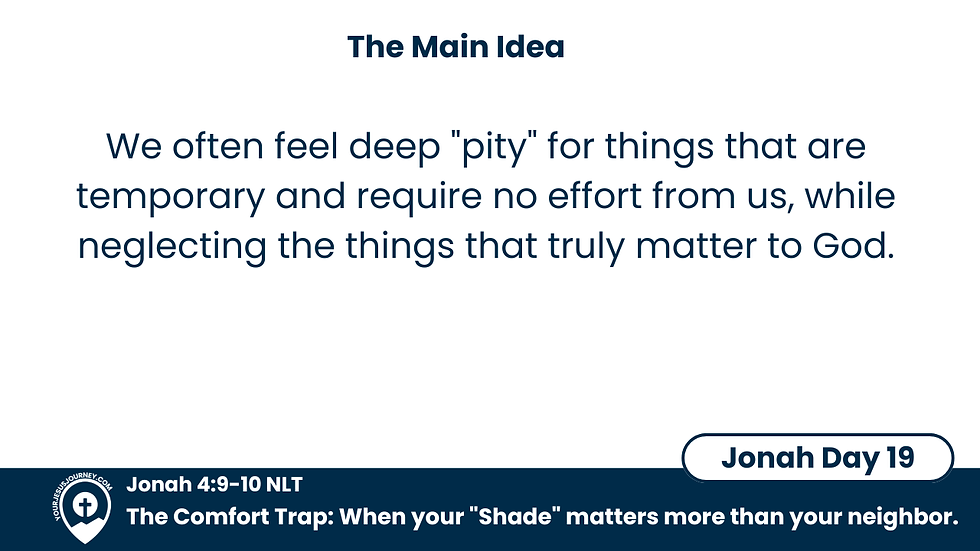
In the final chapter of Jonah, we see a man who is heartbroken over a plant but heartless toward a city of 120,000 people. God points out the absurdity: Jonah didn't plant it, he didn't water it, and it grew overnight. Yet, he "pitied" the plant because it made his life comfortable. This is the Easy Pity Trap—feeling deep emotional attachment to things that serve us, while remaining indifferent to the souls of others.
The Honest Confrontation (Verse 9): God starts by asking a very direct question: “Is it right for you to be angry because the plant died?” In the NLT, Jonah’s response is sharp and disrespectful. He retorts, “Yes, even angry enough to die!” Jonah isn't just annoyed; he is consumed by his anger. He feels he has a "right" to his comfort, and he is grieving the loss of a plant he didn't even work for. He is choosing to value a short-lived plant more than his own life or God’s plan.
The "Easy Pity" Trap (Verse 10): The Lord points out the flaw in Jonah’s logic. He says, “You feel sorry about the plant, though you did nothing to put it there. It came quickly and died quickly.” God is highlighting two things here:
Investment: Jonah didn't plant the seed, water it, or protect it. He had zero "sweat equity" in the plant. His sadness wasn't because he loved the plant; it was because he loved the shade the plant gave him.
Time: The plant was a "vapor"—it appeared overnight and vanished just as fast. God is showing Jonah that his emotions are tied to something that was never meant to last.
Connecting the Dots

It is easy to look at Jonah and think, "I would never value a weed over a human life." But for those of us in the middle and later chapters of our lives—our 50s, 60s, and 70s—the "Plant" just looks a little different. We fall into this same trap when we allow our personal comforts or our "stuff" to carry more weight than the people around us.
Real-Life "Plant" Traps for Today:
The Heirloom Hurdle: We often get "Jonah-level" angry when our adult children tell us they don't want the "good china," the heavy oak table, or the boxes of family keepsakes. We aren't really mourning the loss of the objects; we are mourning the feeling of importance they gave us. We "pity" the furniture, but we risk alienating the children.
The "I Earned This" Defense: After decades of hard work, it’s easy to feel like we own our comforts. Like Jonah thinking he had a right to that shade, we can become bitter when our quiet neighborhood changes or our favorite routine is disrupted. We value our "peace and quiet" (our shade) more than the messy, noisy work of helping people in need.
Storage Unit Syndrome: Many of us pay monthly fees to house items we haven't touched in a decade. We are "pitying" the boxes—keeping them safe and climate-controlled—while that same money or the value of those items could be used to feed a family or support a local mission. We are protecting the "plant" while the "city" is struggling.
The Routine Over the Relationship: We can get more upset about a change in our church seating or a shift in how things are "usually done" than we are about the fact that younger generations are drifting away. If our comfort in the "way it’s always been" matters more than reaching a soul, we are sitting in Jonah’s chair under a withered vine.
Conclusion: The Question
God asked Jonah, "Is it right for you to be angry?" Today, He might ask us: "Is it right for you to hold on so tightly?" When we learn to loosen our grip on our "plants," we finally have our hands free to help the people in our city.
👇🏻👇🏻👇🏻 DID YOU SEE THIS VIDEO YET? 👇🏻👇🏻👇🏻
🛑 How to Apply the Lesson Incorrectly (Missing the Point):
The "Stuff is Evil" Mistake: Thinking that God is mad at Jonah for liking the plant.
Correction: God isn't saying the plant is bad; He’s saying Jonah’s attachment to it is out of proportion. It's okay to enjoy your comforts, but it's not okay to value them more than people.
The "Suppressed Emotions" Trap: Thinking that we aren't allowed to be sad when we lose things we like.
Correction: Grief is a human emotion, but when we say we are "angry enough to die" over a lost comfort, we’ve lost our perspective on what's truly valuable.
✅ How to Apply the Lesson Correctly (Tips and Principles):
The "Pity Pivot": The next time you feel a surge of sadness over a minor loss (like a lost item or a ruined plan), use that feeling as a "trigger." Say to yourself: “If I can feel this bad about a thing I didn't even create, how much more does God feel about the people He did create?”
Checking the "Work": Ask yourself: "Am I more upset about losing things I did nothing to earn (like luck or easy comforts) than I am about the things I'm supposed to be working on (like my character or helping others)?"
Questions to Chew on and Discuss:
These questions are designed to help you personally dig deeper into the passage.
Jonah said he was "angry enough to die" over a plant. What is one "small thing" in your life that, if it went wrong, would totally ruin your entire week?
God points out that Jonah did "nothing" to put the plant there. Why do we feel like we "deserve" comforts that we didn't actually work for?
How does knowing that things "come quickly and die quickly" change the way we should look at our possessions?
Journey Group Discussion Starter:
Whether you're helping facilitate a small group, talking about this passage one-on-one with a friend, or even just need a topic to guide the conversation at the dinner table, these ideas can help start a good group conversation about justice and what we think is fair.
"Share a time when you were way too upset over something small (like a video game glitch, a stain on a shoe, or a canceled plan). Looking back, why did that thing feel so important in the moment?"
"If someone looked at your 'pity'—the things you get most upset about losing—what would they say you value most in life?"
BE SURE TO WATCH THE VIDEO PODCAST THAT GOES WITH THIS STUDY GUIDE
See viewer comments and questions on screen at the end of the podcast.
MORE RESOURCES TO HELP YOU GROW AS A CHRISTIAN
Your Jesus Journey is an independent, non-denominational Christian ministry. We're fueled by God's grace and the generosity of our supporters. Our team—led by Pastor Thad and his wife Kaila—is made up of dedicated disciples from all over the United States. Together, we work to help people understand the Bible, find Christian friends, and grow as disciple-makers.

Be sure to grab our free E-Book, "Stop Reading the Bible Wrong: 7 Strategic Shifts that Change Everything." Just click the Free Gift button at the top of our website, and we'll send it to you today!
Go to https://www.yourjesusjourney.com/journeygroups to learn more about Journey Groups, get connected in one, or even learn how to start your own. It's like a spiritual potluck, but instead of questionable casseroles, we share insights and grow closer to God. See you there!
You can also get our FREE in-Depth Bible-Study Guides delivered to your inbox: https://forms.wix.com/r/7330608166566101604.
To learn more about YJJ, Thad and Kaila, and Your Jesus Journey, check out our ABOUT US section: https://www.yourjesusjourney.com/learn-about-thad-and-kaila-and-the-journey-church-online.
There's lots more to see and learn on our website, from our "what we believe" page to hundreds of blogs. We encourage you to swing on by and take a look around at www.YourJesusJourney.com!


Comments