
The One Thing Most People Miss in the Book of Acts

Intro to the book of Acts 1-12

Imagine you’ve lived in the same small town your entire life. In the center of town is a massive, beautiful house where the King lives. If you want to talk to the King or feel his presence, you have to pack a bag, travel to that specific front door, and wait in line. It’s the only place on earth where the King’s world and your world meet.
Now, imagine one morning you wake up and the house is empty. The King has moved out. But he didn’t move to a different city. Instead, he sent a "moving crew" to every single house in the neighborhood. He didn’t just want to live near you; he decided to move in with you. Suddenly, the whole town is glowing because the King is everywhere at once.
This is exactly what happens in the first half of the book of Acts. God moves out of his "Grand House" (the Temple) and moves into His people.
Before you dig into the study guide, I would suggest reading or listening to the passage in two different bible translations from this list: NIV, NLT, NASB, ESV, NKJV

Learn more about our exciting out-of-the-box ministry here
Setting the Scene: From Stone to Skin
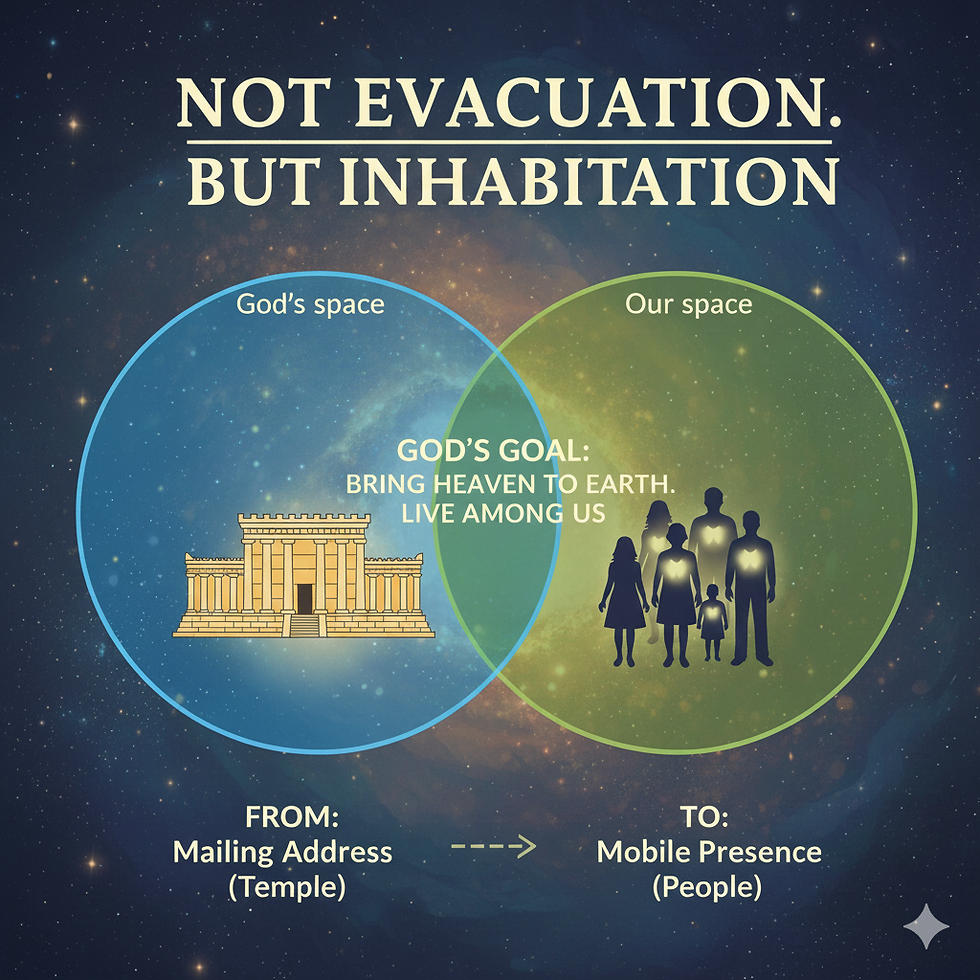
To really "get" the Book of Acts, you have to realize it is a story about a massive architectural shift. But before we look at the buildings, we have to look at the "where."
Most people today imagine "Heaven" as a far-off place, like a distant planet in another solar system where we go after we die to escape the earth. But the Bible tells a different story. In the Bible, Heaven and Earth are like two circles that overlap. Heaven is God’s space (the "control room"), and Earth is our space.
God’s big goal isn't to help us "evacuate" Earth to go live with Him in the clouds. His goal has always been to bring His space into ours—to reside here, to bring His reign to His people, and to live among us. As you read Acts, you are watching God move from a "mailing address" where those two circles met in a building, to a "mobile presence" where those circles meet inside of people.
Here is a deeper look at that history and why it caused so much trouble in the first century.
The History of God’s "Housing"
1. The Tabernacle: God on the Move
When the Israelites were freed from Egypt, God didn't tell them to stay put. He told them to build a Tabernacle—essentially a high-tech, portable tent (Exodus 25-27).
The "Moving In" Moment: When it was finished, Exodus 40:34-35 says a cloud covered the tent and the "glory of the Lord filled the tabernacle."
The Point: God was a traveler. He didn't want a fixed palace; He wanted a home that could move. He lived in a tent because His people lived in tents. He went wherever they went.
2. The Temple: The Permanent HQ
Once the people settled in the Promised Land, King Solomon built a magnificent stone Temple in Jerusalem. It was meant to be the permanent spot on Earth where Heaven and Earth overlapped.
The "Moving In" Moment: In 1 Kings 8:10-11, the cloud and fire returned. The presence of God was so heavy and thick that the priests couldn't even perform their duties.
The Point: For hundreds of years, this building was the "center of the world." If you wanted to get close to God, you had to travel to this specific GPS coordinate, offer a specific animal, and stand in a specific line.
3. The Prophetic Promise: A Heart, Not a Hut
Over time, God started dropping hints through the prophets that the stone building wasn't the final plan. He didn't want to just be "near" His people in a building; He wanted to be "in" them so His reign could spread everywhere.
Ezekiel 36:26-27: God promised, "I will give you a new heart and put a new spirit in you... I will put my Spirit in you."
Joel 2:28: God said, "I will pour out my Spirit on all people."
The Hint: God was planning to move from a "Stone House" back to a "Mobile Presence"—but this time, the "tent" would be human skin.
4. The Transition: Why the Leaders Fought So Hard
By the time we open the book of Acts, the Temple in Jerusalem had become a "religious trophy." The leaders there had a lot of power and money tied up in that building.
The Conflict: When Jesus came, he famously said, "Destroy this temple, and I will raise it again in three days" (John 2:19). He wasn't talking about bricks; he was saying that He was now the place where Heaven and Earth met.
The Arrests: In Acts 6 and 7, when they arrested Stephen, the main charge against him was that he wouldn't stop speaking against "this holy place" (the Temple).
The "Mic Drop" Moment: Stephen’s final defense in Acts 7:48 was the ultimate insult to the religious leaders: "The Most High does not live in houses made by human hands." He was telling them that God had moved out of their building to bring His kingdom directly to the streets.
Why This Matters Today
Understanding this transition from Building to People changes everything about how you read Acts 1-12:
It Explains the "Wind and Fire": When the wind and fire show up in Acts 2, it’s a direct callback to the Tabernacle and Solomon’s Temple. God is signaling: "I’m moving in again—but this time, my 'Holy of Holies' is the person sitting in that chair."
It Explains the Community: In Acts 2:42-47, the believers start meeting in homes and sharing everything. Why? Because they realized they didn't need the big stone building to experience God’s reign. They were experiencing Heaven and Earth overlapping in their own living rooms.
It Explains Your Identity: You are no longer a "visitor" to God’s house. According to 1 Corinthians 6:19, your body is the temple. You are a "Mobile Mini-Temple." God’s goal isn't just to get you into Heaven; it's to get Heaven into you so you can change the world around you.

The Story Summary: God on the Move
1. The Sequel (Acts 1)
The author, Luke, makes it clear that his first book (the Gospel of Luke) was just the "Part 1." In Acts 1:1-8, Jesus tells his friends that even though he is heading back to heaven, he isn't leaving them alone. He promises them "power." He is moving to the "control room" of the universe, and his friends are going to be his hands and feet on the ground.
2. Moving Day (Acts 2)
This is the "explosion" that starts the engine. The followers are gathered in a room when a sound like a roaring wind fills the house and what looks like fire appears. But here is the big detail: the fire lands on the people, not the building (Acts 2:1-4). This is the fulfillment of ancient promises that God would pour his Spirit into human hearts. They become "Mobile Mini-Temples."
3. The New Lifestyle (Acts 3-7)
Because God now lives in the people, the community starts looking different. In Acts 2:42-47 and Acts 4:32-35, we see them sharing their money, eating together, and making sure nobody is poor. They are doing "Temple work" (healing and caring) out in the streets. This makes the "Stone Temple" leaders furious. When they kill a man named Stephen (Acts 7), it’s because he told them straight out: "God doesn't live in houses made by human hands."
4. The Scattering (Acts 8-10)
The leaders think that by attacking the followers in Jerusalem, they can kill the movement. They were wrong. When you have a stone building, you can destroy it. But when the "Temple" is people, they just move. The followers were scattered, and everywhere they went, they brought God’s presence with them.
Saul (Acts 9): The biggest enemy of the movement meets Jesus and becomes a "Mobile Temple" himself.
Cornelius (Acts 10): A Roman soldier (an outsider) receives the same Spirit. Peter realizes that God's new home has no "Members Only" signs.
5. The Global Hub (Acts 11-12)
The story moves to a city called Antioch. This is a massive "melting pot" city. For the first time, people from all different races are following Jesus together. This is where the world gives them a nickname: "Christians," or "Little Christs" (Acts 11:26).
🛑 How to APPROACH ACTS Incorrectly: Common Pitfalls
People often get off track when reading Acts by pulling specific events out of their historical context. Here are four ways we tend to miss the point:
The "History Only" Trap: Treating Acts like a dusty history book that has nothing to do with us today. It’s not just a record of what happened; it’s an invitation to see what God is still doing.
The "Superhuman" Trap: Thinking the people in Acts were "superheroes." They were ordinary, messy people who got scared and argued. The only thing "super" was the Spirit living in them.
The "Formula" Trap (Wind and Fire): Many people look at the wind and fire in Acts 2 and think, "If I don’t see literal fire or hear a roar of wind, God isn't here." They try to make a one-time "Moving Day" event into a permanent requirement.
Think about it: When God moved into the stone Temple, the cloud was so thick the priests couldn't work. But people didn't see that cloud every single Tuesday for the next 400 years. The fire and wind were God’s "Grand Opening" announcement that He was establishing His presence in His people. It was a unique, historical marker, not a recurring "prescription" for every church service.
The "Language Benchmark" Trap: People often take the miraculous speaking of different languages at Pentecost and try to build an entire belief system or "benchmark" of faith around it. They treat a unique miracle—designed to show that God’s message was for all nations—as a mandatory test of whether someone is a "real" believer. When we pull these events out of their context to create "rules," we miss the much bigger story of God’s expanding family.
The "Copy-Paste" Agenda: Trying to force every detail in Acts to be a strict "rule" for how every church service must look today. Acts isn't a manual for church seating charts; it's a story of God’s Spirit breaking human rules to reach people who were previously left out.
✅ How to APPROACH ACTS Correctly (Tips and Principles):
To get the most out of Acts and stay on the right path, try these steps:
Look for the Spirit, Not Just the Signs: Instead of asking, "Where is the fire?" ask, "How is God's Spirit leading these people to be more brave, more generous, and more loving?" The result of God’s presence is more important than the sound effects of His arrival.
Understand the "Grand Opening" Logic: Recognize that some things in Acts happen to signal a new era. Just like you only cut the ribbon on a new building once, God used unique signs to show that the "Mobile Temple" era had officially begun.
Watch the Geography: Notice how the story starts in a small room in Jerusalem and ends up in the biggest, most powerful cities in the world. God is always moving outward. If your faith is only about your own comfort, you're moving in the opposite direction of the Book of Acts.
Identify with the Outsiders: Remember that for most of us, we weren't the "first choice" in the eyes of the religious leaders of that time. We are the "outsiders" from the far-off nations. Acts is the beautiful story of how God fought through every religious and cultural barrier to make sure you were included in His family.
Questions to Chew on and Discuss:
These questions are designed to help you personally dig deeper into the passage.
If the "Wind and Fire" was God’s way of saying "I’m moving in," how does that change how you view your own body and your own worth?
We often focus on the "flashy" miracles in Acts. But what about the "quiet" miracles, like enemies becoming friends or rich people giving to the poor? Which one do you think is harder for God to do in our world today?
Are there "religious trophies" or "traditions" in your life that you are protecting so much that you might be missing where God is moving next?
Journey Group Discussion Starter:
Whether you're helping facilitate a small group, talking about this passage one-on-one with a friend, or even just need a topic to guide the conversation at the dinner table, these ideas can help start a good group conversation before you dive into the passage and questions in this study guide.
1. The "Open House" vs. "Private Club" Question In the old days of the stone Temple, if you wanted to experience God’s presence, you had to follow a strict set of rules, belong to a specific family, and go to a specific room. It was a "Private Club." But in Acts, God moves into people and starts sending them out to the streets.
The Starter: If someone followed you around for a week at your job, your gym, or your home, would they feel like they were standing in a "private club" or an "open house"? What is one practical way we can make our "Mobile Temple" feel more like an "open house" for people who feel like outsiders this week?
2. The "Grand Opening" vs. "Daily Operations" Question We talked about how the wind and fire at Pentecost were like a "Grand Opening" ribbon-cutting ceremony. It was a unique event to show God was moving into a new home (us!).
The Starter: Sometimes we get discouraged because we don’t see "fire and wind" in our daily lives, and we wonder if God is still around. In the stone Temple, after the cloud settled, the "daily operation" was simply people being fed, healed, and taught. Looking at your life right now, where do you see God in the "daily operations"—the quiet moments of peace, the courage to be honest, or the desire to help a neighbor—rather than just waiting for a "Grand Opening" firework show?
Sum it Up
The Book of Acts isn't a story about us trying to get "up" to God; it’s the story of God coming "down" to live in us. He moved out of the stone buildings of the past so that He could move through the streets in the present. You are a Mobile Mini-Temple, and when you gather with other believers, you are showing the world what it looks like when Heaven and Earth overlap.

BE SURE TO WATCH THE VIDEO PODCAST THAT GOES WITH THIS STUDY GUIDE
See viewer comments and questions on screen at the end of the podcast.
HAVE YOU WATCHED THIS VIDEO YET?
MORE RESOURCES TO HELP YOU GROW AS A CHRISTIAN
Your Jesus Journey is an independent, non-denominational Christian ministry. We're fueled by God's grace and the generosity of our supporters. Our team—led by Pastor Thad and his wife Kaila—is made up of dedicated disciples from all over the United States. Together, we work to help people understand the Bible, find Christian friends, and grow as disciple-makers.

Be sure to grab our free E-Book, "Stop Reading the Bible Wrong: 7 Strategic Shifts that Change Everything." Just click the Free Gift button at the top of our website, and we'll send it to you today!
Go to https://www.yourjesusjourney.com/journeygroups to learn more about Journey Groups, get connected in one, or even learn how to start your own. It's like a spiritual potluck, but instead of questionable casseroles, we share insights and grow closer to God. See you there!
You can also get our FREE in-Depth Bible-Study Guides delivered to your inbox: https://forms.wix.com/r/7330608166566101604.
To learn more about YJJ, Thad and Kaila, and Your Jesus Journey, check out our ABOUT US section: https://www.yourjesusjourney.com/learn-about-thad-and-kaila-and-the-journey-church-online.
There's lots more to see and learn on our website, from our "what we believe" page to hundreds of blogs. We encourage you to swing on by and take a look around at www.YourJesusJourney.com!


Comments