
What Happens When Rules Matter More Than People? Mark 3:1-6

Study Guide: Mark 3:1-6

You ever meet somebody who was so determined to prove they were right that they completely forgot how to act like a decent human being?
Maybe you've worked with that guy. Maybe you're related to him. Maybe you sat across from him at Thanksgiving dinner while he explained, for the fourteenth time, why everybody else was an idiot.
Or maybe—and here's where things get uncomfortable—you've been that guy.
There's a special kind of stubborn that kicks in when we're convinced we're right. We stop listening. We stop asking questions. We start treating every conversation like a competition, and heaven help the poor soul who gets between us and our victory.
And Christians aren't immune. We can argue about worship music, what people wear to church, which Bible translation is best, and whether somebody is doing Christianity correctly. Meanwhile, there's a hurting person standing right in front of us who could use a little help.
But hey, at least we won the argument.
Here's the uncomfortable truth: You can know a whole lot about the Bible and still completely miss what Jesus is trying to teach you.
Today's passage is a perfect example. A man needs help. Jesus is ready to help him. And some religious leaders are so determined to catch Jesus doing something wrong that they can't recognize something wonderful happening right in front of their noses.
By the end, a man's hand is healed, and the people supposedly defending God's commands are planning a murder.
Yeah. That escalated quickly.
Let's find out how they managed to miss the point so badly—and whether we might be doing some of the same things today.
📖 TODAY'S PASSAGE
READ: Mark 3:1-6
BIG IDEA
Jesus shows us that God's commands are meant for people's good, and that being determined to defend our rules can blind us to what God actually wants.
👀 WATCH FOR THIS
Pay attention to the difference between what Jesus does for the man and what His opponents decide to do to Jesus. The contrast is hard to miss once you see it.
🎥 WATCH THE TEACHING

This study guide goes with our teaching from the Daily Bible Podcast.
You can watch the teaching first and then work through this guide, follow along while you watch, or come back afterward and use the questions to dig deeper.
SETTING THE SCENE
We're still in the early chapters of Mark, but things between Jesus and some of the religious leaders are already getting pretty tense.
Jesus has forgiven sins, eaten with people considered sinners, and challenged the way certain religious traditions were being understood. In the passage immediately before this one, His disciples were criticized for picking grain on the Sabbath.
The Sabbath was the seventh day of the week, a day God had set apart for rest. It was an important part of Jewish life and worship, rooted in God's commands to Israel.
But over time, Jewish teachers developed different interpretations of what counted as work and what activities were permitted on that day.
Jesus had just reminded His critics that the Sabbath was made to benefit people, not the other way around (Mark 2:27). He also made the remarkable claim that He, the Son of Man, is Lord even over the Sabbath.
Now Mark takes us into a synagogue, a Jewish gathering place for prayer, Scripture reading, and teaching. It's another Sabbath, and another disagreement is about to unfold.
Only this time, the consequences will be much more serious.
1. THEY'RE LOOKING FOR TROUBLE — Mark 3:1–2
Jesus enters the synagogue, and Mark tells us there's a man present with a deformed hand. We aren't told what caused the condition, how long the man has lived with it, or how much it has affected his ability to work. We simply know that something is wrong with his hand.
For a man living in the first century, a physical limitation involving his hand could make everyday life especially difficult. Most work required physical labor, and there weren't many alternatives available for someone whose ability to use a hand was severely limited.
But here's what makes the scene disturbing.
Some of the people watching Jesus aren't concerned about whether this man might receive help. They're watching to see whether Jesus will heal him on the Sabbath so they can accuse Him.
Think about what that tells us.
These opponents have already seen or heard enough about Jesus to believe that healing is a real possibility. Their question isn't simply whether Jesus has the ability to help. They're waiting to see whether He'll do it at a time they consider inappropriate.
To understand the disagreement, remember that the Sabbath was a day of rest. Jewish teachers generally recognized that saving someone's life could take priority over Sabbath restrictions. But treating a condition that wasn't immediately life-threatening raised different questions. Why not wait until the next day?
From that perspective, the man's hand could wait.
But Jesus is about to challenge the entire way they're looking at the situation.
The issue isn't that God's command to rest was bad. The issue is whether their understanding of that command reflects what God intended in the first place.
And that's a question worth asking whenever our rules seem to get in the way of doing good.
2. JESUS PUTS THE MAN RIGHT IN THE MIDDLE — Mark 3:3
Jesus tells the man to come and stand in front of everyone.
That's an important detail because Jesus could have avoided making this a public confrontation. He could have waited until another day to heal the man, when the Sabbath controversy wouldn't be an issue.
Instead, He deliberately brings the man into the center of the gathering.
Now everyone has to look at the person this argument actually affects.
This is no longer just a discussion about religious rules. There's a real human being standing in front of them, someone whose life could be changed by what Jesus is about to do.
And Jesus refuses to let him become nothing more than an example in somebody else's religious debate.
It's worth noticing that Jesus doesn't begin by giving a long lecture about Sabbath regulations. He begins by bringing the person who needs help into full view.
There's something important here about the way arguments work.
It's much easier to debate an issue when we don't have to look at the people affected by it.
We can get caught up in proving our point, defending our position, or explaining why somebody else is wrong.
But when we're face-to-face with someone who's hurting, those discussions become a lot more personal.
Jesus is about to ask a question that forces His opponents to think beyond their argument and consider the purpose behind God's command.
And judging by their response, it's a question they would rather not answer.
3. WHAT'S THE SABBATH ACTUALLY FOR? — Mark 3:4
Jesus asks whether the Sabbath is a day for doing good or doing evil, for saving life or destroying it.
It's a brilliant question because it gets straight to the heart of the disagreement.
Remember what Jesus said in the previous passage: the Sabbath was made to meet people's needs (Mark 2:27).
God gave Israel the Sabbath as a gift. It was a day when people could stop working, rest, worship, and remember that their lives weren't supposed to be one endless cycle of labor.
In Deuteronomy 5:12–15, God even connects the Sabbath to Israel's rescue from slavery in Egypt. They had once lived under Pharaoh, where their work never seemed to end. Now God was giving them a regular day to stop.
Even servants and animals were included in that rest.
So think about this.
Wouldn't it be strange if God said, “I made this day for your good, but you're not allowed to do anything good for somebody else”?
That's the problem Jesus is exposing.
He isn't arguing that God's commands don't matter. He's challenging the way His opponents are applying them.
The Sabbath was meant to reflect God's goodness toward people. And here stands a man who could experience that goodness firsthand. (Pun intended 🤣)
Jesus doesn't appear to view healing this man as the kind of ordinary work the Sabbath was intended to interrupt. He sees an opportunity to do good.
His opponents, however, remain silent.
They won't answer His question because doing so would force them to confront the possibility that their understanding of the Sabbath is missing something important.
And sometimes silence tells you more than an argument ever could.
4. JESUS GETS ANGRY—AND HEARTBROKEN — Mark 3:5
This is one of those verses we shouldn't rush past.
Mark tells us that Jesus looks around at His opponents angrily and is deeply saddened by their hard hearts.
Wait a minute. Jesus got angry?
Absolutely.
But notice what made Him angry.
It wasn't that someone had asked a difficult Bible question. Jesus regularly welcomed questions and used them to help people understand God's Word.
His anger was directed at people who were so determined to oppose Him that they refused to recognize the good standing right in front of them.
And Mark tells us Jesus wasn't only angry. He was also deeply saddened.
Those two emotions belong together in this scene.
Jesus is angry at their stubborn refusal to respond to what God is doing, but He's also grieved by the condition of their hearts.
In the Bible, a hard heart isn't simply someone who has questions or struggles to understand something. It's a person who stubbornly refuses to respond even when God is making something clear.
These opponents weren't lacking an opportunity to reconsider. Jesus had just placed the man in front of them and asked a question that exposed the heart of the issue.
But they wouldn't budge.
That's a sobering picture because it reminds us that knowing Scripture and responding to God aren't always the same thing.
A person can become so committed to defending a position that they stop being willing to learn.
And according to Mark, that kind of stubbornness both angers and grieves Jesus.
5. JESUS HEALS WITH A WORD — Mark 3:5
Jesus tells the man to stretch out his hand.
The man does, and his hand is completely restored.
Mark describes the healing in remarkably simple terms. There's no medicine, elaborate ceremony, or physical labor involved. Jesus speaks, the man responds, and the hand is healed.
The simplicity matters because it makes the disagreement even more striking.
Jesus hasn't spent the day doing ordinary labor. He hasn't opened a business or taken on a construction project. He's helped someone whose life has been affected by a physical condition.
And He does it simply by speaking.
This is another demonstration of the authority Mark has been showing us since the beginning of his Gospel.
Jesus teaches with authority. He commands evil spirits. He forgives sins. He heals sickness and disability. And now He demonstrates that His authority extends even to questions about how the Sabbath should be understood.
Remember, Jesus had already claimed to be Lord of the Sabbath in Mark 2:28.
Now He's showing what that authority looks like in practice.
He isn't using His authority to make life harder for people. He's using it to restore someone who needs help.
You might expect everyone in the synagogue to celebrate. After all, a man who arrived with a deformed hand now has a restored one.
But that's not what happens.
Instead, Mark takes us from an incredible act of healing to something much darker.
6. THEY'D RATHER KILL JESUS — Mark 3:6
Immediately after the healing, the Pharisees leave and begin plotting with supporters of Herod about how to kill Jesus.
Let that sink in.
Jesus has just healed a man's hand, and His opponents respond by planning His death.
The Herodians were associated with the political interests of the Herodian ruling family. They weren't necessarily natural allies of the Pharisees, whose main concerns included religious teaching and obedience to Jewish law.
But opposition to Jesus gives them common ground.
This is a major turning point in Mark's Gospel.
The disagreements we've been watching throughout Mark 2 and the beginning of Mark 3 have been growing more serious. What started with questions about Jesus' authority has now become an actual plot to destroy Him.
And here's the part you really don't want to miss.
Remember the question Jesus asked in verse 4?
Is the Sabbath for saving life or destroying it?
Jesus has just used the Sabbath to restore a man's hand.
His opponents are using the same day to begin planning a man's death.
Jesus restores a man's hand. They start planning a murder.
Mark doesn't have to explain the contradiction because it's sitting right there in front of us.
The people accusing Jesus of violating God's intentions for the Sabbath are now making plans to kill Him.
They've become so determined to stop Jesus that they've lost sight of the very things God's commands were meant to protect.
And that's what makes this story so much more than an argument about which activities were permitted on the Sabbath.
It's a warning about what can happen when defending our position becomes more important than recognizing what God is actually doing.
🔎 DON'T MISS THIS: THE QUESTION THAT EXPOSES EVERYTHING
One of the smartest things Mark does in this passage is place Jesus' question in verse 4 right next to the actions that follow.
Jesus asks whether the Sabbath is for doing good or doing evil, for saving life or destroying it.
At first, that might sound like an exaggerated way of discussing a man's injured hand. After all, the man isn't described as being in immediate danger of dying.
But Jesus is doing more than debating whether a particular medical condition qualifies as an emergency.
He's exposing the difference between God's purpose for the Sabbath and the way His opponents are responding to the opportunity to do good.
Then Mark shows us the answer through their actions.
Jesus heals.
His opponents plot to kill.
The contrast is deliberate, and it brings the entire series of confrontations in Mark 2:1–3:6 to a dramatic conclusion.
The people who believe they're defending God's commands are moving toward destroying the very person who has been showing them God's authority and goodness.
They were so focused on catching Jesus doing something wrong that they couldn't celebrate Him doing something wonderful.
That's the point Mark wants us to see.
THE BIGGER LESSON
Here's what this passage is not saying: God's commands don't matter, rules are always bad, or being kind means pretending right and wrong don't exist.
Jesus isn't throwing out the Sabbath. He's showing what it was for.
God gave His people a day of rest because He cared about them. So when Jesus sees a man who needs help, doing good for that man fits perfectly with the purpose behind the Sabbath.
The tragedy is that His opponents can't see it.
They know the Scriptures. They care about obedience. But in this moment, their determination to defend their understanding of the rules has become more important than recognizing God's goodness at work.
And that's where this passage gets personal.
WHO IS JESUS?
Jesus is the Lord of the Sabbath, with the authority to show us what God's commands really mean. He sees the man others are treating as part of an argument, and He acts with compassion. He also refuses to ignore stubborn hearts that are resisting what God is doing.
WHAT DOES IT ACTUALLY MEAN TO FOLLOW HIM?
Following Jesus means allowing Him to correct us, even when we're convinced we're right.
It means caring about truth without using truth as an excuse to treat people badly. It means recognizing that defending our position isn't the same as obeying God.
And sometimes it means asking a very uncomfortable question:
Am I more interested in proving somebody wrong—or actually helping them?
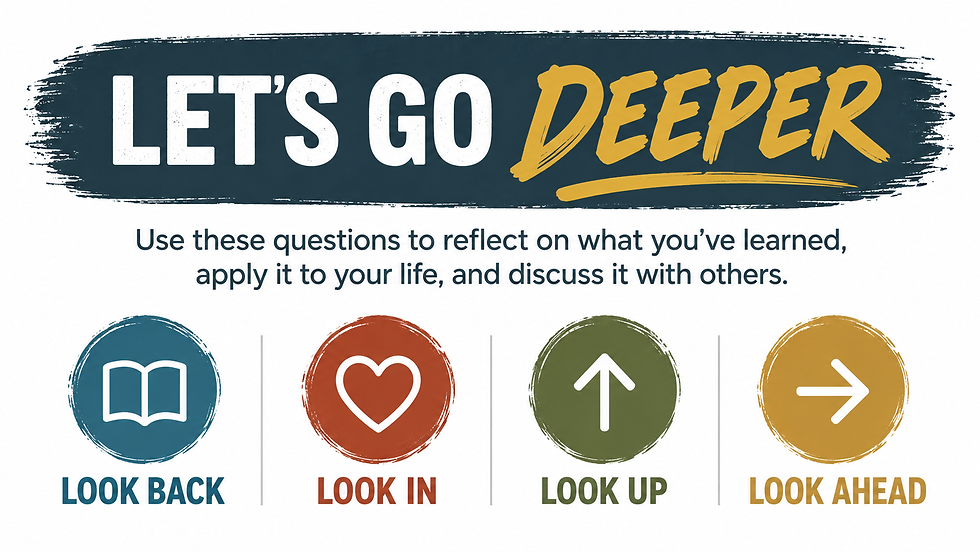
👀 LOOK BACK — WHAT DOES THE PASSAGE ACTUALLY SAY?
1. Why were some people watching Jesus so closely in the synagogue? What were they hoping He would do?
2. Why do you think Jesus asked the man to stand in front of everyone before healing him?
3. How does the Pharisees' decision to plot Jesus' death connect to the question Jesus asked in verse 4?
🪞 LOOK IN — WHAT IS HAPPENING INSIDE ME?
1. Have you ever been so determined to prove you were right that you forgot to consider how you were treating the other person?
2. Are there any church traditions, personal preferences, or unwritten rules that you sometimes treat as though they're direct commands from God?
3. Think about someone whose beliefs or lifestyle frustrate you. Do you spend more time thinking about what's wrong with them or how you might show them kindness?
⬆️ LOOK UP — WHAT DOES THIS SHOW ME ABOUT JESUS AND GOD?
1. What does Jesus' decision to heal this man reveal about God's heart for people who are hurting?
2. Why is it important that Mark describes Jesus as both angry and deeply saddened?
3. What does this passage teach us about Jesus' authority to explain the true purpose of God's commands?
➡️ LOOK AHEAD — WHAT WILL I DO WITH THIS?
1. Is there a relationship where you need to stop trying to win an argument and start listening more carefully?
2. Who is someone you could show kindness to this week, even though you disagree with them about something important?
3. What's one belief, tradition, or personal rule you might need to examine more carefully in light of Jesus' teaching?
💬 SMALL GROUP DISCUSSION STARTER
Tell us about a time when someone showed you unexpected kindness, especially when they didn't have to. What made that experience memorable?
After a few people share, connect the conversation to today's passage. What would our churches, families, and friendships look like if we became quicker to notice people who needed help?
A NOTE FOR GROUP LEADERS
This passage can easily turn into a conversation about everything people think is wrong with churches, denominations, or other Christians. Don't be surprised if someone has a story about being hurt by a religious rule or tradition. Give them room to share without immediately correcting or explaining away their experience.
At the same time, gently help the group move from criticizing other people toward examining their own hearts. Ask questions like, “What might Jesus want us to learn from that?”
You don't need to cover every question. A meaningful conversation where people feel heard and take one honest step toward following Jesus is worth far more than finishing the worksheet.
🌱 DISCIPLE-MAKER TIP: SEE THE PERSON BEFORE THE PROBLEM
Here's a simple disciple-making skill that can change the way you interact with people: Before you offer advice, ask one more question.
When someone tells you about a problem, it's tempting to jump straight into fixing it.
Maybe you've got a Bible verse ready, a great explanation, or three things they should do differently.
But people aren't projects, and helping someone follow Jesus begins with actually caring about them.
Try asking, “What's been the hardest part of that for you?” or “How are you doing with all of this?”
Then listen without planning your next speech.
Jesus didn't treat the man with the deformed hand as an argument to win. He saw a person who needed help.
We can learn a lot from that.
🤝 DON'T JUST STUDY IT — PRACTICE IT
Do one unexpected act of kindness for someone you disagree with this week.
It doesn't have to be complicated. Send an encouraging message, offer practical help, buy someone coffee, or simply take time to listen.
Don't use the kindness as a setup for correcting them afterward. Just do something good for them because Jesus has been good to you.
📌 REMEMBER THIS
You can win the argument, know the rules, and still completely miss the heart of Jesus.
📖 NEXT: MARK 3:7–19 — WHY THESE TWELVE GUYS?
Things are getting serious.
Jesus has just healed a man, and some of the religious leaders are already plotting to kill Him. You might expect Jesus to slow down, disappear for a while, or at least reconsider His approach.
But that's not what Mark shows us next.
Instead, the crowds keep growing. People are traveling from all over the region to see Jesus, hear Him teach, and experience His healing power.
And right in the middle of all that attention, Jesus does something that will shape the future of His entire mission.
He chooses twelve men to be His apostles.
But why these twelve? Were they the smartest, most educated, most impressive religious candidates available?
Not exactly.
Next time, we'll discover why Jesus chose the people He did—and what that tells us about the kind of people He still calls to follow Him today.
📺 KEEP GOING THROUGH MARK
Follow the complete Gospel of Mark Verse-by-Verse Bible Study as we work through the entire Gospel together.
New Daily Bible Podcast teachings and study guides will be added throughout our journey.
Understand the Bible | Find Christian Friends | Grow as Disciple Makers
Don't follow Jesus alone.
📺 FROM THE YJJ ARCHIVES: HAVE YOU SEEN THIS SERIES?
If you’re newer to YJJ, there’s a whole lot of older teaching you may have never discovered!
Our S.O.M.A. Series — Sermon on the Mount Alone started with a crazy question: What if you only had 18 teachings from Jesus to help you live as His disciple?
We traveled through the Canadian Rockies and northern Canada, exploring Jesus’ Sermon on the Mount against some absolutely spectacular scenery—and asking one practical question: How do we actually LIVE what Jesus taught?
There are 18 lessons waiting for you. Give the series a try!
▶️ START THE S.O.M.A. ADVENTURE: CLICK HERE
Watch the series promo 👇🏻


Comments