
Why Did Jesus Heal This Blind Man TWICE?

Study Guide: Mark 8:22-26

Have you ever been absolutely certain you understood something, only to discover later that you'd missed an important part of the picture?
Maybe it was something your parents tried to explain when you were young. At the time, you thought you understood what they meant. Years later, after a little more life experience, you suddenly realized what they had been trying to tell you all along.
Or perhaps you've had that experience while learning a new skill. Someone shows you how to do something, and you think you've got it. Then you try it yourself and discover there are a few things you still don't understand. With some practice, a little patience, and someone willing to keep teaching you, things gradually begin to make sense.
Learning doesn't always happen all at once. Sometimes we understand a little, then a little more, until something that once confused us finally becomes clear.
That's a helpful thought to keep in mind as we continue through the Gospel of Mark.
Jesus has been traveling with His disciples, teaching them, answering their questions, and showing them remarkable things. They've witnessed miracles that most people could hardly imagine, yet they're still struggling to understand what those miracles reveal about Him.
And now Mark introduces us to a blind man who meets Jesus and experiences something unusual.
His sight doesn't become clear all at once.
It's a fascinating story of healing and compassion. But when we consider where Mark places it, we may also discover something encouraging about the way Jesus treats people who are still learning to see Him clearly.
📖 TODAY'S PASSAGE
READ: Mark 8:22-26
BIG IDEA
Jesus heals a blind man in two stages, giving us a picture of how people can begin to understand Him without seeing everything clearly right away.
👀 WATCH FOR THIS
As you read, pay attention to how Jesus treats the blind man, what happens after the first touch, and what Jesus does when the man's sight is still unclear.
🎥 WATCH THE TEACHING

This study guide goes with our teaching from the Daily Bible Podcast.
You can watch the teaching first and then work through this guide, follow along while you watch, or come back afterward and use the questions to dig deeper.
SETTING THE SCENE
Jesus and His disciples have been traveling around the Sea of Galilee, teaching crowds and witnessing some remarkable events.
Jesus has recently fed thousands of hungry people for the second time. Afterward, some Pharisees, respected Jewish religious teachers, demanded another miraculous sign to prove His authority. Jesus refused their demand and left.
While crossing the lake, Jesus warned His disciples about the dangerous influence of the Pharisees and Herod. But when He mentioned yeast, the disciples thought He was talking about their shortage of bread.
Jesus was concerned that they still didn't understand what His miracles were showing them.
In Mark 8:18, He challenged them with a question about having eyes but failing to see and ears but failing to hear.
These weren't strangers who had never met Jesus. They had been traveling with Him, watching Him heal people, listening to His teaching, and seeing Him provide food for thousands.
Yet they were still struggling to understand Him.
Now Jesus and His disciples arrive at Bethsaida, a fishing town near the northern shore of the Sea of Galilee.
And Mark introduces us to someone who cannot see at all.
1. SOME FRIENDS BRING A BLIND MAN TO JESUS — Mark 8:22
When Jesus arrives in Bethsaida, some people bring a blind man to Him and beg Him to touch the man.
Mark doesn't tell us how long this man has been blind, what caused his blindness, or who brought him. They might have been friends, relatives, or concerned neighbors. We simply don't know.
But we do know that someone cared enough to bring him to Jesus.
That's worth noticing.
In the ancient world, living with blindness could be especially difficult. There were no modern eyeglasses, mobility aids, or medical treatments like those available today. Depending on his circumstances, this man may have relied heavily on others to help him travel, find work, or meet everyday needs.
We shouldn't assume he was helpless or unable to contribute to his community. Mark doesn't tell us that. But his blindness certainly presented challenges.
Now imagine being the man in this story.
You've heard people talking about Jesus. Perhaps you've heard stories about the sick being healed and people receiving help in ways nobody expected.
Then someone tells you that Jesus is nearby.
We don't know what the man was thinking or feeling, but it's easy to imagine the hope that might come with such an opportunity.
And then his companions bring him to Jesus.
What happens next is especially interesting because Jesus doesn't simply speak a command from a distance.
He takes the man by the hand.
2. JESUS TAKES HIM BY THE HAND — Mark 8:23
Try to picture this moment.
A blind man is standing before Jesus, surrounded by people who have brought him there for help.
Jesus reaches out, takes his hand, and personally leads him outside the village.
There's something wonderfully human about that detail.
The man cannot see where Jesus is taking him, so Jesus guides him. They walk together until they are away from the village.
Mark doesn't tell us why Jesus chooses this quieter setting. In another healing story, Jesus also takes a man aside from the crowd before healing him (Mark 7:33). Perhaps privacy allowed for a more personal encounter, but the text doesn't give us a definite reason.
What we can see is that Jesus gives this man His personal attention.
Jesus then puts saliva on the man's eyes and places His hands on him.
That may sound strange to modern readers. In the ancient world, saliva was sometimes associated with healing practices. People didn't have our understanding of medicine, and various substances were used in attempts to treat illness.
But Mark doesn't tell us that the saliva itself had healing power. The focus remains on Jesus and what He is doing for the man.
Then Jesus asks a question.
He wants to know whether the man can see anything.
Now that's unusual.
Jesus has healed people before without asking them to describe the results. Here, He pauses and invites the man to tell Him what he is experiencing.
It's a small detail, but one that makes this encounter feel especially personal.
Jesus isn't treating him like a problem to solve. He's interacting with a person.
And the man's answer is one of the most memorable lines in the Gospel of Mark.
3. PEOPLE LOOK LIKE TREES WALKING AROUND — Mark 8:24
The man looks up and reports that he can see people, but they look like trees walking around.
What a remarkable description!
Imagine spending your life unable to see clearly and suddenly beginning to make out shapes and movement.
You recognize that something has changed. You can see figures moving nearby, and you understand that they're people.
But everything is still blurry.
The man compares them to walking trees.
We don't know whether he had once been able to see and was remembering what trees looked like, or whether he was using a comparison familiar to him through other means. Some readers think his description suggests he once had sight, but Mark doesn't tell us.
What matters is that he can now see something, but not clearly.
And that's what makes this miracle so unusual.
Throughout Mark, Jesus has healed people with remarkable authority. A man with a damaged hand stretches it out and is healed. A woman suffering from years of bleeding touches His clothing and is restored. A deaf man receives his hearing.
But here, the healing happens in stages.
Why?
It's tempting to immediately come up with an explanation. Perhaps Jesus was testing the man's faith. Perhaps the man didn't believe strongly enough. Perhaps Jesus wanted to demonstrate something about the healing process.
But Mark doesn't say any of those things.
And there's certainly no reason to conclude that Jesus lacked the power to heal him completely.
Instead, consider where Mark places this story.
Just a few verses earlier, Jesus had asked His disciples why they had eyes but still couldn't see.
Of course, He wasn't accusing them of being physically blind. He was challenging their failure to understand what they had been witnessing.
Now Mark introduces a man whose eyes are beginning to work, but whose vision remains unclear.
Could Mark be inviting us to recognize a connection?
The disciples have seen Jesus do extraordinary things. They know He is someone remarkable. Yet they still don't understand everything His actions reveal about Him.
Like the man in Bethsaida, they're beginning to see, but the picture hasn't fully come into focus.
That doesn't mean the blind man's healing was merely an illustration. Jesus was helping a real person with a real need.
But the way Mark places this story invites us to think about both the man's physical sight and the disciples' struggle to understand.
And that brings us to the second touch.
4. JESUS HELPS HIM SEE CLEARLY — Mark 8:25
Jesus places His hands on the man's eyes again.
This time, the man's sight is completely restored. He can see everything clearly.
Pause for a moment and imagine what that experience might have been like.
A few moments earlier, the man couldn't see. Then he began recognizing shapes and movement, although everything remained blurry.
Now the people standing nearby come into focus. Their faces, their clothing, the surrounding landscape—all the details he couldn't make out before are suddenly clear.
Mark doesn't describe the man's reaction, but it's difficult not to wonder what he might have felt.
Relief? Amazement? Joy? Perhaps all three.
What Mark does tell us is that Jesus completed the healing.
And this is where I find myself thinking again about the disciples.
Remember the conversation in the boat?
Jesus had asked some pretty direct questions. He challenged them for failing to understand, questioned whether their hearts were hard, and reminded them of the feeding miracles they had witnessed.
Those questions must have been uncomfortable.
We don't know how the disciples felt afterward, but imagine being one of them. You've left your ordinary life to follow Jesus. You've watched Him do things you can barely explain. You genuinely want to understand Him, yet you keep getting things wrong.
Then, not long afterward, you watch Jesus take a blind man by the hand.
You see the man's vision begin to improve, but it isn't clear yet.
And what does Jesus do?
He helps him again.
I wonder whether the disciples noticed that.
Could this healing have offered them a picture of the patience Jesus was showing them, too?
Mark doesn't record Jesus explaining the miracle that way, so we shouldn't claim to know what He intended the disciples to think.
But it's a beautiful possibility to consider, especially when we remember how patiently Jesus has continued teaching them despite their confusion.
He didn't abandon the disciples because they hadn't understood everything.
He kept walking with them, asking questions, correcting their misunderstandings, and helping them learn.
And here, with this blind man, we see Jesus bringing someone from darkness to partial sight and finally to clear vision.
Perhaps there's something encouraging in that for anyone who is still trying to understand Jesus.
5. A QUIET ENDING — Mark 8:26
After healing the man, Jesus sends him home and tells him not to go back into the village.
That's a surprisingly quiet ending to such an extraordinary miracle.
There is no recorded celebration, no crowd rushing forward, and no speech from the man describing what happened.
Mark simply tells us that Jesus restored his sight and sent him home.
Why did Jesus tell him not to return to the village?
We don't know.
Jesus has sometimes healed people away from crowds, and at other times He has instructed people not to spread news about His miracles. This may be connected to that pattern, but Mark doesn't explain His reason here.
What we do know is that the man who was brought to Jesus unable to see is now able to see clearly.
Think about how the story began.
Other people brought him to Jesus and begged for help.
Jesus took him by the hand, led him away, and personally cared for him.
The man began to see, but his vision wasn't clear.
Jesus touched him again, and his sight was fully restored.
It's a simple story, but there's a great deal of tenderness in it.
And when we remember the conversation that took place in the boat just before this encounter, the timing becomes especially meaningful.
🔎 DON'T MISS THIS: THE CONNECTION BETWEEN THE BOAT AND THE BLIND MAN
One of the most interesting things about this story is where Mark places it.
In the boat, Jesus asks His disciples why they have eyes but still cannot see and why they haven't understood what He's been showing them.
Then, almost immediately, Mark tells us about a man who literally cannot see.
And unlike other healings we've encountered, this man's sight comes into focus gradually.
That arrangement is probably not accidental.
Mark frequently places stories beside one another in ways that help us understand them more deeply.
Here, the disciples' struggle to understand Jesus sits right beside a story about someone moving from blindness to clear sight.
The connection doesn't require us to turn every part of the miracle into a symbol. We don't need to decide what the saliva represents, why Jesus used exactly two touches, or whether every movement has a hidden meaning.
The simple connection is powerful enough.
Sometimes seeing something is not the same as seeing it clearly.
And perhaps just as important, Jesus doesn't stop helping the man when his vision is only partly restored.
It's worth considering whether that tells us something about His continued patience with the disciples.
THE BIGGER LESSON
The more I think about this passage, the more I appreciate both the compassion of Jesus and the way Mark tells the story.
Jesus meets a man with a real physical need. He takes him by the hand, gives him personal attention, and restores his sight.
That's already a wonderful picture of who Jesus is.
But when we remember what just happened in the boat, there's another layer worth considering.
The disciples had been struggling to understand Jesus. They had witnessed His miracles, but they still weren't seeing the whole picture.
Jesus challenged them about that. His questions were direct, and He clearly wanted them to understand more than they did.
Yet He continued traveling with them and teaching them.
Then comes this healing, where a man begins to see but needs further help before everything becomes clear.
We can't know exactly what the disciples thought as they watched. But perhaps Mark wants readers like us to notice something about the way Jesus works with people who aren't seeing clearly yet.
WHO IS JESUS?
Jesus is someone who notices people in need and responds with compassion.
He doesn't treat the blind man as an inconvenience. He takes time to guide him, listen to his answer, and restore his sight.
And in His relationship with the disciples, we see someone who keeps teaching people even when they're slow to understand.
WHAT DOES IT ACTUALLY MEAN TO FOLLOW HIM?
If the disciples could spend so much time with Jesus and still misunderstand Him, we shouldn't be surprised when we struggle to understand Him too.
That's encouraging, but it's also a warning against assuming we've already figured Him out.
Following Jesus means remaining willing to learn. It means listening carefully, asking honest questions, and allowing Scripture to challenge ideas we may have held for years.
We may not see everything clearly today, but we can keep looking to Jesus and learning from Him.
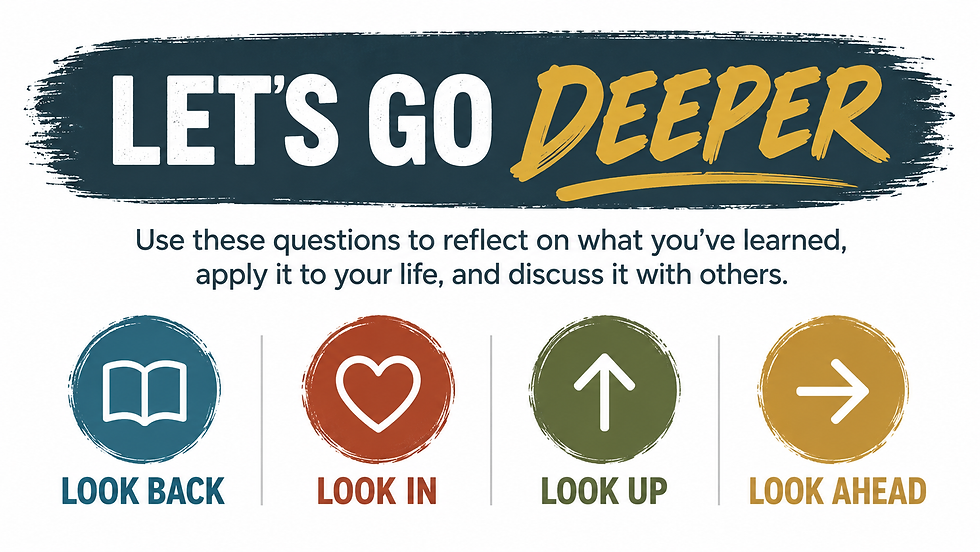
👀 LOOK BACK — WHAT DOES THE PASSAGE ACTUALLY SAY?
Who brought the blind man to Jesus, and what did they ask Jesus to do?
What did Jesus do before beginning to heal the man? What does Mark tell us about their interaction?
How did the man's sight change between Jesus' first touch and His second touch?
🪞 LOOK IN — WHAT IS HAPPENING INSIDE ME?
Can you remember something about Jesus or the Bible that you understand much better today than you did a few years ago? What helped you see it differently?
When you discover that you've misunderstood something, is your first response usually curiosity, embarrassment, or defensiveness?
Is there an area of your life where you're still trying to understand what following Jesus should look like?
⬆️ LOOK UP — WHAT DOES THIS SHOW ME ABOUT JESUS AND GOD?
What do you notice about the way Jesus treats the blind man throughout this encounter?
What might the way Jesus completes the man's healing help us appreciate about His character?
How does Jesus' continued patience with His disciples help us understand the way He teaches people?
➡️ LOOK AHEAD — WHAT WILL I DO WITH THIS?
What's one question about Jesus or His teaching that you'd like to explore more carefully in Scripture this week?
Who in your life might need someone patient enough to help them learn without making them feel foolish for asking questions?
What's one practical way you could become a more patient listener when someone doesn't understand something as quickly as you do?
💬 SMALL GROUP DISCUSSION STARTER
Tell us about something you understand today that you didn't understand very well when you were younger.
It could be something your parents taught you, a lesson you learned at work, a skill that took practice, or something you discovered about relationships.
What helped it finally make sense?
Give everyone a chance to share a story. Then connect those experiences to the disciples, who had been traveling with Jesus but still had a great deal to learn.
The goal isn't to suggest that understanding Jesus is exactly like learning a new skill. It's simply to recognize that learning often takes time, and patient teachers can make a tremendous difference.
A NOTE FOR GROUP LEADERS
This is a good passage for creating an atmosphere where people feel comfortable admitting they don't understand something.
When someone asks a question, resist the urge to immediately supply an answer. Ask what they're noticing in the passage, invite others to share their thoughts, and take time to look at the text together.
You don't need to finish every question. A thoughtful conversation about one important detail may be more valuable than rushing through the entire guide.
If someone shares an experience of feeling embarrassed or discouraged while learning, listen carefully. Help the group become a place where people can ask honest questions without feeling judged.
🌱 DISCIPLE-MAKER TIP: BE PATIENT WITH PEOPLE WHO ARE STILL LEARNING
Think about someone who helped you learn something difficult.
Chances are, what made that person a good teacher wasn't simply how much they knew. It was their willingness to explain things, answer questions, and give you time to understand.
That's a useful example to remember when helping someone follow Jesus.
If a friend is confused about something in Scripture, don't make them feel like they should already know the answer.
Read the passage together. Ask what they notice. Explain what you understand, but be willing to admit when you're still learning too.
And don't assume that one conversation has to settle everything.
Sometimes the most helpful thing you can do is say, "That's a good question. Let's keep looking at it together."
Patient, ongoing conversations can help people grow far more than a quick answer followed by silence.
🤝 DON'T JUST STUDY IT — PRACTICE IT
This week, reach out to someone you've had a Bible conversation with before.
Ask whether they've had any new questions or thoughts since you last talked.
If something is still unclear, offer to read the relevant passage together rather than immediately explaining your answer.
Give them room to think, ask questions, and discover something for themselves.
You don't need to solve every question in one conversation. Just be someone who's willing to keep learning alongside them.
📌 REMEMBER THIS
You don't have to see everything clearly to keep following Jesus. Just keep looking to Him.
📖 NEXT: MARK 8:27–30 — WHO DO YOU SAY JESUS IS?
Today we watched Jesus restore a blind man's sight in two stages.
At first, the man could see people, but they looked like trees walking around. After Jesus touched his eyes again, everything came into focus.
That story comes immediately after Jesus challenged His disciples for failing to understand what His miracles revealed about Him.
Now the story continues, and Jesus asks His disciples a question that brings their understanding into the open.
He's been traveling with them, teaching them, and showing them extraordinary things.
They've heard what other people are saying about Him.
But what do they believe?
In our next lesson, Jesus will ask them a question that every follower of Jesus eventually needs to consider:
Who do you say I am?
📺 KEEP GOING THROUGH MARK
Follow the complete Gospel of Mark Verse-by-Verse Bible Study as we work through the entire Gospel together.
New Daily Bible Podcast teachings and study guides will be added throughout our journey.
Understand the Bible | Find Christian Friends | Grow as Disciple Makers
Don't follow Jesus alone.
🛶 Apparently, I'm No Better at Rowing Than the Disciples!
Reading the story in Mark 6 about the disciples struggling to row their boat against the wind reminded me of another boating disaster.
The time Kaila discovered that her husband apparently had no idea how to paddle a canoe. 😂
Turns out, knowing which end of the paddle goes in the water doesn't automatically make you a skilled outdoorsman.
If you mostly know us from the Daily Bible Podcast, here's your chance to see a different side of our lives!
Come along with Kaila and me on a 7-day canoe adventure through Minnesota's beautiful Boundary Waters, where we enjoyed incredible scenery, wildlife, good friends, plenty of laughs, and a few lessons in humility.
It's a fun glimpse into what we do when we're not teaching the Bible. And trust me, you'll want to stick around for the hilarious outtakes at the end!
🎬 Come take an adventure with us!


Comments