
You Can’t Just Add Jesus to Your Life: Mark 2:18–22

Study Guide: Mark 2:18-22
If you’re here in this study guide, I’m going to assume you’re serious enough about Jesus to handle a little tough love and straight talk.
You can fill your life with Christian things and still never make room to actually follow Jesus.
You can add church on Sunday. Add a Bible study. Add prayer in the morning. Add a small group. Add Christian music in the truck. Add serving, giving, volunteering, and a dozen other good things. Before long, you can be doing more “Jesus stuff” than ever while feeling more exhausted than ever.
Maybe the problem isn’t that you need to try harder.
Maybe something needs to go.
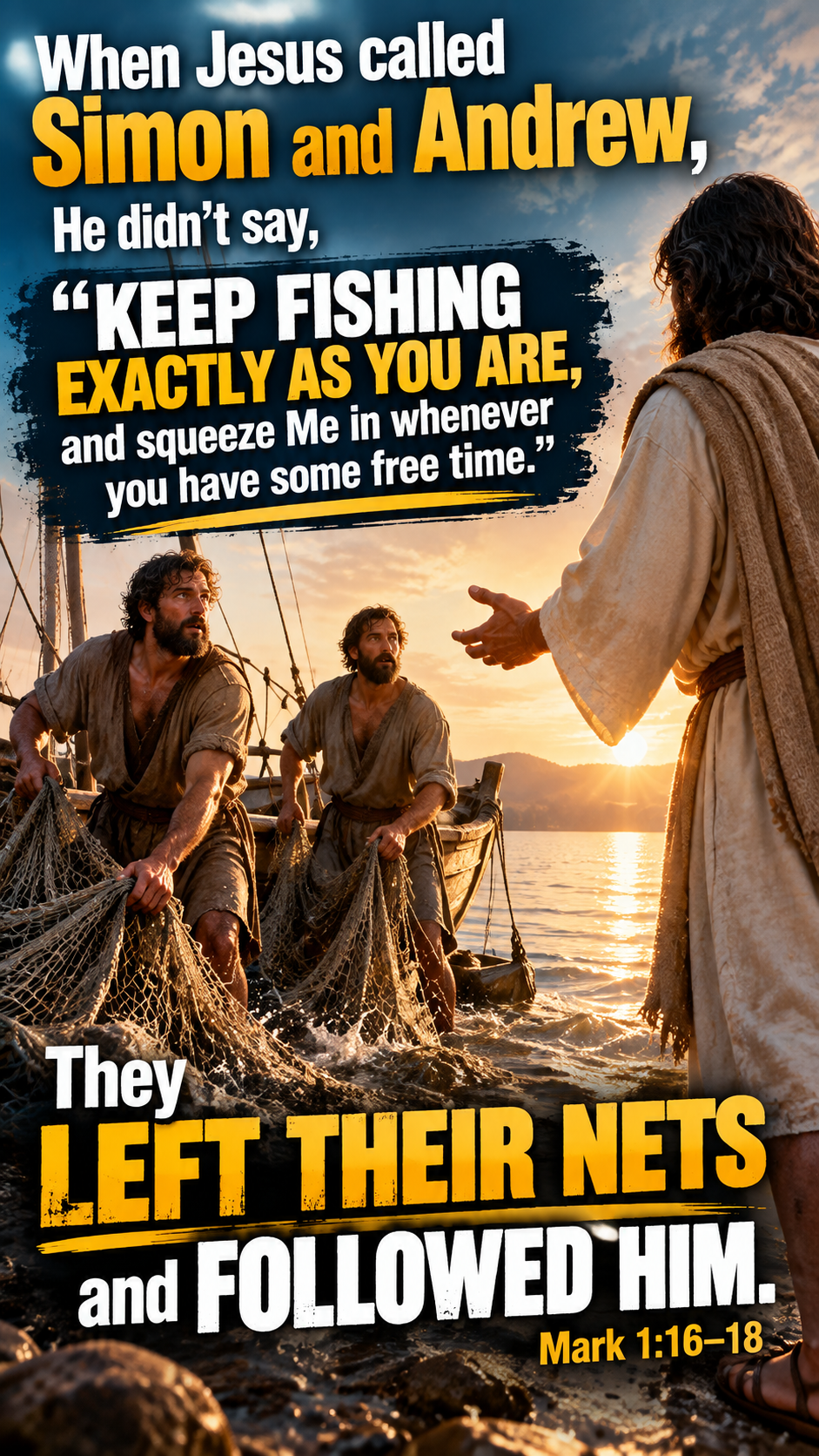
When Jesus called Simon and Andrew, He didn’t say, “Keep fishing exactly as you are, and squeeze Me in whenever you have some free time.” They left their nets and followed Him (Mark 1:16–18).
That’s uncomfortable because you may be asking Jesus to fit into a life already packed with your job, projects, hobbies, commitments, relationships, possessions, plans, and expectations. Then when everything starts pulling apart, Jesus can feel like the new thing that doesn’t fit.
Today Jesus gives us a torn coat and a bursting wineskin—and maybe a much-needed invitation to take inventory of what you’re still trying to carry.
That’s exactly where Mark 2 takes us today.
📖 TODAY'S PASSAGE
READ: Mark 2:18-22
BIG IDEA
Jesus didn’t come merely to be added onto the life you already have. His arrival changes everything, and following Him means allowing Jesus to reshape what stays, what changes, and what you may need to leave behind.
👀 WATCH FOR THIS
As you read, notice that Jesus doesn’t give His disciples a new list of religious rules. Instead, He gives three pictures that all make the same basic point: something has changed because He is here.
🎥 WATCH THE TEACHING
This study guide goes with our teaching from the Daily Bible Podcast.
You can watch the teaching first and then work through this guide, follow along while you watch, or come back afterward and use the questions to dig deeper.
SETTING THE SCENE
Mark has been showing us what happens when Jesus doesn’t fit neatly into people’s expectations.
Jesus forgives a paralyzed man’s sins and then heals him (Mark 2:1–12). Next, He calls Levi, a tax collector, to follow Him and sits down for dinner with people the religious crowd considered sinners (Mark 2:13–17). Now another question comes up: Why aren’t Jesus’ disciples fasting like John’s disciples and the Pharisees?
That’s actually a fair question. Fasting wasn’t bad. It was a recognized part of Jewish spiritual life, often connected with repentance, mourning, or seeking God. Jesus Himself fasted, and elsewhere He taught His followers about fasting (Matthew 4:2; 6:16–18).
So the issue isn’t that everyone else is doing something terrible. The question is why Jesus and His disciples seem to be doing something different.
His answer begins with a wedding.
1. YOU DON’T MOURN AT A WEDDING — Mark 2:18–20
Jesus asks how wedding guests can fast while the bridegroom is with them. We don’t really use the word bridegroom anymore—we just call him the groom. Jesus is basically saying, Look at the occasion. The groom is here!
Fasting could express sorrow, repentance, or longing for God. But a wedding was a celebration. Imagine walking into a wedding reception, sitting beside the cake, and announcing that you’re going to mourn all evening. There’s nothing wrong with mourning; you’ve simply picked a strange time to do it.
But there’s something much bigger happening here. Jesus calls Himself the groom.
That should get our attention because the Old Testament repeatedly uses marriage language to describe God’s relationship with His people:
Isaiah 54:5 (NLT):
“For your Creator will be your husband; the LORD of Heaven’s Armies is his name! He is your Redeemer, the Holy One of Israel, the God of all the earth.”
Isaiah 62:4–5 (NLT):
“Never again will you be called ‘The Forsaken City’ or ‘The Desolate Land.’ Your new name will be ‘The City of God’s Delight’ and ‘The Bride of God,’ for the LORD delights in you and will claim you as his bride. Your children will commit themselves to you, O Jerusalem, just as a young man commits himself to his bride. Then God will rejoice over you as a bridegroom rejoices over his bride.”
Hosea 2:19–20 (NLT):
“I will make you my wife forever, showing you righteousness and justice, unfailing love and compassion. I will be faithful to you and make you mine, and you will finally know me as the LORD.”
We shouldn’t assume everyone standing there immediately understood everything Jesus was implying about His identity. But Mark’s readers have good reason to stop and think.
God is pictured as the husband or groom of His people—and now Jesus places Himself in the groom’s position.
Once again, Mark is pushing us toward his biggest question:
Who is this man?
Then Jesus suddenly adds a darker note: the groom will someday be “taken away from them” (Mark 2:20 NLT). That appears to point ahead toward His coming death. There will be a time for His followers to mourn and fast.
But right now, Jesus’ point is simple:
The Groom is here. His presence changes the moment.
2. JESUS ISN’T A PATCH FOR YOUR OLD LIFE — Mark 2:21
Jesus moves from a wedding to somebody doing a really bad sewing repair.
If you sew a piece of new, unshrunk cloth onto an old garment, the new cloth can shrink and pull against the old material, making the tear worse. Jesus isn’t giving clothing advice. He’s showing what happens when you try to attach something new to something that cannot accommodate it.
This doesn’t mean everything old is bad. Jesus isn’t throwing away the Old Testament or declaring Jewish faith useless. He is standing inside Israel’s story and announcing that God’s long-awaited Kingdom is arriving through Him.
But you cannot simply patch Jesus onto everything else and carry on as usual.
His first disciples are already discovering this. Simon and Andrew couldn’t keep fishing exactly as before while simultaneously following Jesus wherever He went. Levi couldn’t remain sitting at his tax booth while following Jesus down the road. Jesus has touched someone considered unclean, forgiven sins, eaten with sinners, and challenged familiar religious expectations.
He hasn’t explained everything discipleship will eventually require. They have a lot left to learn.
But they’re getting clues.
Following Jesus will not mean your old life plus some Jesus stuff.
3. NEW WINE NEEDS ROOM — Mark 2:22
Jesus’ final picture would have made immediate practical sense in His world. New wine continued fermenting, producing pressure. Fresh wineskins could flex as that happened, while old, brittle skins could eventually split. Then you lost both the wine and the container.
Again, Jesus isn’t saying, “New things are good; old things are bad.”
He’s saying that something new is happening that cannot simply be squeezed into every old container.
And the new thing isn’t primarily a new worship style, religious program, church structure, or fasting schedule.
The new thing is Jesus.
That matters because Christians can sometimes use this passage to justify whatever new idea they happen to like. But Jesus isn’t preaching innovation for innovation’s sake. He’s answering a question about why His disciples are behaving differently.
The answer is that He is here.
Following Jesus means letting Him call the shots—even when that’s different from what you expected or how you’ve always done things.
That can be uncomfortable, because eventually something may have to give.
4. MAYBE YOU’RE CARRYING TOO MUCH — Mark 2:21–22
Here’s where this can get painfully practical.
Suppose Simon and Andrew had dropped their nets when Jesus called—but picked them back up every morning.
They fish before sunrise, hurry off to find Jesus, listen to Him teach, race back to repair the boat, return for another lesson, run to the market to sell the catch, skip dinner because they’re behind, then head back onto the lake for the evening fishing.
They’re trying to run the family business and follow Jesus wherever He goes.
How long before they’re exhausted?
How long before their families are frustrated, the business is suffering, they’re constantly late, and they’re not fully present anywhere?
Eventually something has to give.
And here’s the danger: when your life is already packed and you add Jesus on top, following Jesus can start feeling like the problem.
Bible study is another obligation.
Christian community is another meeting.
Serving is another demand.
Time with Jesus is another thing you’re failing to accomplish.
So when the wineskin feels ready to burst, you start cutting back on the “new stuff.”
But what if you’re cutting the wrong thing?
🔎 DON’T MISS THIS: WHAT IF SOMETHING ELSE NEEDS TO GO?
Jesus once gave an invitation that sounds almost strange when compared with the exhausted version of Christianity many people experience:
“Come to me, all of you who are weary and carry heavy burdens, and I will give you rest.” — Matthew 11:28 NLT
He goes on to describe His yoke as easy to bear and His burden as light (Matthew 11:29–30).
That doesn’t mean following Jesus will always be comfortable. Mark will eventually show us that discipleship involves sacrifice, suffering, taking up a cross, and surrender. Jesus is certainly not promising an easy life.
But there’s an important difference between the cost of following Jesus and the exhaustion of trying to follow Jesus while refusing to put anything else down.
Maybe you’re not tired because Jesus is asking too much.
Maybe you’re tired because you’re still carrying things He never asked you to carry.
A job.
A project.
A lifestyle.
A financial commitment.
A hobby.
A relationship.
An expectation.
An overloaded calendar.
A version of success you’ve spent years chasing.
Not every busy season means you’re outside God’s will, and this passage doesn’t give us permission to abandon responsibilities whenever life gets hard. But it does give you permission to ask a hard question:
What am I trying to carry while following Jesus that may be keeping me from actually following Him?
THE BIGGER LESSON
Mark 2:18–22 isn’t primarily a lesson about managing your calendar. It’s about Jesus.
The Bridegroom has arrived. That changes things.
Jesus hasn’t yet handed these disciples a complete description of what following Him will require. Mark is letting them discover it as they go. But they already know this much: Jesus isn’t going to fit neatly into their old lives.
WHO IS JESUS?
He isn’t merely another religious teacher offering a few improvements. Jesus places Himself at the center of the picture. His presence is what changes the situation.
WHAT DOES IT ACTUALLY MEAN TO FOLLOW HIM?
It means more than adding Christian activities to a life that remains fundamentally under your control.
At some point, following requires leaving.
The question is not whether you should quit your job, sell your possessions, drop every hobby, or abandon legitimate responsibilities. Jesus didn’t give everyone the identical instructions He gave Simon and Andrew.
The question is more personal—and probably more uncomfortable:
What are you holding onto that makes it harder for you to go where Jesus is leading?
Maybe it’s time for a net-dropping inventory.
Not, “How can I squeeze more Jesus into my life?”
But, “What needs to leave so I can faithfully follow Jesus without running myself ragged?”
🥅 THE NET-DROPPING INVENTORY
Here’s a simple test: If following Jesus feels like one more thing piled onto an already overloaded life, don’t automatically assume Jesus is the thing you don’t have time for. Maybe you’re still carrying some nets He’s asking you to put down.
Take a hard look at your career, friendships, hobbies, habits, diet, sleep, exercise, entertainment, spending, possessions, projects, passions, goals, and dreams. None of those things are automatically bad. The question is whether they’re helping you faithfully follow Jesus—or competing with Him.
Run each one through a few straight-talk questions:
Does this help me follow Jesus, or regularly pull me away from Him? Jesus said, “Seek the Kingdom of God above all else” (Matthew 6:33 NLT).
Is this controlling me? Paul said, “I must not become a slave to anything” (1 Corinthians 6:12 NLT). That can include your phone, food, work, money, entertainment, hobbies—or even something everyone else thinks is perfectly respectable.
Is this eating time, money, or energy that belongs somewhere more important? Ephesians 5:15–16 tells us to live carefully and make the most of every opportunity.
Is my body paying the bill for the life I’m trying to maintain? Lack of sleep, terrible eating, no movement, constant stress, and running on fumes eventually collect their payment. Your body belongs to God too (1 Corinthians 6:19–20).
Would I be willing to put this down if Jesus asked me to? That may be the toughest test. Jesus told Simon and Andrew, “Come, follow me”—and “they left their nets at once and followed him” (Mark 1:17–18 NLT).
Am I exhausted because following Jesus is hard—or because I’m trying to follow Jesus while dragging my old life behind me? Jesus invites the weary and burdened to come to Him and promises rest (Matthew 11:28–30).
Don’t quit your job, dump your friends, sell the bass boat, and throw away the Oreos because you read a Bible study.
Do take an honest inventory.
Put everything on the table and ask:
Jesus, what belongs in the life You’re leading me into—and what net do I need to finally drop?

👀 LOOK BACK — WHAT DOES THE PASSAGE ACTUALLY SAY?
What question causes Jesus to tell the stories about the wedding, the patch, and the wineskins?
What do all three pictures have in common? What has changed that makes the old response no longer fit the present situation?
Why is the Bridegroom more important to understanding this passage than the fasting question itself?
🪞 LOOK IN — WHAT IS HAPPENING INSIDE ME?
When you first started following Jesus, did you think mostly about changing your life or simply adding Christian things to it?
Where does your life currently feel overloaded, hurried, or stretched thin? Could part of the problem be that you’re trying to follow Jesus without letting go of something else?
What is hardest for you to imagine putting down—your plans, career, money, possessions, relationships, hobbies, reputation, comfort, or something else?
⬆️ LOOK UP — WHAT DOES THIS SHOW ME ABOUT JESUS AND GOD?
What does Jesus calling Himself the Bridegroom suggest about how important His arrival is?
What do Jesus’ actions so far in Mark—calling fishermen, touching the unclean, forgiving sins, and eating with sinners—show you about the kind of Messiah He is?
➡️ LOOK AHEAD — WHAT WILL I DO WITH THIS?
If you took a completely honest net-dropping inventory of your life, what is one thing you would seriously ask Jesus whether you need to reduce, change, or leave behind?
What would following Jesus more faithfully look like if your first move wasn’t adding something new, but making room?
Is there something you already suspect Jesus has been asking you to release? What concrete step could you take this week?
💬 SMALL GROUP DISCUSSION STARTER
Tell about a season when you finally let something go and realized afterward how much time, energy, or attention it had been taking from you.
A NOTE FOR GROUP LEADERS
This discussion could move into some pretty personal territory, so don’t rush to tell people what they should quit. Your job isn’t to decide which job, hobby, relationship, or commitment someone needs to drop.
Ask follow-up questions and help people listen to Jesus.
Healthy silence is okay. You also don’t need to finish every question.
If one honest conversation helps someone recognize what has been running them ragged, stay there. People matter more than completing the worksheet.
🌱 DISCIPLE-MAKER TIP: DON’T DECIDE FOR THEM
When someone tells you they’re overwhelmed, it’s tempting to immediately diagnose the problem: “You need to quit that,” “You need to say no,” or “Here’s what I would do.”
Try asking questions instead.
“What’s taking most of your energy right now?”
“What do you think Jesus may be asking you to do?”
“Is there anything you already know needs to change?”
Good disciple makers don’t make people dependent on their advice.
They help people learn to listen to Jesus, understand Scripture, and take faithful next steps themselves.
🤝 DON'T JUST STUDY IT — PRACTICE IT
Take 15 quiet minutes today and make a simple “net-dropping inventory.”
Write down the major things consuming your time, attention, money, and emotional energy.
Don’t immediately quit anything. Instead, pray over the list and ask:
“Jesus, is there anything here I’m holding onto that is keeping me from following You faithfully?”
Then be willing to listen.
📌 REMEMBER THIS
You can’t follow Jesus somewhere new while refusing to leave anything behind.
📖 NEXT: MARK 2:23–28 — WHEN RELIGION MISSES THE POINT
Jesus has just challenged expectations about fasting. Next, another familiar religious practice becomes the center of controversy: the Sabbath.
Jesus’ disciples walk through a grainfield and pick heads of grain to eat. The Pharisees immediately want to know why they’re doing something they believe is unlawful on the Sabbath.
But Jesus’ answer will take the conversation somewhere much bigger than a handful of grain.
If the Sabbath came from God, who gets to decide what the Sabbath is actually for?
And what does Jesus mean when He makes the stunning claim that “the Son of Man is Lord, even over the Sabbath”?
📺 KEEP GOING THROUGH MARK
Follow the complete Gospel of Mark Verse-by-Verse Bible Study as we work through the entire Gospel together.
New Daily Bible Podcast teachings and study guides will be added throughout our journey.
Understand the Bible | Find Christian Friends | Grow as Disciple Makers
Don't follow Jesus alone.
📺 FROM THE YJJ ARCHIVES: HAVE YOU SEEN THIS SERIES?
If you’re newer to YJJ, there’s a whole lot of older teaching you may have never discovered!
Our S.O.M.A. Series — Sermon on the Mount Alone started with a crazy question: What if you only had 18 teachings from Jesus to help you live as His disciple?
We traveled through the Canadian Rockies and northern Canada, exploring Jesus’ Sermon on the Mount against some absolutely spectacular scenery—and asking one practical question: How do we actually LIVE what Jesus taught?
There are 18 lessons waiting for you. Give the series a try!
▶️ START THE S.O.M.A. ADVENTURE: CLICK HERE
Watch the series promo 👇🏻


This is a good one!