
Ezra & The Truth About Corporate Sin: Study Guide

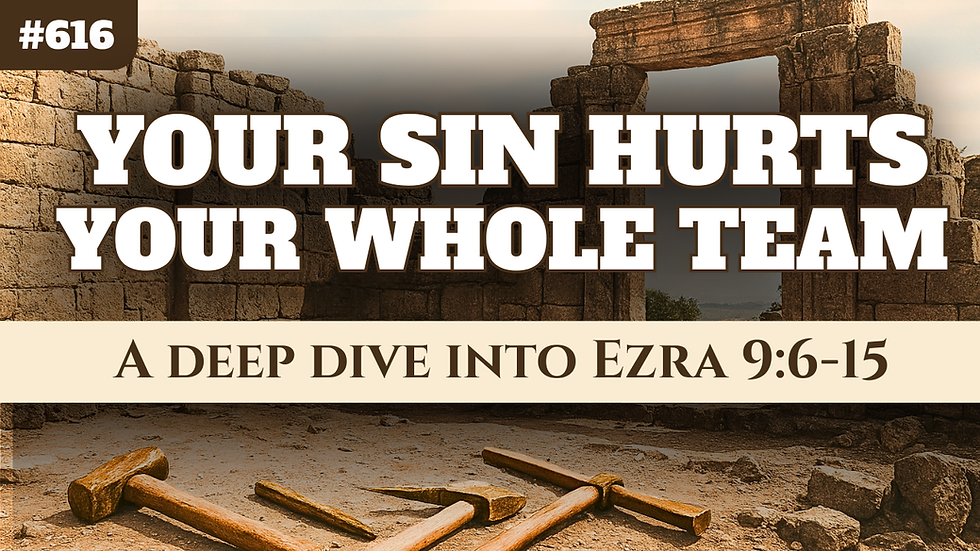
Ezra Chapter 9, verses 6-15
Ezra's confession shows why corporate accountability is key to spiritual revival.

Do you ever feel a deep spiritual exhaustion—a weariness from watching the same cycles of brokenness and failure in your own life and in the world around you? It’s easy to look at the news, or even the people in our churches, and just point the finger, sighing, "If only they would change." We're trained by modern Western culture to see sin as a private problem: "It’s my mess, and their mess is their mess."
But the Bible introduces a radical, challenging idea: Team Guilt.
The truest path to spiritual revival begins not by blaming others but by humbly looking inward and owning our part in the collective sin and dishonor brought to God’s name. This is exactly what we see in the profound, raw prayer of the priest, Ezra. He models a powerful truth: genuine repentance recognizes the collective brokenness and owns it, rather than isolating and accusing.
Before you dig into the story, I would encourage you to read through the passage in two different bible translations from this list: NIV, NLT, NASB, ESV, NKJV
Learn more about our exciting out-of-the-box ministry here
Setting the Scene: Ezra 9:6-15

Ezra's prayer is an emotional explosion, not a neat, theological statement. To understand its power, we have to look at the pressure cooker he was in.
The Context: A Remnant's Failure
The setting is Jerusalem, sometime after 538 BC. The people of Judah have been in exile in Babylon for decades due to their rampant unfaithfulness. God, showing incredible mercy, allowed a small "remnant" to return to the promised land to rebuild the Temple and their spiritual lives.
Ezra, a dedicated priest and scribe, arrives with a later group of exiles. He expects a purified people, sobered by exile and devoted to the Law of Moses. Instead, he discovers a devastating betrayal: the people, including the priests and Levites, have been intermarrying with the pagan nations surrounding them.
Why Was Intermarriage Such a Big Deal?
For the original Israelite audience, this was more than a bad dating choice; it was an act of treason that threatened to destroy their identity.
Covenant Betrayal: God had explicitly forbidden intermarriage (Deuteronomy 7:3-4). The concern wasn't race but faith. Marrying into pagan groups inevitably led to adopting their idolatry and breaking the covenant. This very sin is what led to the Babylonian exile in the first place!
Visceral Reaction: When Ezra hears the news, he tears his garments, pulls hair from his head and beard, and sits appalled. This isn’t a gentle frown; it's a visceral, cultural display of utter shock and devastation—as if he’s mourning a death or a great public catastrophe.
The "We" Prayer: His prayer (verses 6-15) is the heart of the matter. Ezra, who may not have personally committed this specific sin of intermarriage, fully identifies with the people's guilt. He doesn't say, "O God, they sinned." He uses communal language: "O my God, I am ashamed and blush to lift up my face to you, my God, for our iniquities have risen higher than our heads..." (v. 6). Ezra models the radical truth that we are not spiritual islands.
The Clash: Why "Team Guilt" Feels So Alien
The central struggle for a modern believer is moving from an individualistic worldview—where faith is private and personal—to the Biblical Shared Life of the Church. This shift is difficult because the two worldviews operate on opposite foundations.
1. The Myth of Personal-Only Guilt
The modern person is taught that guilt is strictly a matter of personal action. Therefore, we resist the idea of confessing or grieving over the sins of our community, nation, or even the church's past. Why apologize for things I didn't personally do? This feels illogical and unfair, as it violates the principle of personal culpability. Yet, the biblical model often starts with Ezra's alien-sounding confession: "we have sinned."
2. Loss of Privacy and Autonomy
In the West, self-sufficiency is a core value, and privacy is a fundamental right. Biblical corporate accountability often involves mutual confession, warning, and correction (Matthew 18:15-17; James 5:16). The individualistic believer sees this as an invasion of personal boundaries rather than a necessary part of a healthy, supportive spiritual family.
3. Resistance to Community Authority
The independent mindset views any external authority (especially non-governmental) with suspicion. The biblical call to "obey your leaders and submit to their authority" (Hebrews 13:17) directly challenges the modern pursuit of absolute self-governance. The default response becomes, "It's my life, and I'll make my own decisions," rather than submitting to the wisdom of the collective body.
4. Sacrificing Comfort for Corporate Good
Individualism creates a "consumer" mentality in church: if a service or small group isn't meeting my needs, I leave. The biblical, corporate idea of the Church demands the opposite: staying, serving, and sacrificing for the good of the whole body (Philippians 2:3–4). This requires setting aside personal preference for a "contributor" mentality.
Questions to Chew on and Discuss:
This passage challenges the individualistic mindset we carry. Use these questions to process the biblical call to corporate confession.
In what specific ways do you tend to point the finger at "the culture" or "other people" rather than humbly seeing the reflection of that brokenness in your own heart and community?
Ezra makes no excuses; he appeals only to God’s mercy. What keeps you from offering God that same raw, complete confession for your own sins and the sins of your culture?
The text describes the people's iniquities as "risen higher than our heads" (v. 6). What current cultural or personal sins do you feel are so pervasive they threaten to overwhelm God’s people today?
Journey Group Discussion Starter
The struggle for a modern believer is moving from an individualistic worldview to the Biblical Team Identity of the Church.
Starter Question: Think about a time when you saw an injustice or an instance of cultural brokenness (e.g., apathy, divisiveness, materialism) and your first thought was, "Someone needs to fix that." Share what that situation was. Now, reflecting on Ezra's example of corporate confession, how might you reframe that issue by asking, "What is my responsibility, or my community's responsibility, in contributing to this or in seeking forgiveness for it?"
Applying It Today: The New Spiritual Family Bond
It's simple: once you trust Christ, your faith is personal, but your life becomes communal. You are adopted into a new family, the Church.
The Bible compares the Church to a body. The Apostle Paul explained this shared connection: "If one part suffers, all the parts suffer with it, and if one part is honored, all the parts share its joy." (1 Corinthians 12:26, NLT).
Your actions—good or bad—don't just affect you. They impact the entire Church family. If you do something helpful or holy, the whole group is strengthened and honored. If you struggle or sin, the whole group suffers alongside you. This shared connection and responsibility is the Shared Life and Identity the New Testament describes.
Your Next Step
Ezra's prayer models a heart that is truly broken over sin. Acknowledge that the first step toward change is not personal activism but communal repentance.
Consider what God is guiding you to do in response to what you've learned. Is he prompting you to Pray for a deeper sorrow over the collective sins of your community? Is he asking you to Forgive someone whose sin against you is hindering your own confession? Is he challenging you to Connect with a spiritual mentor who can guide you in this journey of humility? Take one immediate, specific step today toward owning your part in the collective brokenness and appealing to God's mercy.
Ready to find others to help you stand firm against the pressures of the world?
Join a Journey group and walk alongside others committed to building a life of radical devotion! You can learn more about how to connect with a small group at this link: https://www.yourjesusjourney.com/journeygroups
BE SURE TO WATCH THE VIDEO PODCAST THAT GOES WITH THIS STUDY GUIDE
See viewer comments and questions on screen at the end of the podcast.

🎧 Listen on Apple Podcasts: https://podcasts.apple.com/us/podcast/the-daily-bible-podcast-with-pastor-thad/id1838217398
🎧 Listen on Spotify: https://open.spotify.com/show/6NA8lvRahCOhBNTxWaI16Q
🎧 Listen on Amazon Music: https://music.amazon.com/podcasts/2a5a9f7e-e5b3-4fd6-a523-20da6910774a
🎧 Listen on PodBean: https://www.podbean.com/pw/pbblog-xbsb7-1450dee
MORE RESOURCES TO HELP YOU GROW AS A CHRISTIAN
Your Jesus Journey is an independent, non-denominational Christian ministry. We're fueled by God's grace and the generosity of our supporters. Our team—led by Pastor Thad and his wife Kaila—is made up of dedicated disciples from all over the United States. Together, we work to help people understand the Bible, find Christian friends, and grow as disciple-makers.

Be sure to grab our free E-Book, "Stop Reading the Bible Wrong: 7 Strategic Shifts that Change Everything." Just click the Free Gift button at the top of our website, and we'll send it to you today!
Go to https://www.yourjesusjourney.com/journeygroups to learn more about Journey Groups, get connected in one, or even learn how to start your own. It's like a spiritual potluck, but instead of questionable casseroles, we share insights and grow closer to God. See you there!
You can also get our FREE in-Depth Bible-Study Guides delivered to your inbox: https://forms.wix.com/r/7330608166566101604.
To learn more about YJJ, Thad and Kaila, and Your Jesus Journey, check out our ABOUT US section: https://www.yourjesusjourney.com/learn-about-thad-and-kaila-and-the-journey-church-online.
There's lots more to see and learn on our website, from our "what we believe" page to hundreds of blogs. We encourage you to swing on by and take a look around at www.YourJesusJourney.com!
Have you ever struggled to discern God's voice amidst the noise of modern life and spiritual claims? This jam-packed study guide is your essential tool for confidently navigating the world of prophets and prophecy, grounding your faith firmly in the Bible.

👆🏻 DON'T MISS THIS GUIDE👆🏻
Discerning God's Voice
This guide provides a comprehensive framework to move you from passive acceptance to active, confident discernment.
Understanding the Prophet's Role: It clarifies that a prophet is a spokesperson for God (naˉḇıˆʾ), contrasting the Old Testament role of authoritative, foundational revelation (forth-telling and foretelling) with the New Testament role of edification, exhortation, and comfort—always in harmony with the completed foundation of Scripture.
Prophecy vs. Word of Knowledge: You'll learn the key distinction between prophecy (a message for the church's well-being, applying biblical truth) and a word of knowledge (a divinely given, supernatural fact for ministry or guidance).
Your Spiritual Lie Detector: The guide equips you with three vital biblical tests for any message:
The Doctrine Test: Does the message align with the final authority of Scripture?
The Character Test: Does the person speaking the word exhibit the fruit of the Spirit?
The Fulfillment Test: Does any specific, verifiable prediction come true?
Hearing God for Yourself: Ultimately, your most reliable way to hear from God is through a personal relationship, focusing on the Bible as God's primary voice and prayer as a two-way conversation. When sharing a personal message, the guide emphasizes phrasing it humbly as an invitation, not a demand.
The Sure Foundation: Regardless of varying views on whether spiritual gifts continue today (Continuationism vs. Cessationism), the guide stresses that the closed canon of Scripture is your surest foundation, as the final, complete, and unchanging revelation from God.
Don't let uncertainty leave you vulnerable to deception; equip yourself to confidently test every word and embrace your own ability to hear God. Click the link and dive into this jam-packed tool today to secure your spiritual footing!
We've journeyed through the Bible, verse by verse, for over 15 books now! We take each passage and break it down into easy-to-understand chunks of plain English. Along the way, we uncover fascinating historical details and explore the cultural context, truly bringing the scriptures to life in a way that resonates. Forget dusty footnotes and words that send you reaching for a thesaurus – we make God's Word approachable and meaningful for everyone. And because we know you're eager to dig even deeper, make sure to subscribe to the Daily Bible Podcast and catch the video podcast each day that complements these blogs!


I look forward to these studies. Reading is my best learning medium.