
Psalm 130 - A Song of Hope From the Depths
Songs of Ascent Bible Study: Finding Hope When You’re Still Waiting
“Out of the depths I cry to you, LORD.”
There are prayers we pray from the mountaintop, and then there are prayers we pray from the bottom of the valley. Psalm 130 is one of those prayers.
It is a Song of Ascent, one of the seven penitential psalms, and one of Scripture’s most honest pictures of what it means to cry out to God when life, guilt, grief, or circumstances have taken us somewhere we never wanted to be.

The meaning of Psalm 130 is not, “Everything is fine.”
It is, “I am not fine, but I know who to call.”
This Psalm 130 Bible study walks through a song about crying out for mercy, discovering the forgiveness of God, waiting on the Lord like a watchman waits for morning, and learning that biblical hope does not require pretending the darkness isn't there.
And perhaps even more interestingly, Psalm 130 doesn't stand alone.
Psalm 129 has just finished singing in our ears.
Psalm 129 says, “They have oppressed me, but they have not prevailed.”
Psalm 130 says, “Out of the depths I cry to you, LORD.”
One says, We survived.
The other says, We still need You.
That is where our journey begins.
SETTING THE SCENE: What Psalm 130 Means on the Journey
Psalm 130 is the eleventh of the fifteen Songs of Ascent, found in Psalms 120–134.
These songs were associated with Israel's journey toward Jerusalem and worship at the temple. They are songs for people who are moving toward God, and they don't pretend that the journey is always easy.
Some Psalms celebrate.
Some cry out.
Some confess.
Some ask for protection.
Some wait.
That is important because sometimes we imagine that getting closer to God should mean everything gets easier.
The Songs of Ascent tell us something different.
You can be moving toward God and still have a hard road beneath your feet.
Even though Psalm 130 is traditionally counted among the seven penitential psalms, this isn't a Psalm that wallows in guilt. It tells the truth about sin so that it can move toward mercy.
The Psalm moves in four simple steps:
I cry from the depths.
I tell the truth about sin and forgiveness.
I wait for the Lord like a watchman waits for morning.
I turn and tell God's people to put their hope in the Lord.
That's a journey all by itself.
And Eugene Peterson, in A Long Obedience in the Same Direction, titled his chapter on Psalm 130 “Hope.” He doesn't treat hope as simply a pleasant feeling. Hope is what allows us to face suffering, remain faithful, and wait for what God will do.
That becomes especially powerful when we realize what Psalm 129 has just told us.
FROM PSALM 129 TO PSALM 130
Psalm 129 is still ringing when Psalm 130 begins. In Psalm 129, Israel looks backward at years of oppression:
“They have greatly oppressed me from my youth, but they have not gained the victory over me.”
The imagery is brutal. The enemies have plowed their backs like farmers plow a field. Israel has scars. But the enemies didn't win. The Lord cut the cords of the wicked. Psalm 129 is a song of perseverance.
You can be faithful for a very long time and still have the marks to prove what you've been through.
Then Psalm 130 goes somewhere deeper.
Psalm 129 looks at what they did to us.
Psalm 130 looks at what is in us.
You can survive your enemies and still cry from the depths.
You can say, “They did not prevail,” and still know that if God kept a record of every sin, none of us could stand. That distinction matters.
Sometimes we spend so much time identifying what other people did wrong that we forget to ask God to search our own hearts. The greatest obstacle on the road toward God isn't always the person who made the journey difficult.
Sometimes it's the sin, bitterness, pride, fear, or unforgiveness we are carrying with us.
So Psalm 129 and Psalm 130 make a beautiful pair.
Psalm 129 says, “They didn't destroy us.”
Psalm 130 says, “We still need redemption.”
Perseverance without hope can become hard and joyless.
Hope without perseverance can become shallow.
Together they give the pilgrim a fuller picture: We made it this far because of the Lord, and we still need the Lord.

Learn more about our exciting out-of-the-box ministry here
READ PSALM 130
1. Hope Starts in the Depths
“Out of the depths I cry to you, LORD; Lord, hear my voice.Let your ears be attentive to my cry for mercy.”
Psalm 130:1–2
The meaning of Psalm 130 does not begin with the psalmist standing on top of a mountain shouting, “I'm doing great!” It begins in the depths. The depths can look different for each of us. They can be grief, fear, failure, guilt, loneliness, consequences or a situation we cannot fix.
The psalmist doesn't pretend he can climb out of this by himself. Instead, he cries out.
And notice where the cry is directed.
Toward God! And that matters.
There is a difference between despair that turns inward and lament that turns toward God.
Psalm 130 doesn't decorate the pit. It prays from it.
Some of us have been taught, intentionally or unintentionally, that strong faith should always sound cheerful. But Psalm 130 gives us permission to be honest.
“Out of the depths I cry to you” is not a declaration of unbelief.
It is an act of faith.
The psalmist believes God is there and He believes God hears.
He believes God is the one who can meet him where he is.
Psalm 129 already told us what happens when God's people survive wounds inflicted by others.
Psalm 130 shows us what happens when, after all that survival, we finally say:
“Lord, I still need You.”
2. If God Kept a Record of Sins, Who Could Stand?
“If you, LORD, kept a record of sins, Lord, who could stand? But with you there is forgiveness,so that we can, with reverence, serve you.”
Psalm 130:3–4
Here the Psalm goes deeper still. The depths aren't only circumstances happening around us. Sometimes the depths are inside us.
The psalmist asks a question none of us can answer differently:
If God kept a perfect record of every sin, every failure, every selfish motive, every hidden thought, every word we wish we could take back...
Who could stand?
Nobody.
And then comes one of the most beautiful and important turns in the Psalm:

“But with you there is forgiveness.”
There it is.
But.
That little word changes everything. If God kept the record, we couldn't stand.
But God forgives.
Forgiveness doesn't mean sin doesn't matter. It means God's mercy is greater than our sin.
The psalmist doesn't respond to forgiveness with casual indifference. He says it leads us to reverence. Mercy should never make us think less of God. It should make us worship Him more.
This is one of the great truths about God's forgiveness throughout Scripture: grace doesn't minimize the seriousness of sin. It magnifies the character of the God who chooses to redeem sinners.
This is also where Psalm 130 moves beyond Psalm 129.
Psalm 129 says:
“They have not prevailed.”
Psalm 130 says:
“With you there is forgiveness.”
Those are not the same thing. Survival isn't the same as wholeness. Getting through something isn't necessarily the same as being healed from it.
You can survive what someone did to you and still need God to redeem what it did inside you. And that is where the Gospel shines.
3. Waiting Like Watchmen for the Morning
“I wait for the LORD, my whole being waits,and in his word I put my hope.I wait for the Lord more than watchmen wait for the morning,more than watchmen wait for the morning.”
Psalm 130:5–6
This may be the most familiar image in Psalm 130, and for good reason.
But let's slow down here. The middle of this Psalm isn't a dramatic rescue scene. It's a night watch.
Imagine an ancient watchman standing guard through the darkness.

That gives us a beautiful picture of waiting on God.
The psalmist says:
“I wait for the LORD, my whole being waits.”
Not part of him. Not merely his circumstances. His whole being.
And then he compares that waiting to watchmen waiting for morning.
But why does the Psalm repeat the line?
“More than watchmen wait for the morning, more than watchmen wait for the morning.”
The repetition matters.
The psalmist isn't simply trying to make the sentence sound poetic.
He is making us feel the waiting.
A watchman doesn't check the horizon once and go home.
He watches.
He waits.
He checks again.
Still dark.
He waits some more.
The night may feel endless, but the watchman knows something important:
Morning is coming.
He isn't waiting for a possibility. He's waiting for something he knows will happen.
And that's the heart of biblical hope.
We don't hope because we know exactly when God will act. We hope because we know who God is.
The repeated line also reminds us that waiting can be repetitive.
Sometimes we pray the same prayer again.
And again.
And again.
Sometimes we look toward the horizon and it still looks dark.
That doesn't mean God has forgotten us.
It means we're still waiting for morning.
Morning doesn't come faster because you checked the horizon twice.
You check it twice because you know morning will come.
That's why the watchman is such a powerful picture of faith. Hope isn't pretending the night isn't dark. Hope is believing the night isn't permanent.
Eugene Peterson describes waiting and watching as part of what hope looks like. Hope doesn't use fantasy to escape suffering. It remains present in the darkness while trusting God.
That can be difficult for us!
We like plans. We like timelines. We like solutions we can control. We would much rather pull a lever than stand watch.
But sometimes faith looks like this:
Cry out.
Tell the truth.
Trust God's Word.
Stay at your post.
Wait for morning.
4. Put Your Hope in the Lord: This Isn't a Private Song
Then something changes.
The Psalm began with “I.”
Now it ends with Israel.
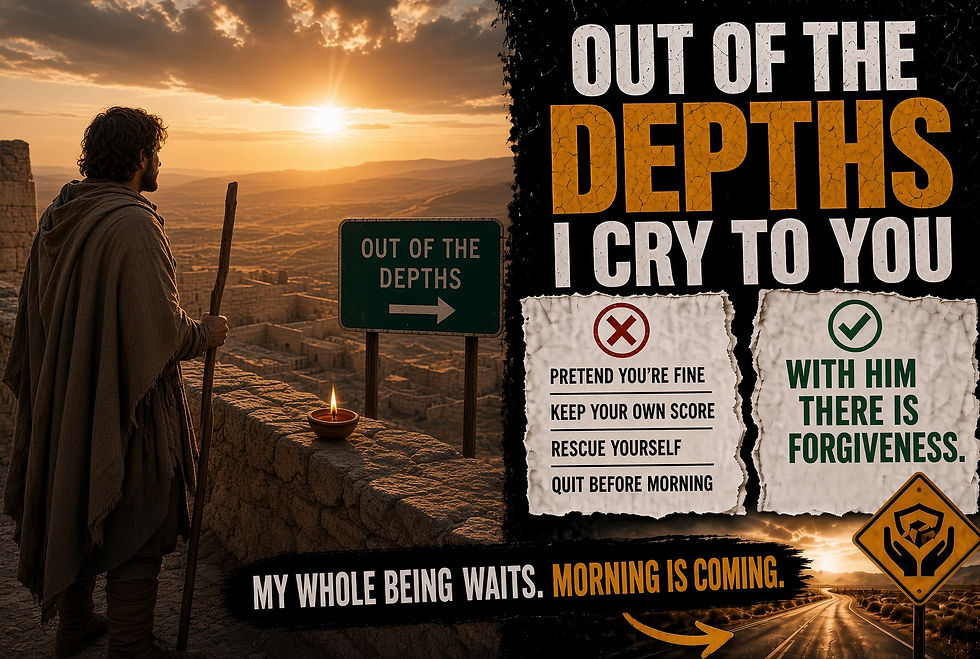
“Israel, put your hope in the LORD,for with the LORD is unfailing loveand with him is full redemption.He himself will redeem Israelfrom all their sins.”
Psalm 130:7–8
This is important. The psalmist doesn't keep the hope to himself. He has cried from the depths. He has confronted sin.
He has remembered forgiveness.
He has waited through the night.
And now he turns toward the people around him and says:
Put your hope in the Lord.
This is what happens when God teaches us something in the dark.
Eventually, our experience becomes a word of encouragement for someone else.
Maybe you've been through something you never would have chosen.
Maybe you know what it feels like to wait.
Maybe you've discovered that God's grace is deeper than your failure.
Maybe you've had to learn that forgiveness doesn't always mean forgetting the wound, but it does mean surrendering your right to carry it forever.
Those experiences aren't wasted. They can become part of the testimony you offer someone else. And notice what Israel is told to hope in. Not themselves. Not circumstances.
Not other people. Not a particular outcome.
The Lord.
Why?
Because:
“With the LORD is unfailing love.”
And:
“With him is full redemption.”
Not partial redemption.
Not a temporary patch.
Full redemption.
The God who meets us in the depths is also the God who redeems.
—Psalm 130:7–8 (NIV)
The song starts with “I.” It ends with “Israel.”
Psalm 129 ended with a word about those who hate Zion. Psalm 130 ends with a word to Zion: put your hope in the Lord. One voice tells the truth. Then the whole traveling company is invited in. Peterson’s line still fits: God’s help is not a private experience; it is a corporate reality. So is hope in the Lord.
Unfailing love. Full redemption. Not a little relief. Not “try harder and maybe you’ll feel better.” He Himself will redeem His people from all their sins.
If you have been in the depths this week, this last stanza is not extra. It is the reason you do not stay down there alone. What God did for you in the dark is meant to become a word you can speak to someone else still waiting for morning.


Learn more about supporting this ministry here.
Why Context STILL Changes Everything
If you read Psalm 130 by itself, you hear a beautiful prayer about distress, forgiveness, waiting, and hope.
But read it as a Song of Ascent, and especially read it immediately after Psalm 129, and another layer appears.
These aren't people who have never suffered.
These are people who have scars.
Psalm 129 has just reminded them that their enemies didn't prevail.
Now Psalm 130 reminds them that surviving their enemies isn't the ultimate goal.
They still need the mercy and redemption of God.
That's an important lesson for us, too.
Sometimes we think the goal is simply to get through the difficult thing.
But God may be doing something deeper than helping us survive.
He may be changing us in the process.
Psalm 129 says: “They did not finish us.”
Psalm 130 says: “God must finish the work of redemption.”
And suddenly the journey becomes more personal. You can be on the way to God and still cry from the depths. You can have survived something and still need healing. You can have strong faith and still have questions. You can trust God and still be waiting.
Ascent does not mean you never go under. It means you keep turning toward God.
FOUR WAYS TO THINK ABOUT WHAT YOU'VE LEARNED
LOOK BACK: What have I heard?
Where did this Psalm 130 Bible study name something true about your life?
Are you living more in Psalm 129 right now, thinking about what someone did to you?
Or are you in Psalm 130, recognizing something that still needs to be surrendered to God?
LOOK IN: Is there something I need to leave?
Is there a record of sins you keep replaying even though God has offered forgiveness?
Are you carrying guilt that God has already called you to surrender?
Is there a self-rescue plan you need to put down?
LOOK AROUND: What lies am I believing?
Are there voices telling you that hope is pretending?
That waiting is weakness?
That surviving is the same as healing?
That forgiveness means what happened didn't matter?
What does Psalm 130 say instead?
LOOK AHEAD: What's my next step?
What would it look like to wait for the Lord with your whole being?
Who needs you to say, “Put your hope in the Lord”?
Perhaps you've been in the depths long enough to recognize someone else standing there.
Maybe your story can remind them: Morning is coming.
Journey Group OR ME & 3 Small Group Discussion Starters:
If you’re using this Psalm 130 study guide with your Journey Group, Me & 3 group, or a few friends, don’t feel like you need to work through every question. Start with something that gets people talking and then let the conversation go deeper.
Start with something everyone can answer:
“When have you been in ‘the depths’—and what did you actually need from God or from people in that season?”
“Psalm 129 is ‘they did not win.’ Psalm 130 is ‘I still need mercy.’ Which one is harder for you to pray right now—and why?”
That naturally moves the conversation from old wounds into present hope.
Then bring Psalm 130 back into the discussion:
“What would it look like for our group to be people who can cry out honestly and say to one another, ‘Put your hope in the Lord’?”
Remember This
Hope in Psalm 130 does not start on the mountaintop. It starts in the depths, after the long road of Psalm 129, tells the truth about sin, waits on God’s word, and then turns outward.
Don’t just ask, “When will this be over?” Ask, “Who needs me to hope out loud while I wait?”
You don't have to pretend the flood wasn't real. You do need to know who broke the snare.
FINAL THOUGHT
Psalm 129 taught us we can be knocked down and not knocked out.
Psalm 130 teaches us not to hide the depths.
You can survive what people did to you and still need forgiveness. Survival is not the same thing as being whole. Hope is not the same thing as being tough.
The Lord who cut the cords in Psalm 129 is the Lord who forgives and redeems in Psalm 130.
You can be on the Jesus journey and still cry, “Lord, hear my voice.” You can know you would not stand if He kept a record of sins—and still stand, because with Him there is forgiveness. You can wait longer than you wanted to wait, like watchmen who have seen enough dawns to trust the next one.
And when morning is still only a promise, you get to say to the people walking with you:
Israel, put your hope in the Lord.
With Him there is unfailing love.
With Him there is full redemption.
That is not denial. That is the meaning of Psalm 130: a Song of Ascent from the bottom of the road.
Experience the God of the Wilderness

Throughout the Bible, the desert isn't just a place of heat and sand; it is God’s favorite classroom. It’s where He took Moses to see the burning bush, where He shaped the Israelites into a nation, and where Jesus was prepared for His ministry.
There is something about stepping away from the "safe structures" of the city and into the stillness of the high desert that clears the noise and lets you hear God's voice.
Are you willing to come to the wilderness for a time of preparation and growth? If you feel God moving you out of your comfort zone and into a deeper dependence on Him, we invite you to join us on our off-grid property in Northwest Arizona.
Arizona Bible Experience Retreat 📅 Dates: October 17-23, 2026 📍 Location: Meadview, AZ
Incredible scenery, excellent teaching, and friendships forged from slot canyons to campfires. We have limited spots available to keep the experience intimate and impactful.
Several lodging options. Daily excursions. Shared meals, campfires, and more! Includes a day at the West Rim of the Grand Canyon and so much more.

IT'S NOT TOO LATE:
Every September, the whole YJJ community rallies together in beautiful North Idaho for our annual gathering. We call it "The Pig Out-Play & Praise"—and for good reason! We smoke a whole hog and briskets for a week of incredible food, deep fellowship, and powerful worship led by two different teams.
The Biblical Connection:
Did you know that God actually built "big meet-ups" into the very rhythm of life for His people? From the Appointed Feasts to the harvest gatherings, the ancient Israelites were commanded to stop, gather, and celebrate what God was doing. The value of these rhythms remains true for us today. We need these "mountain top" moments to refuel and reconnect.
Registration is OPEN now! Get your tickets here:
HAVE YOU WATCHED THIS VIDEO YET?
MORE RESOURCES TO HELP YOU GROW AS A CHRISTIAN
Read Our Full Statement of Faith: CLICK HERE
Your Jesus Journey is an independent, non-denominational Christian ministry. We're fueled by God's grace and the generosity of our supporters. Our team—led by Pastor Thad and his wife Kaila—is made up of dedicated disciples from all over the United States. Together, we work to help people understand the Bible, find Christian friends, and grow as disciple-makers.

Be sure to grab our free E-Book, "Stop Reading the Bible Wrong: 7 Strategic Shifts that Change Everything." Just click the Free Gift button at the top of our website, and we'll send it to you today!
Go to https://www.yourjesusjourney.com/journeygroups to learn more about Journey Groups, get connected in one, or even learn how to start your own. It's like a spiritual potluck, but instead of questionable casseroles, we share insights and grow closer to God. See you there!
You can also get our FREE in-Depth Bible-Study Guides delivered to your inbox: https://forms.wix.com/r/7330608166566101604.
To learn more about YJJ, Thad and Kaila, and Your Jesus Journey, check out our ABOUT US section: https://www.yourjesusjourney.com/learn-about-thad-and-kaila-and-the-journey-church-online.
There's lots more to see and learn on our website, from our "what we believe" page to hundreds of blogs. We encourage you to swing on by and take a look around at www.YourJesusJourney.com!


Comments