
Your Biggest Problem Isn't Outside—It's Inside You

Study Guide: Mark 7:14-23

Have you ever known someone who could quote Scripture, explain complicated Bible passages, and tell you exactly what Christians should and shouldn't do—but wasn't particularly pleasant to be around?
Maybe they were quick to criticize, slow to forgive, or convinced their opinions were always right. They knew their Bible, but somehow that knowledge wasn't making them more loving, patient, or kind.
Now here's the uncomfortable part. It's pretty easy to recognize those qualities in someone else. It's considerably harder to recognize them in ourselves!
Some of us have spent 20, 30, or even 50 years around Christianity. We've attended countless church services, listened to thousands of sermons, participated in Bible studies, and learned plenty about what God expects from us.
But here's a question worth considering: Are we actually becoming more like Jesus, or are we simply becoming more familiar with Christianity?
It's possible to become very good at looking religious without allowing God to change what's happening inside us.
That's exactly the problem Jesus addresses in Mark 7:14–23. His words challenge a deeply held assumption about what makes someone acceptable to God, and they might challenge a few assumptions we've been carrying around ourselves.
📖 TODAY'S PASSAGE
READ: Mark 7:14-23
BIG IDEA
Jesus teaches that our deepest spiritual problems don't come from what enters our bodies, but from the sinful thoughts, desires, and choices that come from our hearts.
👀 WATCH FOR THIS
Notice how Jesus moves the conversation from what people eat and how they wash their hands to something much more personal.
🎥 WATCH THE TEACHING

This study guide goes with our teaching from the Daily Bible Podcast.
You can watch the teaching first and then work through this guide, follow along while you watch, or come back afterward and use the questions to dig deeper.
SETTING THE SCENE
Jesus is in Galilee, where a group of Pharisees and religious teachers from Jerusalem have challenged Him about His disciples' behavior.
The disciples were eating without performing the traditional ceremonial handwashing expected by these religious leaders.
This wasn't primarily about hygiene. It was about religious purity and following traditions that had developed around God's Law.
In Mark 7:1–13, Jesus exposed how some of these traditions had become more important to the religious leaders than God's actual commands. He even gave an example of a religious practice that allowed people to avoid helping their own parents.
Now Jesus takes the conversation further.
The religious leaders were worried about what might make someone unclean from the outside. Jesus is about to explain why the bigger problem comes from somewhere else entirely.
1. JESUS CHALLENGES WHAT EVERYONE BELIEVED — Mark 7:14–16
After confronting the religious leaders, Jesus calls the crowd together and tells everyone to listen carefully.
He's about to say something that would have surprised many of them.
Under the Old Testament Law, the Jewish people had instructions about which foods were considered clean and unclean (Leviticus 11). These rules were part of Israel's covenant relationship with God and helped distinguish them from surrounding nations.
Religious leaders also developed additional traditions about washing and avoiding anything considered spiritually unclean.
But Jesus challenges the assumption behind the argument. He explains that what enters a person's body from the outside isn't what makes that person spiritually unclean. Instead, the problem comes from what comes out of the person.
Jesus isn't saying that hygiene doesn't matter or that everything we put into our bodies is healthy. He's talking about what makes someone spiritually unclean before God.
And His point is much bigger than washing hands before dinner.
Bible note: Some translations place verse 16 in a footnote because it is missing from some early Greek manuscripts. This doesn't change Jesus' teaching in the passage.
2. THE DISCIPLES NEED AN EXPLANATION — Mark 7:17–19
Later, Jesus goes into a house, away from the crowd, and His disciples ask Him to explain.
It's understandable that they're confused. They've grown up in a culture where food restrictions and religious purity were important parts of everyday life.
Jesus explains that food enters the stomach, passes through the digestive system, and eventually leaves the body. It doesn't enter the heart.
When the Bible talks about the heart, it often means more than our feelings. It refers to the center of our thoughts, desires, attitudes, and decisions.
Then Mark adds an important explanation: Jesus was declaring all foods clean.
That's a major development in the biblical story. The food restrictions given to Israel under the Old Covenant were no longer to define spiritual purity among Jesus' followers.
Jesus isn't simply offering a better interpretation of handwashing traditions. He's teaching with authority about what truly makes a person clean or unclean before God.
3. THE REAL PROBLEM COMES FROM WITHIN — Mark 7:20–21
Now Jesus explains what He means.
Our sinful behavior doesn't begin with something outside us making us spiritually dirty. It grows out of what's happening within our hearts.
Think about how this works in everyday life.
Someone says something that irritates you. Their words may trigger your reaction, but the anger, pride, or desire to hurt them back comes from within you.
Someone else receives recognition, success, or something you wish you had. Their good fortune isn't sinful, but jealousy can grow in your own heart.
Jesus isn't saying our surroundings never influence us. He's showing us that we can't blame all our wrongdoing on outside influences.
The condition of our hearts matters because our thoughts and desires shape our choices.
4. JESUS NAMES THE PROBLEMS WE OFTEN OVERLOOK — Mark 7:21–22
Jesus gives a list of sinful behaviors and attitudes, including sexual immorality, theft, murder, adultery, greed, dishonesty, envy, slander, pride, and foolishness.
Some are obvious actions that hurt people. Others are attitudes we can hide behind a friendly smile.
Someone might never steal anything but be consumed by greed. Another person might avoid obvious public sins while regularly criticizing others, spreading rumors, or looking down on people.
And here's something worth noticing: Jesus doesn't divide His list into respectable sins and really bad sins.
He takes seriously both the things people can see and the things happening privately inside us.
That should make us think carefully before assuming that someone is spiritually mature simply because they know Scripture, attend church regularly, or follow the expected religious rules.
Those things can be valuable, but they don't automatically produce a Christlike character.
5. RELIGIOUS RULES CAN'T FIX OUR HEARTS — Mark 7:23
Jesus finishes by explaining that these evil things come from within and make a person spiritually unclean.
Think back to how the conversation started.
The religious leaders were concerned that the disciples hadn't washed their hands according to tradition. Jesus was concerned about something far more serious.
Their attention was on outward religious behavior. Jesus wanted them to recognize the condition of the human heart.
This connects with something Jesus said earlier in Mark 2:17, when He compared Himself to a doctor who came for people who recognized they were sick.
Jesus didn't come simply to give people a better list of religious rules. He came to deal with the deeper problem of sin.
Good habits, Bible knowledge, and spiritual disciplines can help us grow. But they cannot substitute for the forgiveness and inner transformation we need through Jesus.
🔎 DON'T MISS THIS: THE CONNECTION TO YESTERDAY'S LESSON
There's an important connection between today's passage and what Jesus said just a few verses earlier.
In Mark 7:6, Jesus quoted the prophet Isaiah, who described people honoring God with their lips while their hearts remained far from Him.
Now, in verses 14–23, Jesus explains why the heart is so important.
The religious leaders were focused on whether people were following the proper outward practices. Jesus wanted them to understand that outward religious behavior cannot make up for a heart filled with pride, greed, dishonesty, or hatred.
It's possible to do religious things for years without becoming more like Jesus.
That doesn't mean religious practices are worthless. It means they're not the same thing as spiritual maturity.
And that's worth remembering whether we've been following Jesus for three weeks or fifty years.
THE BIGGER LESSON
WHO IS JESUS?
Jesus isn't simply another religious teacher offering advice about better behavior. He speaks with authority about what makes people spiritually clean or unclean before God.
He sees beyond outward appearances and understands the deeper problem of the human heart.
And He came to do something about it.
WHAT DOES IT ACTUALLY MEAN TO FOLLOW HIM?
Following Jesus involves much more than knowing the right answers, avoiding certain behaviors, or participating in church activities.
It means allowing His teaching to challenge our attitudes, desires, motives, and relationships.
We should certainly continue learning Scripture, gathering with other Christians, and developing healthy spiritual habits. But those practices should help us become more like Jesus.
After years of following Him, are we becoming more patient? More forgiving? More generous? More honest? More loving toward difficult people?
Spiritual maturity isn't measured simply by how much Christianity we know. It's revealed in how our lives are being changed as we follow Jesus.
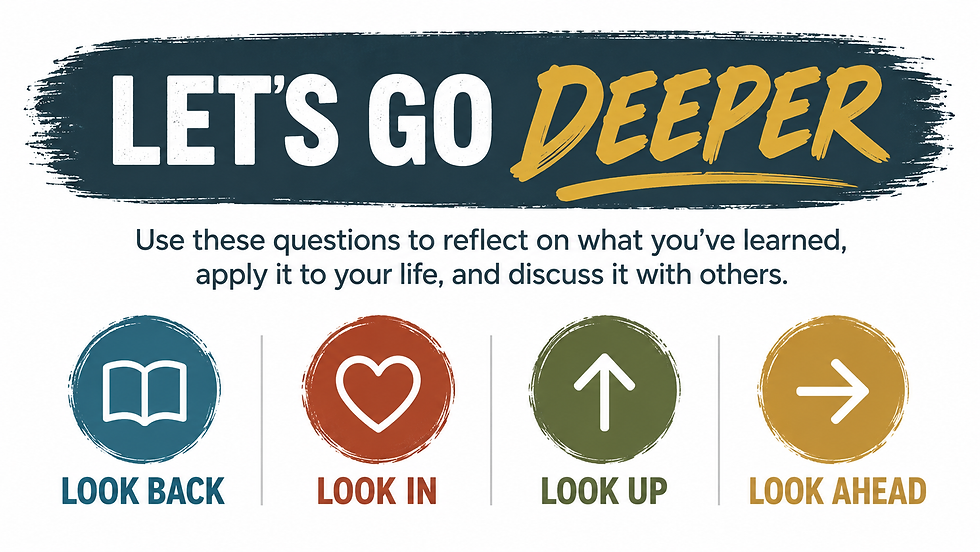
👀 LOOK BACK — WHAT DOES THE PASSAGE ACTUALLY SAY?
What did Jesus say makes a person spiritually unclean?
Why did the disciples have trouble understanding His explanation?
What kinds of behaviors and attitudes did Jesus include in His list?
🪞 LOOK IN — WHAT IS HAPPENING INSIDE ME?
Which is easier for you to recognize: someone else's bad behavior or your own bad attitude?
Have you ever been more concerned about being right than being kind?
If you've followed Jesus for many years, where have you seen genuine growth in your character?
⬆️ LOOK UP — WHAT DOES THIS SHOW ME ABOUT JESUS AND GOD?
What does Jesus' teaching reveal about what matters most to God?
Why is it important that Jesus addresses both outward behavior and inward attitudes?
➡️ LOOK AHEAD — WHAT WILL I DO WITH THIS?
What's one attitude or habit you'd like Jesus to help you change?
How could you respond differently the next time someone irritates or disappoints you?
Who could you invite to help you grow in an area where you've been struggling?
💬 SMALL GROUP DISCUSSION STARTER
Can someone know the Bible really well and still be difficult to live with?
Share an example without naming or embarrassing anyone. Then talk about what helps biblical knowledge become genuine character growth.
A NOTE FOR GROUP LEADERS
Today's conversation could become surprisingly personal, especially for people who have spent many years in church.
Start with the easier questions and allow the conversation to develop naturally. You don't need to finish every question.
Be careful that the discussion doesn't turn into a list of things wrong with other Christians or churches. Jesus' teaching invites us to examine our own hearts.
If someone shares an area where they're struggling, resist the urge to immediately correct them or offer a solution. Listen, thank them for being honest, and ask how the group can encourage or pray for them.
🌱 DISCIPLE-MAKER TIP: ASK ABOUT GROWTH, NOT JUST KNOWLEDGE
When helping someone follow Jesus, it's easy to focus on what they're learning.
We ask whether they read their Bible, understood the passage, or completed their study.
Those are good questions, but try adding another:
"How is what you're learning about Jesus changing the way you live?"
You might ask how they're handling a difficult relationship, responding to frustration, or showing kindness to someone who needs encouragement.
This helps move discipleship beyond simply gathering information.
And remember, you don't need to have everything figured out yourself. Sometimes sharing an area where Jesus is still working on your own character can open the door to an honest, helpful conversation.
🤝 DON'T JUST STUDY IT — PRACTICE IT
Think of one person who has recently irritated or disappointed you.
Before your next interaction, take a moment to pray and ask Jesus to help you respond with patience, humility, and kindness.
Then deliberately choose one response that reflects the character of Jesus rather than your first emotional reaction.
📌 REMEMBER THIS
Knowing more about Jesus should lead to becoming more like Jesus.
📖 NEXT: MARK 7:24–30 — A DESPERATE MOTHER AND A SURPRISING CONVERSATION
In our next lesson, Jesus travels into the region of Tyre, outside the traditional Jewish homeland. There, a mother approaches Him because her daughter desperately needs help.
But this woman isn't Jewish, and the conversation that follows is one of the more surprising exchanges in the Gospel of Mark.
At first, Jesus' response may even sound unusually harsh. Yet there's much more happening than we might notice on a quick reading.
After today's lesson about what truly makes someone spiritually clean or unclean, this encounter raises another important question:
Who gets to come to Jesus, and what does genuine faith look like when someone seems to be an outsider?
📺 KEEP GOING THROUGH MARK
Follow the complete Gospel of Mark Verse-by-Verse Bible Study as we work through the entire Gospel together.
New Daily Bible Podcast teachings and study guides will be added throughout our journey.
Understand the Bible | Find Christian Friends | Grow as Disciple Makers
Don't follow Jesus alone.
🛶 Apparently, I'm No Better at Rowing Than the Disciples!
Reading the story in Mark 6 about the disciples struggling to row their boat against the wind reminded me of another boating disaster.
The time Kaila discovered that her husband apparently had no idea how to paddle a canoe. 😂
Turns out, knowing which end of the paddle goes in the water doesn't automatically make you a skilled outdoorsman.
If you mostly know us from the Daily Bible Podcast, here's your chance to see a different side of our lives!
Come along with Kaila and me on a 7-day canoe adventure through Minnesota's beautiful Boundary Waters, where we enjoyed incredible scenery, wildlife, good friends, plenty of laughs, and a few lessons in humility.
It's a fun glimpse into what we do when we're not teaching the Bible. And trust me, you'll want to stick around for the hilarious outtakes at the end!
🎬 Come take an adventure with us!


Comments