
Your true identity isn't what you’ve earned, but who you belong to.

Study Guide: Acts 22:23-30
The "Who do you think you are?" moment.

Imagine you are being pulled over by a police officer who is having a very bad day. He’s frustrated, the traffic is loud, and he’s ready to throw the book at you. He starts to reach for the handcuffs, treating you like a common criminal. But then, you calmly reach into your wallet and show him a badge or an ID card that proves you are actually a high-ranking official or even the mayor’s top advisor.
The officer’s face goes pale. The handcuffs disappear. The "power dynamic" in the room flips upside down in a second.
In Acts 22:23–30, Paul is in a much more dangerous version of that story. He’s been beaten by a mob and is about to be tortured by the Roman army. But Paul has a secret "ID card" in his pocket—his Roman Citizenship. This study is about how Paul used his worldly status to protect his heavenly mission, and what it looks like when the "Kingdom of God" crashes into the "Kingdom of Rome."
Before you dig into the rest of the study guide, I would suggest reading or listening to the passage in two different bible translations from this list: NIV, NLT, NASB, ESV, NKJV

Learn more about our exciting out-of-the-box ministry here
Setting the Scene
To understand why the Roman commander was so terrified at the end of this story, we have to understand how serious Roman citizenship was in the first century.
The Antonia Fortress: Paul is being dragged inside the barracks, away from the screaming mob. This fortress was a Roman military building attached to the Temple Mount. From here, soldiers could watch for riots.
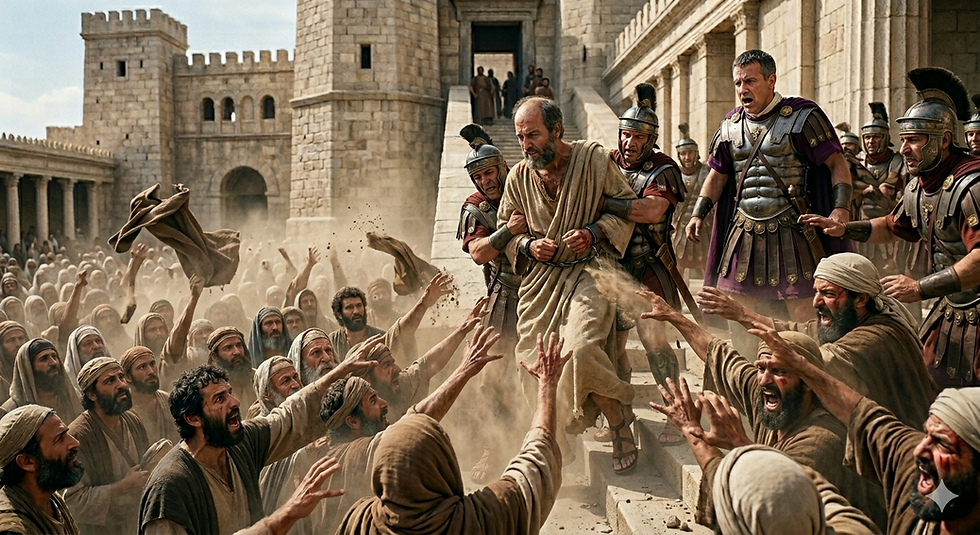
The "Examination": The commander, Claudius Lysias, orders Paul to be "examined by whipping." This wasn't just a few lashes; it was the flagrum—a whip with pieces of metal or bone designed to tear flesh. It was used to force a confession out of people who weren't Roman citizens.
The Law: Under Roman laws (the Lex Valeria and Lex Porcia), it was a major crime to bind or whip a Roman citizen without a formal trial. If a commander did this, he could lose his job or even his life.
Summary: Citizenship and Sovereignty
In our live podcast, we talked about how Paul navigated this crisis. Here is a deeper look at the details and the history behind those moments.
1. The Sound of Fury (Acts 22:23–24)
The crowd isn't just yelling; they are throwing off their cloaks and flinging dust into the air. This was a Middle Eastern way of saying, "This man is so repulsive he’s polluting the very air we breathe! Remove him from the earth!" The Roman commander, Claudius Lysias, is lost in translation. He doesn't speak Aramaic, so he has no idea why the crowd just exploded. He assumes Paul must be a major criminal and decides to beat the truth out of him.
2. The Question that Changed Everything (Acts 22:25–26)
As the soldiers are tying Paul up to be whipped, Paul stays calm. He doesn't scream or beg. He asks a simple, legal question: "Is it legal for you to whip a Roman citizen who hasn't even been tried?" (Acts 22:25). The reaction was instant. The officer (centurion) ran straight to the commander. He essentially said, "Stop! Do you realize what you’re doing? This man is a Roman citizen!"
3. Born into It (Acts 22:27–28)
The commander hurries over, shocked. He tells Paul, "I had to pay a huge sum of money to buy my citizenship." During the reign of Emperor Claudius, officials were known for "selling" citizenship for massive bribes. But Paul’s answer is the ultimate "status" move: "But I was born a citizen." (Acts 22:28). This meant Paul’s family had been influential and loyal to Rome for at least a generation. Paul wasn't just a citizen; he had a higher social class than the commander himself.
4. The Fear of the Law (Acts 22:29–30)
The soldiers who were about to whip Paul "withdrew immediately." The commander was "alarmed" (terrified). He realized he had already broken the law by putting a citizen in chains without a trial. He immediately shifted from "interrogator" to "legal facilitator," ordering the Sanhedrin (the Jewish High Council) to meet the next day to get to the bottom of the case legally.

Deep Dive Rabbit Trail: From Earthly Citizen to Eternal Heir
To truly grasp what was happening on those stairs in Jerusalem, we have to look at how Paul’s "Roman ID card" was just a shadow of a much bigger identity he had been writing about for years. By the time Paul stood before Claudius Lysias, he had already written letters to the Romans, the Galatians, and the Corinthians. In those letters, he was obsessed with one idea: Your DNA doesn't define you, but your adoption does.
1. The Cultural Power of Adoption
In our modern world, adoption is a beautiful way to build a family. But in the Roman world, it was a high-stakes legal maneuver. If a wealthy Roman man had no heir to carry on his name or managed his estate, he would adopt a "son."
When this happened:
All Prior Debts Were Canceled: Legally, the person’s "old self" died. Any money they owed or crimes they had committed were wiped off the books.
A New Father, A New Name: They immediately gained the status of the father. If a slave was adopted by a Senator, that slave became a Senator’s son instantly.
The Inheritance was Guaranteed: The adopted son had the exact same legal rights as a biological son.
When Paul writes to the believers in Rome (who lived under the shadow of the Emperor), he uses this exact language:
"For you have not received a spirit that makes you fearful slaves. Instead, you received God’s Spirit when he adopted you as his own children. Now we call him, ‘Abba, Father.’" (Romans 8:15, NLT)
2. The Kingdom "ID Card" (Philippians 3:20)
Paul eventually wrote to the believers in Philippi (a city full of retired Roman soldiers who were very proud of their citizenship). He reminded them that while they lived in Philippi, that wasn't their true home:
"But we are citizens of heaven, where the Lord Jesus Christ lives. And we are eagerly waiting for him to return as our Savior." (Philippians 3:20, NLT)
To a modern reader, this means your "Kingdom Identity" isn't something you're waiting for—it's something you already have.
Now: You are an ambassador. You have the "diplomatic immunity" of knowing that the world’s judgment doesn't define your worth.
The Future: You aren't just "going to heaven" to sit on a cloud. You are inheriting a restored Earth.
3. What Exactly is the "Inheritance"?
Imagine being called into a lawyer’s office to hear the reading of a will from a relative you never knew was a billionaire. You’d be leaning forward, listening for every detail. Here is what the New Testament says is in "The Will" for a follower of Jesus:
The World (Matthew 5:5): Jesus said the humble would "inherit the whole earth." Our future isn't a ghost-like existence; it’s a physical, perfect world without cancer, taxes, or tears.
Incorruptible Bodies (1 Corinthians 15:52-54): Paul tells the Corinthians that we will inherit bodies that never wear out, never get sick, and never die.
The Kingdom Itself (James 2:5): God has promised the Kingdom to those who love Him. This means you aren't just a "guest" in God's house; you are a part-owner of the new creation.
4. Why it’s Okay to be Excited
Some people feel "greedy" for looking forward to an inheritance. But think of it this way: a child isn't greedy for wanting to live in their father’s house.
Paul tells the Galatians:
"Now you are no longer a slave but God’s own child. And since you are his child, God has made you his heir." (Galatians 4:7, NLT)
When Paul stood on those stairs in Acts 22, he knew that even if the Roman commander ignored his Roman citizenship and killed him, it wouldn't matter. He had a higher ID card. He was a co-heir with Christ.
Deep Dive Summary:
Your Status is a Gift: Like Paul’s birthright citizenship, you didn't buy your way into God's family. Jesus paid the "huge sum" so you could be born into it.
Your Past is Canceled: If you are an "heir," your old "debts" (sins) are legally gone. The Father doesn't look at your old rap sheet; He looks at His Son’s resume.
You Live from Victory, Not for It: You don't work hard to become an heir. You work hard because you are an heir and you want to honor the Family Name.
The Big Takeaway: The next time you feel like an "employee" trying to keep God happy, remember the stairs. You are the "born-in" citizen of a Kingdom that makes Rome look like a sandbox. Your inheritance is waiting, and the Father has already put your name on the deed.
Why We Look at "Wrong" and "Right" Applications

We discuss this because people often get confused about how a follower of Jesus should use their "rights" or their "status" in the world. Did Paul "wimp out" by using his citizenship? Was he being selfish? If we don't apply this correctly, we might use our faith as an excuse to be either door-mats or bullies.
🛑 Applying it Wrong: The Common Pitfalls
The "Get Out of Jail Free" Mistake: Thinking that God wants us to use our status just to avoid suffering. Paul didn't use his citizenship to avoid the mob earlier; he used it here specifically to ensure he had a legal platform to keep preaching.
The "Power Trip" Mistake: Thinking that because we are "children of the King," we should demand special treatment or be rude to people in authority. Paul was respectful even while being tied up.
The "Spiritual Only" Mistake: Some think Paul shouldn't have cared about Roman law because he was a Christian. But Paul knew that God put those laws in place for a reason.
✅ Applying it the Right Way:
Using Every Tool: Paul used his education and his citizenship as tools for the Gospel. Ask yourself: "How can my job, my background, or my 'status' help me share Jesus?"
Respecting Authority (With Boundaries): Paul respected the Roman system, but he also held the system accountable to its own laws.
The Sovereignty of God: Paul was saved from a beating by a "coincidence"—he happened to be a citizen. But for the believer, there are no coincidences. God used Roman law to protect His witness.
Questions to Chew on and Discuss:
These questions are designed to help you personally dig deeper into the passage and help guide your discussions in your Journey Groups and Me & 3 small groups.
The Facts (What does it say?)
Goal: To ensure everyone is grounded in the actual text before moving to interpretation.
Why did the commander want to whip Paul in the first place? (22:24)
How did the commander get his citizenship compared to how Paul got his? (22:28)
What was the commander's reaction when he realized Paul was a citizen? (22:29)
The Meaning (What does it mean?)
Goal: To dig into the "Why" behind the history and the culture.
Why is being "born" a citizen more honorable in this culture than "buying" it?
How does Paul’s calm question show he trusts God is in control?
What is the difference between a "worker" and an "heir"?
The Heart (What am I hearing?)
Goal: To let the Holy Spirit use the text as a mirror for our own lives.
Do you ever feel like you have to "buy" God's love with good deeds?
When things go wrong, do you feel like a victim, or do you remember your "ID card" as a child of God?
The Hands (What will I do?)
Goal: To move from "interesting thoughts" to "Kingdom action."
How can you use one "secular" thing about your life (your job, a hobby) to help someone else find Jesus this week?
Practice a "calm response" the next time someone treats you unfairly.
Journey Group Discussion Starter:
Whether you're helping facilitate a small group, talking about this passage one-on-one with a friend, or even just need a topic to guide the conversation at the dinner table, these ideas can help start a good group conversation before you dive into the passage and questions in this study guide.
The ID Card: If you had to describe your "status" to a stranger without using your job or family, what would you say?
The Inheritance: What part of God's "will" (His promises for the future) are you most excited to inherit?
Sum it Up
Paul wasn't just a citizen of Heaven; he used his Roman citizenship as a platform to keep the mission moving. When you follow Jesus, you are adopted into a royal family. Your debts are canceled, and your inheritance is guaranteed. You don't work for your status; you live from it. Your value isn't based on what you’ve earned, but on whose family you belong to.
Experience the God of the Wilderness

Throughout the Bible, the desert isn't just a place of heat and sand; it is God’s favorite classroom. It’s where He took Moses to see the burning bush, where He shaped the Israelites into a nation, and where Jesus was prepared for His ministry.
There is something about stepping away from the "safe structures" of the city and into the stillness of the high desert that clears the noise and lets you hear God's voice.
Are you willing to come to the wilderness for a time of preparation and growth? If you feel God moving you out of your comfort zone and into a deeper dependence on Him, we invite you to join us on our off-grid property in Northwest Arizona.
Arizona Bible Experience Retreat 📅 Dates: April 18-24, 2026 📍 Location: Meadview, AZ
Incredible scenery, excellent teaching, and friendships forged from slot canyons to campfires. We have limited spots available to keep the experience intimate and impactful.
Several lodging options. Daily excursions. Shared meals, campfires, and more! Includes a day at the West Rim of the Grand Canyon and so much more.

BE SURE TO WATCH THE VIDEO PODCAST THAT GOES WITH THIS STUDY GUIDE
See viewer comments and questions on screen at the end of the podcast.

Save the Date: The Pig Out-Play & Praise
Every September, the whole YJJ community rallies together in beautiful North Idaho for our annual gathering. We call it "The Pig Out-Play & Praise"—and for good reason! We smoke a whole hog and briskets for a week of incredible food, deep fellowship, and powerful worship led by two different teams.
The Biblical Connection:
Did you know that God actually built "big meet-ups" into the very rhythm of life for His people? From the Appointed Feasts to the harvest gatherings, the ancient Israelites were commanded to stop, gather, and celebrate what God was doing. The value of these rhythms remains true for us today. We need these "mountain top" moments to refuel and reconnect.
Registration is OPEN now! Get your tickets here:
HAVE YOU WATCHED THIS VIDEO YET?
MORE RESOURCES TO HELP YOU GROW AS A CHRISTIAN
Read Our Full Statement of Faith: CLICK HERE
Your Jesus Journey is an independent, non-denominational Christian ministry. We're fueled by God's grace and the generosity of our supporters. Our team—led by Pastor Thad and his wife Kaila—is made up of dedicated disciples from all over the United States. Together, we work to help people understand the Bible, find Christian friends, and grow as disciple-makers.

Be sure to grab our free E-Book, "Stop Reading the Bible Wrong: 7 Strategic Shifts that Change Everything." Just click the Free Gift button at the top of our website, and we'll send it to you today!
Go to https://www.yourjesusjourney.com/journeygroups to learn more about Journey Groups, get connected in one, or even learn how to start your own. It's like a spiritual potluck, but instead of questionable casseroles, we share insights and grow closer to God. See you there!
You can also get our FREE in-Depth Bible-Study Guides delivered to your inbox: https://forms.wix.com/r/7330608166566101604.
To learn more about YJJ, Thad and Kaila, and Your Jesus Journey, check out our ABOUT US section: https://www.yourjesusjourney.com/learn-about-thad-and-kaila-and-the-journey-church-online.
There's lots more to see and learn on our website, from our "what we believe" page to hundreds of blogs. We encourage you to swing on by and take a look around at www.YourJesusJourney.com!



Comments