
Why Most Christians Overcomplicate Following Jesus
- Thad DeBuhr

- 2 minutes ago
- 14 min read
Follow Jesus Together - Day 1
Imagine a friend who decides they finally want to lose weight and get healthy.
At first, the plan is actually pretty simple:
eat better
move more
stay consistent

But instead of starting with simple daily habits, they begin overcomplicating everything.
They spend hours researching workout plans online. They buy expensive supplements. They watch endless fitness videos. They order special equipment. They create color-coded meal plans. They download five different health apps.
Weeks go by.
They become experts at planning fitness…
…but they still are not actually walking, exercising, or eating differently.
Meanwhile, another person simply starts taking a walk every evening, drinking more water, eating smaller portions, and staying consistent.
Nothing flashy.Nothing impressive.
But six months later, that second person is healthier because they actually practiced simple habits consistently.
Spiritual growth can work the same way.
Many people think following Jesus requires:
advanced Bible knowledge
perfect theology
leadership training
a polished plan
the perfect group setup
impressive teaching

But when we look at the early church in Acts 2, we find something surprisingly simple.
They gathered together regularly.
They learned together.
They ate together.
They prayed together.
They helped each other.
And over time, their lives changed.
The early church did not grow because it was impressive.
It grew because people stayed connected to Jesus and consistently showed up for one another.
That is the heart behind this entire series.
As you go through the study guide, I would suggest reading or listening to the Bible passages in two different bible translations from this list: NIV, NLT, NASB, ESV, NKJV

Learn more about our exciting out-of-the-box ministry here
Setting the scene: The World of Acts 2
The book of Acts picks up right after the resurrection and ascension of Jesus.
Jesus had spent around three years teaching His disciples:
how to live
how to love people
how to trust God
how to carry His message into the world
Then Jesus was crucified.
Three days later, He rose from the dead.
After appearing to many people over forty days (Acts 1:3), Jesus ascended into heaven and told His followers to wait in Jerusalem for the coming of the Holy Spirit.
That brings us to Acts 2.
Jerusalem During Pentecost
Acts 2 takes place during Pentecost, one of the major Jewish pilgrimage festivals.
Jews from all over the Roman Empire had traveled to Jerusalem for this celebration.
Acts 2:5 says there were Jews in Jerusalem “from every nation under heaven.”
Jerusalem would have been crowded, noisy, and packed with travelers speaking many different languages. This matters because the early church was born in the middle of a very diverse and chaotic environment. Christianity did not begin in comfort and stability. It began in a busy city full of tension, politics, religion, cultures, and economic differences.
Some people were wealthy.
Others were poor.
Some were highly educated.
Others were ordinary laborers.
Some were lifelong Jews deeply familiar with Scripture.
Others came from very different backgrounds throughout the Roman world.
And in the middle of all that diversity, the Holy Spirit began forming a new kind of community centered around Jesus.
The Coming of the Holy Spirit
In Acts 2, the Holy Spirit comes upon the followers of Jesus. Peter preaches publicly about Jesus being the promised Messiah. About three thousand people respond and are baptized (Acts 2:41). That is important context for the verses we study in Acts 2:42–47.
These were not lifelong mature believers.
Most of these people were brand-new followers of Jesus.
And yet immediately, they began forming community together.
That tells us something important:
Community was not the reward for spiritual maturity.
Community was part of how people matured.
Many people today think:“I need to get my life together first.”
But the early church grew precisely because people learned to follow Jesus together.
Why Meals Matter in Jewish Culture
Acts 2 repeatedly mentions shared meals and breaking bread. In Jewish culture, meals carried deep meaning.
Sharing a table meant:
acceptance
relationship
trust
belonging
Meals were not rushed. People lingered together. Conversation mattered. Hospitality mattered. Community mattered.
In many modern cultures, meals are squeezed between busy schedules. But in the first-century Jewish world, table fellowship was one of the primary ways relationships were formed and strengthened.
This helps explain why shared meals appear constantly throughout the ministry of Jesus.
Jesus taught around tables.
He challenged people around tables.
He restored people around tables.
He revealed truth around tables.
And now the early church is doing the same thing.
Community in a Digital World
One thing modern readers sometimes miss is this:
The early church used the communication tools available to them.
They gathered in homes.
They met in public spaces.
They traveled.
They sent letters.
They stayed connected however they could.
If the apostles had access to Zoom, texting, FaceTime, voice messages, or group chats, they absolutely would have used them to encourage, teach, pray for, and stay connected to believers.
Today, many healthy Christian relationships grow through:
Zoom Bible studies
prayer text threads
phone calls
voice messages
group chats
video calls
emails
online gatherings
For many people, these tools are not replacing community.
They are creating community.
And often, online relationships eventually grow into:
in-person friendships
travel together
ministry partnerships
gatherings at events
deeper lifelong relationships
The method may change.
But the deeper goal stays the same: following Jesus together consistently.
Summary of the Main Teaching in the Live Podcast
Following Jesus Was Never Meant to Be Complicated
One of the biggest misunderstandings in modern Christianity is the idea that spiritual growth requires complicated systems.
Many people think:
“I need years of Bible training first.”
“I need a perfect curriculum.”
“I need to become an expert.”
“I need a better house.”
“I need a polished group plan.”
But the early church had none of those things.
They had no church buildings, no seminaries, no printed Bibles, no worship bands, no podcasts, no polished systems.
And yet their faith spread rapidly across the Roman world.
Why?
Because they lived closely connected to Jesus and to each other.
Acts 2:42 — The Four Rhythms
Acts 2:42 says:
“They devoted themselves to the apostles’ teaching and to fellowship, to the breaking of bread and to prayer.”
Notice how practical this is. The early believers focused on four simple rhythms.
1. Learning Together
“The apostles’ teaching”
The early Christians gathered to hear and discuss the teachings of Jesus passed down through the apostles. This was not merely collecting information. In Jewish culture, teaching was meant to shape daily life. Knowledge and obedience were connected.
The goal was not:“How much do you know?”
The goal was:“How are you living?”
That is why Jesus often ended teachings with calls to action.
For example:
“Everyone who hears these words of mine and puts them into practice…”(Matthew 7:24)
The early church was learning together in ways that shaped real life.
And today, learning together may happen:
around a kitchen table
over coffee
through a Zoom study
inside a group text
during a phone call
through voice messages throughout the week
The format may change.
The goal remains the same: letting the teachings of Jesus shape real life.
2. Fellowship
The Greek word used here is koinonia.
This word means much more than casual friendship.
It carries the idea of:
shared life
partnership
participation
mutual care
This was not shallow social interaction. People were deeply involved in one another’s lives. They carried burdens together. They supported each other. They belonged to one another in a meaningful way.
And meaningful fellowship today can happen both physically and digitally.
A late-night prayer call.
A text checking in after a difficult day.
A weekly Zoom conversation.
Encouragement shared throughout the week.
None of those things fully replace sitting face to face.
But they still create meaningful rhythms of care, encouragement, honesty, and connection.
3. Breaking Bread
This likely included both ordinary meals and remembrance of Jesus through communion.
Again, meals mattered deeply. People sat together regularly. And something powerful happens when people consistently share meals.
Walls come down.
Trust grows.
People relax.
Conversation deepens.
Some of the most important discipleship moments happen around ordinary tables.
But in our modern world, connection can also happen through consistent digital rhythms.
Some Journey Groups or Me & 3's may eventually gather in person only occasionally while staying connected weekly online.
Some members may live across the country but still grow deeply connected through regular conversations, prayer, encouragement, and shared life.
Technology can be used as a tool to strengthen and maintain genuine relationship.
4. Prayer
The early believers prayed together regularly.
Prayer was not treated like a performance. It was dependence on God. And because many of these believers were facing uncertainty, pressure, and persecution, prayer became a steady source of strength and unity.
That same principle matters today. Prayer does not only happen inside church buildings.
Prayer can happen:
through a voice message
on a Zoom call
during a phone conversation
through text messages
around a fire pit
while walking together
during everyday life
Consistent prayer keeps people connected to both God and each other.
Simple and Consistent Beats Complicated and Impressive
Acts 2 does not describe flashy ministry.
It describes faithful rhythms. And over time, those rhythms shaped people. This is how spiritual growth usually works. Not through constant emotional highs. Not through endless information. But through small acts of faithfulness repeated over time.
This connects closely to Jesus’ teaching in Matthew 13 in the Parable of the Sower.
Healthy growth takes root slowly.
Fruit develops over time.
The Christian life is usually more like farming than fireworks.
Seeds grow quietly underground long before fruit becomes visible.
The same is true in biblical community.
Small weekly conversations. Simple prayers. Consistent encouragement. Checking in regularly. Showing up again and again.
Those ordinary moments slowly shape people over time.
Matthew 18:20 — What Jesus Really Meant
Jesus says:
“For where two or three gather in my name, there am I with them.”
This verse is often quoted casually, but context matters. In Matthew 18, Jesus is teaching about relationships, humility, forgiveness, accountability, and unity among believers.
The point is not: “You only need two people for church.”
The point is: Jesus is present among ordinary believers who gather around Him sincerely.
This would have been deeply encouraging to early Christians who often gathered in homes rather than large buildings.
The power was never in the building.
The power was in the presence of Jesus among His people.
That is still true whether people gather:
around a kitchen table
on a hiking trail
around a campfire
through a Zoom screen
during a group phone call
The format is not the center. Jesus is.
Will you partner with us to help more people understand the Bible, grow in community, and follow Jesus?

Learn more about supporting this ministry here.
Why We Look at "Wrong" and "Right" Applications

One of the easiest ways to misunderstand Scripture is to pull verses away from their original setting and force them to support our own preferences.
Sometimes people approach the Bible asking, “How can I use this verse to support my opinion?”
Instead of asking: “What was happening here?”What did this mean to the original audience?”What is God teaching through this passage?”
Acts 2 has often been romanticized, oversimplified, or used to push personal agendas.
So it is important to slow down and read carefully. Not every detail in Acts is a command. But many details reveal important patterns and priorities. Our goal is not to copy every detail mechanically. Our goal is to understand the heart behind what was happening.
❌ APPLYING IT WRONG
1. Treating Acts 2 Like a Perfect Blueprint
Some people treat Acts 2 as if every church in every culture must function exactly the same way. But Acts describes a moment in history. Not every detail is meant to become a universal rule.
For example:
meeting locations may vary
schedules may vary
group sizes may vary
communication methods may vary
The deeper principle is consistent shared life centered around Jesus.
2. Using “Simple” as an Excuse for Laziness
Sometimes people hear: “Keep it simple” and think: “Nothing matters.” But simplicity is not laziness. The early believers were deeply committed. Acts 2:42 says they “devoted themselves.”
That means persistence, intentionality, and consistency.
Simple does not mean careless.
3. Turning Community Into Performance
People sometimes create environments where everyone pretends to have life together.
But biblical community requires honesty. If people feel pressure to impress one another spiritually, authenticity disappears.
Real growth happens when people can admit:
struggles
fears
failures
questions
without fear of rejection.
4. Treating Community Like Consumerism
Modern culture trains people to ask: “What do I get out of this?” But biblical community asks: “How can we serve, encourage, and strengthen each other?”
The early church was marked by generosity and sacrifice.
Not spiritual consumerism.
5. Thinking Biblical Community Only Counts In Person
Some people unintentionally create shame around digital connections. But Scripture focuses far more on genuine encouragement, shared life, prayer, teaching, and consistency than on the exact format people use.
The apostle Paul often discipled people through letters because distance separated them.
Those letters carried:
encouragement
correction
teaching
comfort
relationship
Modern technology allows believers to do many of those same things instantly. Technology becomes unhealthy when it replaces authentic relationship. But it becomes incredibly powerful when it strengthens authentic relationship.
✅ Applying it the Right Way:
1. Start Small
Many healthy groups begin with something simple:
coffee
breakfast
walking together
reading Scripture together
a Zoom call
a weekly group text
a prayer thread
Do not wait for perfection.
Start with consistency.
2. Focus on Presence Over Performance
You do not need to impress people.
You do not need to preach a sermon.
You do not need to have every answer.
People are often looking for honesty more than expertise.
3. Let Scripture Shape Real Life
The early church was not gathering merely to collect information. They wanted their lives shaped by Jesus.
Ask:
How does this affect my relationships?
My priorities?
My habits?
My reactions?
My generosity?
The goal is transformation, not just information.
4. Build Rhythms, Not Events
Transformation usually happens slowly. A single emotional gathering rarely changes a life permanently. But repeated rhythms often do.
Over time:
trust grows
honesty deepens
prayer becomes natural
relationships strengthen
Simple faithfulness over time changes people.
5. Understand the Jewish Background
Western readers often approach faith as highly individual. But the Bible was written in deeply communal cultures. People lived closely connected to family and community.
Identity was shared more collectively.
This helps explain why the New Testament constantly emphasizes:
unity
hospitality
shared burdens
generosity
reconciliation
gathering together
Following God was never meant to be isolated.
6. Use Technology As A Tool For Consistency
One reason many people drift spiritually is not because they reject God.
They simply become isolated. Modern communication tools allow people to stay connected consistently even across long distances.
A healthy Journey Group or Smaller Me & 3 Group may include:
weekly Zoom gatherings
daily group text check-ins
prayer voice messages
sharing Scripture throughout the week
spontaneous phone calls
meeting in person when possible
traveling to gatherings and events together
The early church used the tools available to stay connected. We should do the same.
The goal is not to idolize technology. The goal is to use every healthy tool possible to help people follow Jesus together consistently.
Questions to Chew on and Discuss:
These questions are designed to help you personally dig deeper into the passage and help guide your discussions in your Journey Groups and Me & 3 small groups.
THE FACTS — What Does the Passage Say?
According to Acts 2:42–47, what activities marked the life of the early church?
What does the word “devoted” communicate about the early believers?
What role did meals, prayer, and shared life play in the early church community?
THE MEANING — What Does It Mean?
Why do you think God designed spiritual growth to happen in community rather than isolation?
What does Acts 2 teach us about the difference between performance and genuine discipleship?
How does understanding the Jewish culture behind these passages help you read them differently?
THE HEART — What Am I Hearing?
Have you been overcomplicating your spiritual growth?
What fears or excuses have kept you from deeper biblical community?
Where are you craving more honesty, connection, or encouragement in your life right now?
THE HANDS — What Will I Do?
What is one simple next step you could take toward biblical community this week?
Who are 2–3 people you could intentionally begin connecting with?
What would it look like to prioritize consistency over impressiveness in your spiritual life?
Journey Group OR ME & 3 Small Group Discussion Starters:
Whether you're helping facilitate a small group, talking about this passage one-on-one with a friend, or even just need a topic to guide the conversation at the dinner table, these ideas can help start a good group conversation before you dive into the passage and questions in this study guide.
What has your experience with Christian community been like in the past—positive or negative?
What do you think people are most hungry for right now:
better teaching, or deeper connection? Why?
How has technology helped you stay connected spiritually with other believers?
Have you ever had an online friendship or small group relationship eventually become a meaningful in-person friendship? What was that experience like?
🧩 SUM IT UP
The early church did not change the world through polished programs or impressive systems.
They stayed connected to Jesus.
They stayed connected to each other.
They learned together.
Prayed together.
Shared meals together.
Encouraged one another.
And kept showing up consistently.
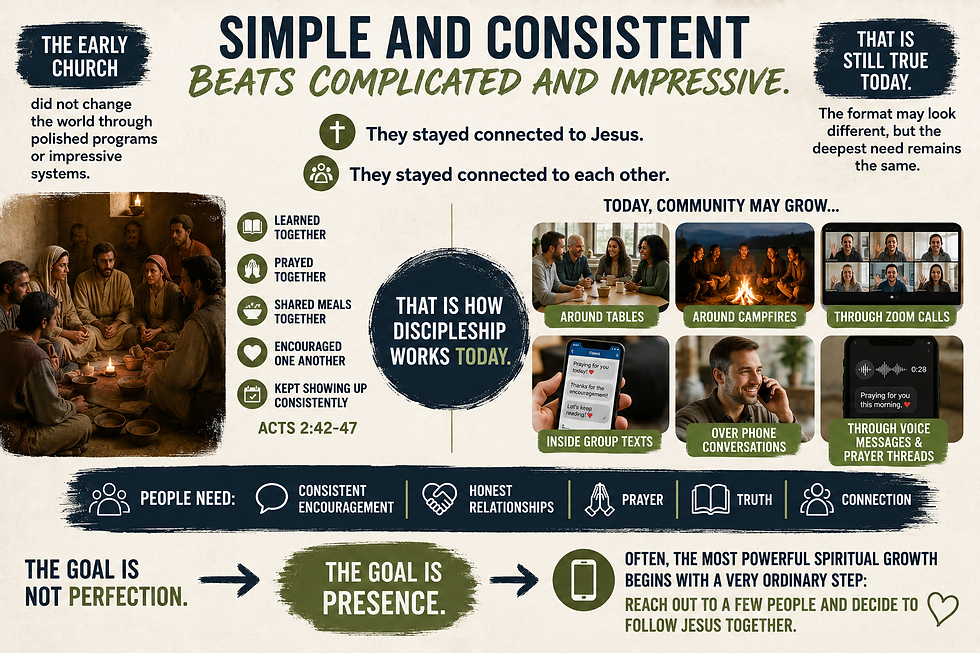
That is still how discipleship works today.
And today, community may grow:
around tables
around campfires
through Zoom calls
inside group texts
over phone conversations
through voice messages and prayer threads
The format may look different than the first century. But the deeper need remains the same:
People need consistent encouragement, honest relationships, prayer, truth, and connection.
Simple and consistent beats complicated and impressive.
The goal is not perfection.
The goal is presence.
And often, the most powerful spiritual growth begins with a very ordinary step: reaching out to a few people and deciding to follow Jesus together.
WHAT'S COMING NEXT

Experience the God of the Wilderness

Throughout the Bible, the desert isn't just a place of heat and sand; it is God’s favorite classroom. It’s where He took Moses to see the burning bush, where He shaped the Israelites into a nation, and where Jesus was prepared for His ministry.
There is something about stepping away from the "safe structures" of the city and into the stillness of the high desert that clears the noise and lets you hear God's voice.
Are you willing to come to the wilderness for a time of preparation and growth? If you feel God moving you out of your comfort zone and into a deeper dependence on Him, we invite you to join us on our off-grid property in Northwest Arizona.
Arizona Bible Experience Retreat 📅 Dates: October 17-23, 2026 📍 Location: Meadview, AZ
Incredible scenery, excellent teaching, and friendships forged from slot canyons to campfires. We have limited spots available to keep the experience intimate and impactful.
Several lodging options. Daily excursions. Shared meals, campfires, and more! Includes a day at the West Rim of the Grand Canyon and so much more.

Save the Date: The Pig Out-Play & Praise
Every September, the whole YJJ community rallies together in beautiful North Idaho for our annual gathering. We call it "The Pig Out-Play & Praise"—and for good reason! We smoke a whole hog and briskets for a week of incredible food, deep fellowship, and powerful worship led by two different teams.
The Biblical Connection:
Did you know that God actually built "big meet-ups" into the very rhythm of life for His people? From the Appointed Feasts to the harvest gatherings, the ancient Israelites were commanded to stop, gather, and celebrate what God was doing. The value of these rhythms remains true for us today. We need these "mountain top" moments to refuel and reconnect.
Registration is OPEN now! Get your tickets here:
HAVE YOU WATCHED THIS VIDEO YET?
MORE RESOURCES TO HELP YOU GROW AS A CHRISTIAN
Read Our Full Statement of Faith: CLICK HERE
Your Jesus Journey is an independent, non-denominational Christian ministry. We're fueled by God's grace and the generosity of our supporters. Our team—led by Pastor Thad and his wife Kaila—is made up of dedicated disciples from all over the United States. Together, we work to help people understand the Bible, find Christian friends, and grow as disciple-makers.

Be sure to grab our free E-Book, "Stop Reading the Bible Wrong: 7 Strategic Shifts that Change Everything." Just click the Free Gift button at the top of our website, and we'll send it to you today!
Go to https://www.yourjesusjourney.com/journeygroups to learn more about Journey Groups, get connected in one, or even learn how to start your own. It's like a spiritual potluck, but instead of questionable casseroles, we share insights and grow closer to God. See you there!
You can also get our FREE in-Depth Bible-Study Guides delivered to your inbox: https://forms.wix.com/r/7330608166566101604.
To learn more about YJJ, Thad and Kaila, and Your Jesus Journey, check out our ABOUT US section: https://www.yourjesusjourney.com/learn-about-thad-and-kaila-and-the-journey-church-online.
There's lots more to see and learn on our website, from our "what we believe" page to hundreds of blogs. We encourage you to swing on by and take a look around at www.YourJesusJourney.com!


Comments