
⏳ PATIENCE: PEOPLE REVEAL WHAT’S REALLY IN YOU
- Thad DeBuhr

- 2 days ago
- 12 min read
Fruit of the Spirit - Day 2
Most people think they are pretty patient… until life stops moving at their preferred speed.
You can feel calm and spiritually mature:
until traffic stalls
until somebody interrupts your plans
until someone argues with you online
until a family member keeps repeating the same behavior
until a coworker becomes difficult
until somebody disappoints you again
That’s when impatience starts leaking out. And the truth is: People usually do not create impatience in us. They expose what was already there.
That’s one reason relationships matter so much spiritually. God often uses frustrating people, difficult situations, and long waiting seasons the same way a gardener uses soil, pressure, water, and fertilizer to grow something deeper.
Patience is not learned mainly through comfort. It is formed through relationships.
As you go through the study guide, I would suggest reading or listening to the Bible passages in two different bible translations from this list: NIV, NLT, NASB, ESV, NKJV

Learn more about our exciting out-of-the-box ministry here
Setting the scene:
The Fruit of the Spirit in Galatians
The main passage for this lesson comes from Galatians 5:22–23:
“But the Holy Spirit produces this kind of fruit in our lives: love, joy, peace, patience, kindness, goodness, faithfulness, gentleness, and self-control...” (NLT)
Paul wrote Galatians to churches in the Roman province of Galatia in what is now modern-day Turkey. The churches were struggling with division, pride, legalism, and spiritual immaturity.
Some teachers insisted that rule-keeping and religious performance were what made someone spiritual.
Paul pushes back strongly against that idea.
Real transformation does not come mainly through external rules. It comes through the work of the Holy Spirit, changing people from the inside out.
That matters because patience is not merely a personality type or emotional self-improvement.
It is fruit. And fruit grows slowly.
The Greek word translated “patience” can also mean:
long-suffering
endurance
restraint toward difficult people
This is not mainly about waiting calmly in line at a store. It is about remaining loving, steady, and controlled while dealing with frustrating people and painful situations.
And in context, Paul is talking about relationships.
Right before Galatians 5:22, Paul lists behaviors that destroy community:
anger
division
jealousy
selfish ambition
hostility
Then he contrasts those things with Spirit-produced character. The fruit of the Spirit grows relationally.
James and Emotional Reactions
James 1:19–20 says:
19 Understand this, my dear brothers and sisters: You must all be quick to listen, slow to speak, and slow to get angry. 20 Human anger does not produce the righteousness God desires. (NLT)
James was likely written by James, the brother of Jesus, to scattered Jewish believers living outside Israel.
These believers were dealing with:
pressure
hardship
conflict
persecution
stress
James is not writing from a peaceful, easy environment.He is writing to people under pressure.
And pressure reveals character.
James repeatedly focuses on practical faith:
speech
relationships
emotional control
treatment of others
In Jewish wisdom tradition, controlling the tongue and emotional reactions was considered a sign of maturity and wisdom.
Proverbs repeatedly warns that reckless words and uncontrolled anger destroy relationships.
James continues that same wisdom tradition.
Jesus and Patience in First-Century Jewish Culture
Rabbis in the first century were expected to teach disciples carefully over long periods of time. But Jesus dealt with extraordinary levels of misunderstanding from His disciples.
They:
argued about status
misunderstood His mission
lacked faith
reacted emotionally
failed repeatedly
And yet Jesus kept walking with them.
That patience mattered because ancient honor-and-shame culture often valued quick judgment, status, and public reputation. But Jesus continually made room for imperfect people to grow. N.T. Wright and Craig Keener often point out that Jesus was forming people relationally over time, not merely transferring information quickly.
Christian formation was never designed to happen instantly.
🧭 SUMMARY OF THE LESSON
Patience Is Fruit, Not Personality
One of the biggest misunderstandings about patience is assuming some people naturally have it while others simply do not.
But Galatians says patience is fruit the Holy Spirit produces.
That means:
patience is formed
patience grows
patience develops over time
Fruit always grows slowly. Nobody plants a seed and expects maturity overnight.
The same is true spiritually.
God often uses:
difficult people
delays
interruptions
criticism
gossip
controlling personalities
emotionally draining people
frustrating coworkers
conflict
waiting seasons
…as the environment where patience grows.

🌱 GOD OFTEN USES “FERTILIZER” TO GROW PATIENCE
One of the biggest mindset shifts from this lesson is learning to stop seeing difficult people as only interruptions… and start recognizing that God may be using them as part of your growth process.
Most of us naturally want to avoid:
argumentative people
critical people
gossip
rude people
controlling personalities
emotionally draining people
interruptions
delays
frustrating coworkers
difficult family dynamics
long waiting seasons
But what if those things are not just obstacles?
What if they are fertilizer?
If God wants to grow patience in us as a character trait, He has to work with the “soil” of our hearts. And patience usually does not grow naturally in human soil.
Most of us naturally grow:
impatience
frustration
defensiveness
selfishness
emotional reactions
So God often adds things into our lives that create an environment where patience can actually grow.
And honestly? Fertilizer usually smells bad by itself.
Some fertilizer is manure. Some is chicken poop. It is not something you want to sit in or carry around by itself.
But when it gets mixed into the soil, something amazing happens: The soil changes. Growth becomes possible. Roots deepen. Fruit begins to form.
In the same way, difficult people and frustrating situations often become the very environment God uses to grow patience in us.
That does not mean the situation itself is good. It means God is able to use even hard things for formation.
James 1:3–4 says:
3 For you know that when your faith is tested, your endurance has a chance to grow. 4 So let it grow, for when your endurance is fully developed, you will be perfect and complete, needing nothing. (NLT)
The testing is not pointless.God is growing something.
And over time, the fruit of patience begins to appear:
slower reactions
gentler responses
emotional stability
wisdom under pressure
grace for imperfect people
That is one of the ways we begin reflecting the character of God Himself.
🔍 PRESSURE REVEALS WHAT PEACE WAS HIDING
Many people assume they are spiritually mature because life is calm. But pressure exposes what is underneath.

Imagine holding two sponges. One was dipped in clear, fresh water, while the other was dipped in a dirty mud puddle. Both sponges sitting on the counter might look similar until you pick them up and squeeze. When pressure is applied, whatever is inside comes out.
The same is true spiritually.
When frustration rises:
anger
sarcasm
defensiveness
control
harshness
…often reveal areas where God still wants to grow us.
That is why difficult people can become unexpected spiritual mirrors.
📖 JAMES CALLS US TO SLOW DOWN
James 1:19–20 gives three powerful instructions.
Quick to Listen
Impatience interrupts. Patience listens.
Many conflicts escalate because people stop trying to understand each other.
Listening requires humility.
Slow to Speak
Spiritually mature people learn restraint.
Not every thought needs expression. Not every emotion needs release.
Patience slows reactions long enough for wisdom to enter the situation.
Slow to Become Angry
James is not saying anger never exists.
Even Jesus expressed righteous anger at times.
But James warns against uncontrolled emotional reactions that damage relationships and distort God’s character.
Human anger often:
humiliates
escalates
wounds
hardens people
And James says it does not produce the righteousness God desires.
✝️ JESUS MODELED PATIENCE REPEATEDLY
Jesus constantly dealt with interruptions and misunderstandings.
The disciples:
argued over who was greatest
lacked faith during storms
misunderstood parables
reacted emotionally
abandoned Jesus during His suffering
Yet Jesus continued teaching them patiently. Peter is one of the clearest examples.
Peter:
spoke impulsively
misunderstood Jesus
denied Jesus publicly
And yet Jesus restored him instead of discarding him.
That reveals something important:Patience gives people room to grow.
🌳 THE FIG TREE AND THE PATIENCE OF GOD
In Luke 13:6–9, Jesus tells the story of a fig tree that has not produced fruit.
The owner wants to cut it down immediately. But the gardener says:
“Give it one more chance.”
This parable reflects the patience of God.
Patience is not pretending problems do not exist. The tree genuinely lacked fruit.
But patience creates room for:
growth
repentance
transformation
This connects closely with Romans 2:4:
“Don’t you see how wonderfully kind, tolerant, and patient God is with you?” (NLT)
God’s patience toward us becomes the model for our patience toward others.
❤️ PATIENCE AND GRACE ARE CONNECTED
Colossians 3:12–13 says:
12 Since God chose you to be the holy people he loves, you must clothe yourselves with tenderhearted mercy, kindness, humility, gentleness, and patience. 13 Make allowance for each other’s faults, and forgive anyone who offends you. Remember, the Lord forgave you, so you must forgive others. (NLT)
Paul assumes relationships will involve failure.
Healthy relationships require:
grace
forgiveness
humility
patience
Impatience keeps score. Patience leaves room for growth.
If you expect perfection from people, every relationship will disappoint you.
🚧 PATIENCE DOES NOT MEAN NO BOUNDARIES
This is important: Biblical patience does not mean becoming a doormat.
Some people hear teaching about patience and assume it means:
tolerating abuse
allowing manipulation
staying in unsafe situations
never confronting unhealthy behavior
letting destructive people control their life
That is not biblical patience.
Jesus was patient, but He also had boundaries.
He:
walked away from hostile crowds
confronted hypocrisy
withdrew to rest and pray
refused manipulation
did not entrust Himself to everyone
Patience and boundaries can absolutely coexist.
A healthy boundary is like a fence. Fences are not built because you hate people.
They are built:
to protect healthy things
to create safety
to prevent harm
to define responsibility clearly
A fence around a garden does not mean the gardener hates the outside world. It means the gardener is protecting what is growing.
The same is true relationally.
You can:
forgive someone and still create distance
love someone and still say “no”
show patience and still speak truth
extend grace and still maintain wisdom
Patience is not weakness. It is controlled strength guided by wisdom and love.

Will you partner with us to help more people understand the Bible, grow in community, and follow Jesus?

Learn more about supporting this ministry here.
Why We Look at "Wrong" and "Right" Applications

Patience is one of those topics people often misunderstand.
Some people confuse patience with:
weakness
silence
avoiding conflict
tolerating abuse
never speaking truth
Others excuse impatience by saying:
“That’s just my personality.”
“I’m just blunt.”
“I have a short fuse.”
Context matters.
The goal is not merely “staying calm.”The goal is to become more like Jesus.
Understanding these passages carefully helps us avoid shallow or harmful applications.
❌ APPLYING IT WRONG
“Patience Means Never Confronting Problems”
Biblical patience does not ignore sin or dysfunction.
Jesus was patient, but He still corrected people and spoke the truth clearly.
Patience is not passive avoidance. It is controlled love.
“This Is Just My Personality”
Galatians calls patience fruit of the Spirit.
That means God intends to grow us beyond our natural reactions.
Spiritual maturity changes behavior.
“Patience Means Allowing Abuse”
This teaching should never trap someone in an abusive situation.
Patience includes wisdom and healthy boundaries.
“If I Feel Frustrated, I’m Failing”
Even mature believers experience frustration.
The issue is not whether emotions arise. The issue is what we do with them.
Patience is often formed slowly over time.
✅ Applying it the Right Way:
See Difficult People as Spiritual Training Ground
What if frustrating people are not merely obstacles?
What if they are part of God’s formation process?
Patience rarely grows in easy environments.
The people testing your patience may actually be revealing where God wants to grow you.
Slow Down Before Reacting
J
ames emphasizes slowing down:
listen first
pause first
breathe first
pray first
Patience creates space between emotion and reaction.
That space is where wisdom grows.
Remember God’s Patience Toward You
One of the strongest motivations for patience is remembering how patient God has been with us.
God:
did not give up on you quickly
continues working on you
shows mercy repeatedly
That perspective changes how we treat others.
Understand That Spiritual Growth Is Usually Slow
The fig tree parable reminds us: Growth takes time.
Modern culture loves instant results.
But biblical transformation is usually gradual. Like a gardener, God patiently keeps working beneath the surface long before visible fruit appears.
Questions to Chew on and Discuss:
These questions are designed to help you personally dig deeper into the passage and help guide your discussions in your Journey Groups and Me & 3 small groups.
THE FACTS — What Does the Passage Say?
According to Galatians 5:22, where does patience come from?
In James 1:19–20, what instructions does James give believers about listening, speaking, and anger?
In Luke 13:6–9, why does the gardener ask for more time for the fig tree?
THE MEANING — What Does It Mean?
Why do difficult relationships often reveal spiritual growth areas more clearly than comfortable situations?
What does Jesus’ patience with the disciples teach us about spiritual formation?
Why do you think patience is described as fruit instead of instant behavior change?
THE HEART — What Am I Hearing?
Who or what tests your patience the fastest right now?
What usually comes out of you under pressure?
Is God revealing an area where you have become reactive, harsh, controlling, or emotionally defensive?
THE HANDS — What Will I Do?
What would it look like to pause and pray before reacting this week?
Is there someone in your life who needs more grace and patience from you right now?
What practical step could help you become slower to speak and quicker to listen?
Journey Group OR ME & 3 Small Group Discussion Starters:
Whether you're helping facilitate a small group, talking about this passage one-on-one with a friend, or even just need a topic to guide the conversation at the dinner table, these ideas can help start a good group conversation before you dive into the passage and questions in this study guide.
Discussion Starter # 1
Describe a situation where someone showed patience toward you when you did not deserve it. How did that impact you?
Discussion Starter # 2
What kinds of people or situations test your patience the most, and why do you think that is?
🧩 SUM IT UP
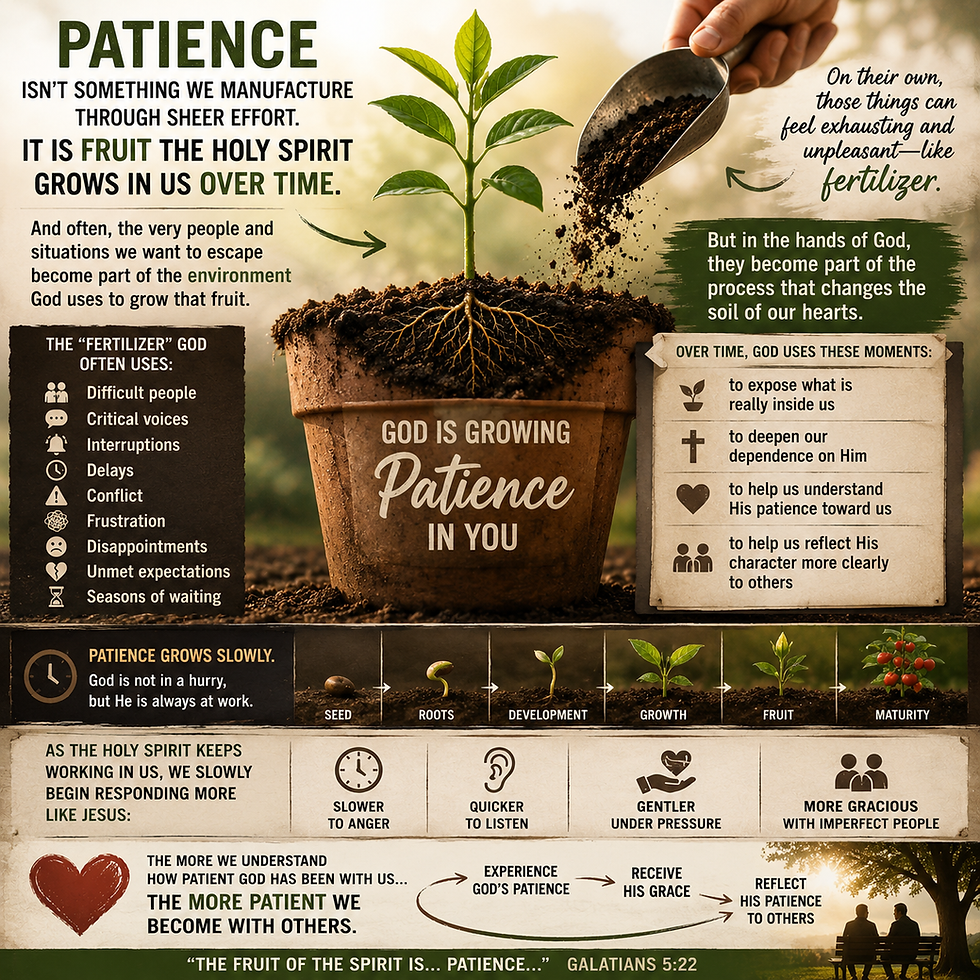
Patience is not something we manufacture through sheer effort. It is the fruit the Holy Spirit grows in us over time.
And often, the very people and situations we want to escape become part of the environment God uses to grow that fruit.
Difficult people.Critical voices.Interruptions.Delays.Conflict.Frustration.
On their own, those things can feel exhausting and unpleasant—like fertilizer.
But in the hands of God, they become part of the process that changes the soil of our hearts.
Over time, God uses those moments:
to expose what is really inside us
to deepen our dependence on Him
to help us understand His patience toward us
and to help us reflect His character more clearly to others
Patience grows slowly.
But as the Holy Spirit keeps working in us, we slowly begin responding more like Jesus:
slower to anger
quicker to listen
gentler under pressure
more gracious with imperfect people
And the more we understand how patient God has been with us…the more patient we become with others.
WHAT TO EXPECT THE REST OF MAY 2026

Experience the God of the Wilderness

Throughout the Bible, the desert isn't just a place of heat and sand; it is God’s favorite classroom. It’s where He took Moses to see the burning bush, where He shaped the Israelites into a nation, and where Jesus was prepared for His ministry.
There is something about stepping away from the "safe structures" of the city and into the stillness of the high desert that clears the noise and lets you hear God's voice.
Are you willing to come to the wilderness for a time of preparation and growth? If you feel God moving you out of your comfort zone and into a deeper dependence on Him, we invite you to join us on our off-grid property in Northwest Arizona.
Arizona Bible Experience Retreat 📅 Dates: October 17-23, 2026 📍 Location: Meadview, AZ
Incredible scenery, excellent teaching, and friendships forged from slot canyons to campfires. We have limited spots available to keep the experience intimate and impactful.
Several lodging options. Daily excursions. Shared meals, campfires, and more! Includes a day at the West Rim of the Grand Canyon and so much more.

Save the Date: The Pig Out-Play & Praise
Every September, the whole YJJ community rallies together in beautiful North Idaho for our annual gathering. We call it "The Pig Out-Play & Praise"—and for good reason! We smoke a whole hog and briskets for a week of incredible food, deep fellowship, and powerful worship led by two different teams.
The Biblical Connection:
Did you know that God actually built "big meet-ups" into the very rhythm of life for His people? From the Appointed Feasts to the harvest gatherings, the ancient Israelites were commanded to stop, gather, and celebrate what God was doing. The value of these rhythms remains true for us today. We need these "mountain top" moments to refuel and reconnect.
Registration is OPEN now! Get your tickets here:
HAVE YOU WATCHED THIS VIDEO YET?
MORE RESOURCES TO HELP YOU GROW AS A CHRISTIAN
Read Our Full Statement of Faith: CLICK HERE
Your Jesus Journey is an independent, non-denominational Christian ministry. We're fueled by God's grace and the generosity of our supporters. Our team—led by Pastor Thad and his wife Kaila—is made up of dedicated disciples from all over the United States. Together, we work to help people understand the Bible, find Christian friends, and grow as disciple-makers.

Be sure to grab our free E-Book, "Stop Reading the Bible Wrong: 7 Strategic Shifts that Change Everything." Just click the Free Gift button at the top of our website, and we'll send it to you today!
Go to https://www.yourjesusjourney.com/journeygroups to learn more about Journey Groups, get connected in one, or even learn how to start your own. It's like a spiritual potluck, but instead of questionable casseroles, we share insights and grow closer to God. See you there!
You can also get our FREE in-Depth Bible-Study Guides delivered to your inbox: https://forms.wix.com/r/7330608166566101604.
To learn more about YJJ, Thad and Kaila, and Your Jesus Journey, check out our ABOUT US section: https://www.yourjesusjourney.com/learn-about-thad-and-kaila-and-the-journey-church-online.
There's lots more to see and learn on our website, from our "what we believe" page to hundreds of blogs. We encourage you to swing on by and take a look around at www.YourJesusJourney.com!


Comments