
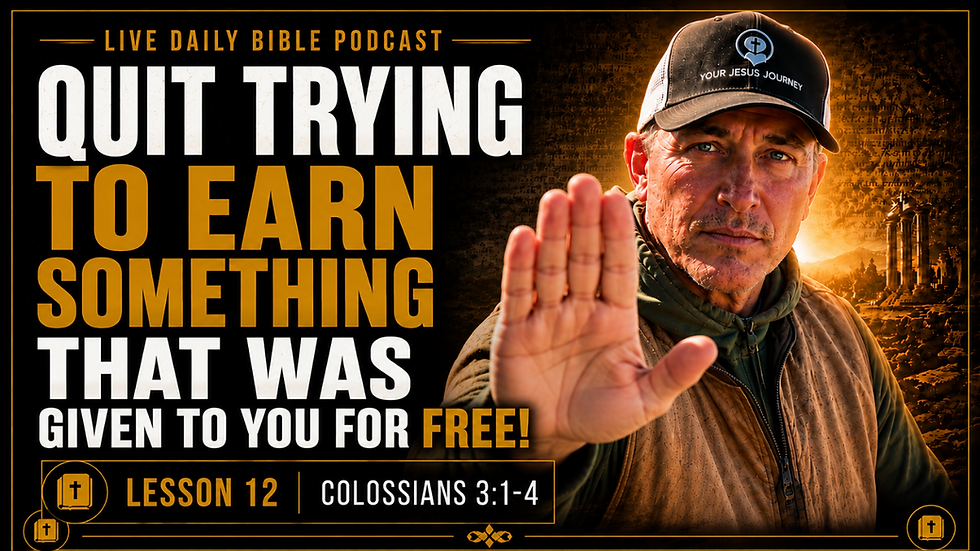
Quit trying to earn something that was given to you for free
- Thad DeBuhr

- 4 hours ago
- 13 min read
Study Guide: Colossians 3:1-4

Imagine you pay good money to go to an escape room with your friends. The door locks behind you, the timer starts ticking down from sixty minutes, and you instantly go to work. You are sweating, flipping over rugs, decoding secret numbers on the wall, and frantically trying to open a massive iron padlock on the main door. You spend forty-five minutes straight exhausting yourself, trying every combination you can think of.
Then, right when you are about to collapse from frustration, someone walks up to the door, gently turns the handle, and it swings wide open.
It was never locked.
The lock on the front was just a prop for decoration. You were free the entire time, but you spent all your energy acting like a prisoner because you assumed you had to earn your way out.
This is exactly what happens to so many well-meaning people when it comes to their faith. We exhaust ourselves trying to break out of our old, broken habits. We build elaborate religious rulebooks, check off daily performance boxes, and chase emotional highs, hoping that if we sweat enough, God will finally let us out of the doghouse.
In Colossians 3:1–4, Paul walks up to our self-made prison cell, turns the handle, and shows us that the door has been completely wide open the whole time. You don't have to climb a ladder to get to God. If you want to change your life, you don't start by working harder down in the mud; you start by realizing your address has already changed.
🎵 Worship Response
Higher Than My Feelings
This original YJJ Worship song was written to help you meditate on the truths of Colossians 3:1-4. Turn it on during your prayer time, your commute, or while reading this passage again.

As you go through the study guide, I would suggest reading or listening to the Bible passages in two different bible translations:
First read it in NASB or NKJV, then read it again from a NLT, NIV or ESV Bible.
Learn more about our exciting out-of-the-box ministry here
Setting the Scene
To really grab hold of what Paul is saying here, we have to look at the map and the neighborhood gossip of the ancient world. The letters Paul wrote weren't sent to floating, imaginary holy places—they were dropped right into messy, real-world towns.
Colossae was located in Asia Minor, which is modern-day Turkey. If you rolled back the clock a few hundred years before Paul wrote this, Colossae was a massive, booming mega-city situated right on a major highway trade route. But by the time Paul writes this letter from a cold Roman prison cell, the Roman government had rerouted the main highways to bypass Colossae entirely. The wealth and traffic shifted down the road to neighboring cities like Laodicea and Hierapolis. Colossae shrank into a quiet, forgotten market town.
But even though it was small, it sat in a geographic valley—the Lycus Valley—that acted like a giant cultural blender.
Generations earlier, around 200 B.C., a Greek ruler named Antiochus the Great legally moved two thousand Jewish families out of Babylon and planted them right in this valley. Over the centuries, that population grew and heavily influenced the whole region. Because of this, the area became a chaotic religious cocktail. You had local non-Jewish people practicing wild, superstitious pagan folk magic—worshipping elemental spirits and planetary rulers to protect themselves from bad luck. Right next door, you had a deeply entrenched Jewish community practicing the ancient laws of the Old Testament, focusing heavily on strict diets, festival calendars, and Saturday Sabbaths.
A group of local religious influencers inside the Colossian church started blending these two worlds together. They told the new believers: "Jesus is a great starting point, but He's just a basic package. If you want real protection from dark spiritual forces, you need an upgrade. You need to keep the hyper-strict Jewish rules, and you need to chase deep, mystical, supernatural visions."
Paul writes Colossians 3 right after telling them that these self-made rules are a total scam.
He turns the page here to give them the real alternative.
Walking Through the Passage
In the first two chapters of this letter, Paul spent a lot of time playing defense—telling the church what not to listen to. Now, he plays offense. He changes his focus from the rules they should drop to the new identity they need to embrace.
Here is how that breaks down in Colossians 3:1–4.
1. Look Up, Not Down (Colossians 3:1)
“Since, then, you have been raised with Christ, set your hearts on things above, where Christ is seated at the right hand of God.”
In the ancient Roman world, everyone was obsessed with status and climbing the social ladder. If you wanted to matter, you had to climb your way up the imperial pecking order. Paul completely flips the script. He tells the believers that they don’t need to climb a ladder to get to the top because, spiritually speaking, they are already there.
When Paul says Christ is "seated at the right hand of God," a modern Western reader might picture a literal physical chair up in the clouds. But to an ancient reader, this was political language. In the ancient Near East, sitting at a king's right hand meant you held the ultimate position of authority, execution, and total victory. You didn't double-check the king's decisions; the person on the right hand was the active power.
Paul is saying: "Stop looking down at human rules to protect you. Look up to the place where the absolute ultimate authority is already running the universe—and remember that you are tied directly to Him."
2. Resetting Your Mind's Compass (Colossians 3:2)
“Set your minds on things above, not on earthly things.”
The phrase "set your minds" in the original language isn’t a one-time thought. It means a continuous, daily, aggressive habit of refocusing. It’s like steering a ship—you don't just set the wheel once and walk away; you constantly adjust for the wind and waves.
We often mistake "earthly things" to mean bad things like stealing or lying. But if you look at the context of chapter 2, Paul is actually calling their religious checklists "earthly things." He means the anxious, performance-driven mindset that says, "If I don't follow this specific rule, God is going to get me."
Think of a magnetic compass. If you place a heavy iron chunk right next to the compass, the needle gets distracted and points toward the iron instead of true North. "Earthly things" are those heavy magnets of daily anxiety, social pressure, and religious performance. Setting your mind on things above means intentionally moving those distractions away so your heart can point true North toward Jesus' grace and love.
3. The Ultimate Vault Security (Colossians 3:3)
“For you died, and your life is now hidden with Christ in God.”
This is one of the most comforting legal realities in the whole Bible, but it sounds like a weird riddle at first glance. How can you be alive writing a study guide if you "died"?
Think about how people protect their absolute most valuable possessions today—like a birth certificate, a passport, or a priceless family heirloom. You don't leave them sitting out on the kitchen counter where the dog can chew them or a fire can destroy them. You take them to a bank and lock them inside a heavy, steel safety deposit box deep within a secure vault.
Paul is using ancient vault language here. He is telling the believers: "Your old, broken history—the version of you that was defined by your failures and your frantic need to prove yourself—that person legally died at the cross. The real you, your true identity, and your eternal security are now safely locked away in God’s ultimate heavenly vault right alongside Jesus. The world can't steal it, your failures can't bankrupt it, and the enemy doesn't have the key to it."
4. The Grand Unveiling (Colossians 3:4)
“When Christ, who is your life, appears, then you also will appear with him in glory.”
The Bible Project highlights an incredible detail about how ancient biblical authors viewed reality. They didn’t see heaven and earth as two places separated by millions of miles of outer space. They saw them as two different dimensions that actively overlap. Right now, a thin spiritual curtain separates our physical eyes from seeing the heavenly reality where Jesus is ruling.
One day, Paul says, that curtain is going to be ripped back completely.
When Jesus is unveiled to the entire universe, the truth about you will be unveiled too. Right now, to the world, you might just look like an ordinary person driving an old vehicle, working a regular job, or struggling through everyday life. But when the curtain pulls back, all your quiet choices to love others, your hidden sacrifices, and your true status as royalty in God’s kingdom will be brought completely into the light.
Will you partner with us to help more people understand the Bible, grow in community, and follow Jesus?

Learn more about supporting this ministry here.
Why Context Changes Everything

It is incredibly easy to take a beautiful passage about our heavenly identity, rip it out of its ancient context, and turn it into a tool that hurts our faith instead of helping it. If we don’t understand exactly why Paul wrote these words to the Colossians, we will do the very thing he warned against: we will turn a message of radical freedom into another heavy religious checklist.
If we apply this wrong, we end up using "heavenly mindedness" as an excuse to escape our earthly responsibilities, or we beat ourselves up with guilt the moment we fail to live with robotic perfection. But when we apply it right, we realize that our spiritual address has changed permanently. Understanding the historical and cultural backdrop helps us stop visiting the old, broken neighborhood of anxious performance and allows us to rest in the secure vault of our identity in Christ. Let’s look at how people pull this specific passage out of alignment, and how to apply it cleanly to our lives.
Applying It Wrong
1. The "Too Heavenly Minded" Trap (The Escape Route)
Some people read “set your minds on things above, not on earthly things” and assume Paul is giving them permission to completely check out of real life. They assume a good Christian should spend all day staring at the clouds, ignoring their family, their job, and their community because "this world doesn't matter." This is a massive mistake. Paul isn't telling you to escape reality; he is giving you the power to live better in reality. When you know your security is safely locked up in heaven's vault, you are finally free to love and serve people on earth without worrying about what you get in return.
2. The "Fake Perfection" Guilt Trip
People look at the phrase “for you died” and turn it into a rigid standard of robotic perfection. They assume that if you are a real believer, you should never face temptation, doubt, or frustration ever again. Then, when they do have a bad day or make a mistake, they fall into massive guilt, thinking, "Well, I guess I didn't actually die to my old self." But Paul is talking about a legal transfer, not an instant loss of human emotions. You legally belong to a new kingdom, but you still have to daily practice learning the language and customs of your new home.
3. The Denominational Agenda Force-Fit
Sometimes folks will use this passage to argue against doing any kind of practical good in the world—like caring for the environment or helping fix broken systems in our local towns—claiming that since our life is "hidden" and this world is "earthly," we shouldn't care about physical things. This completely ignores the rest of the Bible. Paul isn't separating physical and spiritual; he's separating human-made performance from God-given reality.
Applying It Well
To apply this passage correctly, you have to look at it through the lens of a changed address.
Imagine you lived for forty years in a rough, rundown neighborhood with broken windows, high crime, and a landlord who constantly bullied you. Then, you finally buy a beautiful new home in a peaceful, quiet neighborhood across town. You pack up your things and move.
What would happen if, the very next morning, you drove back to your old rundown house, sat on the porch, and let the old landlord bully you about the rent again? It would be completely ridiculous. You don't live there anymore. The old landlord has zero legal authority over you.
When you study this passage, read it with that shift in mind. You have a new address next to Christ. You don't have to visit the old neighborhood of anxious performance, guilt, or fear.
Look at the Geography: Recognize that Colossae was a tiny town being pushed around by the big ideas of the surrounding cities. Don't let the loud, busy culture around you dictate your value.
Look at the Jewish Background: Notice that Paul uses temple and royal language. In the Old Testament, the High Priest carried the names of God's people into the Holy of Holies—the most secure, hidden space in the world. Paul is saying Jesus has taken you into that ultimate secure space permanently.
Questions to Chew on and Discuss:
These questions are designed to help you personally dig deeper into the passage and help guide your discussions in your Journey Groups and Me & 3 small groups.
Look Closely
(What does the passage say?)
According to verse 1, what is Christ currently doing, and where is He located?
What specific contrast does Paul make in verse 2 regarding what we should and shouldn't focus on?
Where does verse 3 say your life is currently located?
Dig Deeper
(What did it mean?)
Based on the ancient cultural view of a king's "right hand," what is Paul trying to teach us about who holds the real power in our lives?
What is the difference between an "earthly thing" (in the context of chapter 2's checklists) and a "thing above"?
What does the word "hidden" tell us about how safe and secure our identity is with God?
Let It Sink In
(What is God showing me?)
When you look at your daily life, do you feel like you are still trying to open a prison door that Jesus already unlocked? Why?
What are the heavy "local magnets" (anxieties, family pressures, the need to look successful) that tend to pull your mind's compass away from Christ?
How does it make you feel deep down to know that your value is safely locked in God's vault, completely out of reach from other people’s opinions or your own bad days?
Live It Out
(What will I do?)
What is one practical, specific "old neighborhood" thought pattern or worry you need to intentionally leave behind this week?
How can you practically adjust your daily routine to "set your mind" on Jesus first thing in the morning before the noise of the world takes over?
Knowing your true life is hidden and secure, what is one bold act of kindness or service you can do for someone else this week without worrying about protecting your own status?
Journey Group OR ME & 3 Small Group Discussion Starters:
Whether you're helping facilitate a small group, talking about this passage one-on-one with a friend, or even just need a topic to guide the conversation at the dinner table, these ideas can help start a good group conversation before you dive into the passage and questions in this study guide.
Discussion Starter Ideas:
The Wallet Photo vs. The Real Person: Think back to the story of the traveler who came home from a grueling journey but ignored their real spouse just to keep staring at a small piece of paper in their wallet. In what ways do we modern believers do the exact same thing by focusing more on religious rules, traditions, or perfect church vibes rather than enjoying a real, conversational relationship with Jesus?
The Vault Check-In: If you were to walk into a bank vault today and look inside your safety deposit box, you would find your name permanently stamped on it because Jesus paid the bill in full. Share a time in your life when you completely forgot your security was guaranteed and you started acting like you were spiritually bankrupt. How did you get your focus back?

Sum It Up
Your old life of trying to earn God's approval through rigid checklists and manufactured emotional performance is completely over—it died at the cross. The moment you chose to follow Jesus, your spiritual address changed permanently. Your true value, your real identity, and your eternal security are now safely locked away in God’s unbreakable heavenly vault right next to Christ, who holds the ultimate authority over the universe. Stop focusing on the rules of the old neighborhood you moved away from. Turn your mind's compass true North, look up to where Jesus is ruling, and live with the quiet confidence of someone whose future is totally secure.
Experience the God of the Wilderness

Throughout the Bible, the desert isn't just a place of heat and sand; it is God’s favorite classroom. It’s where He took Moses to see the burning bush, where He shaped the Israelites into a nation, and where Jesus was prepared for His ministry.
There is something about stepping away from the "safe structures" of the city and into the stillness of the high desert that clears the noise and lets you hear God's voice.
Are you willing to come to the wilderness for a time of preparation and growth? If you feel God moving you out of your comfort zone and into a deeper dependence on Him, we invite you to join us on our off-grid property in Northwest Arizona.
Arizona Bible Experience Retreat 📅 Dates: October 17-23, 2026 📍 Location: Meadview, AZ
Incredible scenery, excellent teaching, and friendships forged from slot canyons to campfires. We have limited spots available to keep the experience intimate and impactful.
Several lodging options. Daily excursions. Shared meals, campfires, and more! Includes a day at the West Rim of the Grand Canyon and so much more.

Save the Date: The Pig Out-Play & Praise
Every September, the whole YJJ community rallies together in beautiful North Idaho for our annual gathering. We call it "The Pig Out-Play & Praise"—and for good reason! We smoke a whole hog and briskets for a week of incredible food, deep fellowship, and powerful worship led by two different teams.
The Biblical Connection:
Did you know that God actually built "big meet-ups" into the very rhythm of life for His people? From the Appointed Feasts to the harvest gatherings, the ancient Israelites were commanded to stop, gather, and celebrate what God was doing. The value of these rhythms remains true for us today. We need these "mountain top" moments to refuel and reconnect.
Registration is OPEN now! Get your tickets here:
HAVE YOU WATCHED THIS VIDEO YET?
MORE RESOURCES TO HELP YOU GROW AS A CHRISTIAN
Read Our Full Statement of Faith: CLICK HERE
Your Jesus Journey is an independent, non-denominational Christian ministry. We're fueled by God's grace and the generosity of our supporters. Our team—led by Pastor Thad and his wife Kaila—is made up of dedicated disciples from all over the United States. Together, we work to help people understand the Bible, find Christian friends, and grow as disciple-makers.

Be sure to grab our free E-Book, "Stop Reading the Bible Wrong: 7 Strategic Shifts that Change Everything." Just click the Free Gift button at the top of our website, and we'll send it to you today!
Go to https://www.yourjesusjourney.com/journeygroups to learn more about Journey Groups, get connected in one, or even learn how to start your own. It's like a spiritual potluck, but instead of questionable casseroles, we share insights and grow closer to God. See you there!
You can also get our FREE in-Depth Bible-Study Guides delivered to your inbox: https://forms.wix.com/r/7330608166566101604.
To learn more about YJJ, Thad and Kaila, and Your Jesus Journey, check out our ABOUT US section: https://www.yourjesusjourney.com/learn-about-thad-and-kaila-and-the-journey-church-online.
There's lots more to see and learn on our website, from our "what we believe" page to hundreds of blogs. We encourage you to swing on by and take a look around at www.YourJesusJourney.com!


Comments